...eigentlich doch wohl ganz gut, oder?
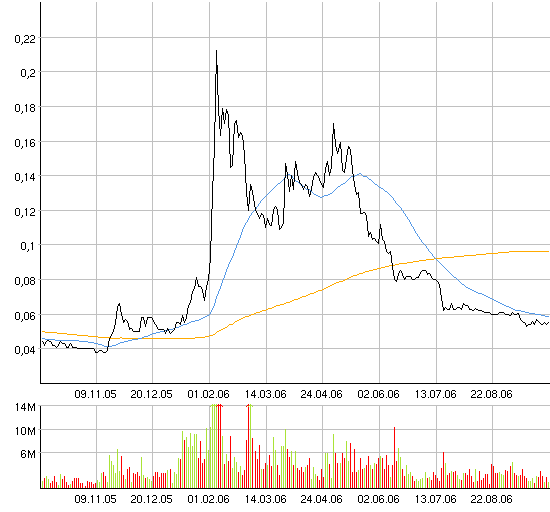
Silverado´s Green Fuel trifft genau den Nerv der Zeit!
Die US-Regierung will Firmen helfen, neue Pilotkraftwerke
zu bauen, die später ausgebaut und in großem Maße Öl
aus Kohle produzieren können, ganz nach dem Vorbild: Sasol!
PRESS CONFERENCE ON THE “COAL-TO-LIQUID FUEL PROMOTION ACT 2006”
“I would like to thank my colleagues and the representatives of the coal and transportation industries who are here today. We have come together to discuss coal-to-liquid fuel technology as a road map for American energy security.
“I believe coal-to-liquid technology offers America the chance to capitalize on a domestic resource that will provide the fuel for economic growth and the energy security required in today’s world.
“Working with some of my friends who are here with me today, I have put together a bill that will provide the right combination of incentives to create a backbone of coal-to-liquid production in the United States.
“S. 3325, the Coal-To-Liquid Fuel Promotion Act of 2006, is a three-part, comprehensive effort to create a vibrant domestic coal-to-liquid fuel market.
“First, this bill expands and enhances the loan guarantee program included in the Energy Policy Act we passed last year. It also creates a new program at the Department of Energy, allowing the Secretary to provide planning loans to help companies prepare a plant for construction.
“Second, this legislation will expand investment tax credits and expensing provisions to include coal-to-liquid plants. These tax incentives build on the loans and loan guarantees and will spur the investment needed to build these multi-billion dollar plants. This bill will also extend the fuel excise tax credit for coal-to-liquid fuels to provide support during initial production.
“Third, this bill provides the Department of Defense the funding to purchase, test, and integrate these fuels into the military. Coal-to-liquid plants will provide our armed forces with a secure domestic fuel supply.
“By combining the abilities of the Department of Energy and Department of Defense with incentives in the Tax Code, I am confident that America will become the world leader in coal-to-liquid fuels production.
“The next step will be to get this bill passed. I am optimistic that we will be able to have a hearing in the Energy committee following the July 4th recess. The Chairman of the Energy Committee and the Majority Leader have told me that they hope to assemble new energy legislation by the middle of next month. I believe that these coal-to-liquid provisions could be an important part of that package.
“I will continue to work with my colleagues on this issue. It is important that we do everything we can to reduce our dependency on foreign oil and identify new means to provide some relief for Americans who are feeling the pinch from rising energy costs.”
bunning.senate.gov/...es.Detail&Speech_id=76&Month=6&Year=2006
Coal-to-liquid fuel offers answer to energy woes
By David Dapice
19-07-04 Amid continuing violence in the Middle East, the issue of energy security is again on the front burner. With oil prices rising to a peak of $ 40 a barrel, countries have been looking at alternative energy with a greater urgency.
This heightened sense of urgency, fortunately, has come at a time when there is evidence that a new approach using existing resources and technology can provide alternative energy to many countries.
A glimmer of good news recently appeared: China signed an agreement with Sasol, a South African energy and chemicals firm, to build two coal-to-liquid fuel plants in China. These plants, costing $ 3 bn each, are reported to jointly produce 60 mm tons of liquid fuel (440 mm barrels) a year. Since China imported 100 mm tons of oil last year, these plants would give China much control over its domestic energy situation, though its demand is growing fast. The raw material and capital costs of a barrel of fuel would fall under $ 10 and other costs would not bring total costs over $ 15.
Coal resources of 1 tn tons are widely distributed around the world. Many countries, including China, India, Russia, Ukraine, Germany, Poland, South Africa, the United States and Australia have extensive coal deposits that would last 100 years or more at current rates of exploitation. But coal is a highly polluting fuel when burned directly and also emits a lot of global-warming carbon dioxide.
The Sasol technology, a third-generation Fischer-Tropsch process, was developed in Germany and used in World War II, and later in South Africa. (Steam and oxygen are passed over coke at high temperatures and pressures; hydrogen and carbon monoxide are produced and then reassembled into liquid fuels.)
It has long been too expensive to compete with standard crude oil. On the plus side, sulphur and other pollutants such as ash and mercury are removed -- the sulphur can be sold as a by-product -- and carbon dioxide is segregated and can be injected underground. If hydrogen is needed for fuel cells, these plants can also provide it. In the near term, the petrol and diesel produced are high grade and clean, meeting even future '”lean diesel” requirements of the United States.
The real question is if these plants can be built and reliably produce fuels for less than $ 20 a barrel. Sasol already produces 150,000 bpd from coal. (Conversion from natural gas is cheaper and Sasol is in the process of switching its feedstock to gas in South Africa.)
Each of the Chinese plants would be four times as large as the existing Sasol plant, and scaling up can involve difficulties. If Sasol can make these larger plants work at the publicised costs, this technology could be used by many other nations -- rich and poor -- who are willing to forego periods of very cheap oil for more security. (Indeed, even oil-producing Indonesia is looking into a coal-to-liquids plant as it now imports oil.)
This technology also works in converting coal to natural gas at a cost of $ 3 to $ 3.50 per mm Btu. Since current natural-gas prices in the US are roughly double that, it would appear that coal-to-gas is also an economically viable technology.
The coal-to-liquid technology would compete with the evolving tar-sands technology being expanded in Canada. This technology involves the production, either by mining or extracting with steam, of heavy oil trapped in sand. The heavy oil is then massaged into more valuable fuels. This source already accounts for a quarter of Canada's 3.2 mm bpd output. It requires natural gas to heat the tar and is energy intensive, but still has production costs of under $ 20 a barrel.
Tar-sand reserves are estimated at over 250 bn barrels. These and similar technologies would allow much more plentiful isolated natural-gas reserves, coal and tar sand to be converted into liquid fuels. The long-predicted decline in petroleum production could be delayed for decades or more, and the geopolitics of energy would be rewritten at something close to or below current crude-oil costs.
Is there a downside to rapidly adopting these technologies? Yes, from a global welfare perspective. Now, onshore oil-production costs are usually under $ 5 a barrel. If prices are higher, somebody (the country owning the oil or the company producing it) gets the difference between the price and the cost. If we switch to $ 15-$ 20 costs from these other technologies, then there is no surplus of price over cost, or a much smaller one.
To use an economic phrase, the “rent” on oil production is destroyed in a quest for self-sufficiency. While true, the instability in oil prices -- as well as the threat of terrorist disruptions to supply -- are such that many nations might be happy to use their own resources to produce this vital input. They are no worse off if oil can be produced at $ 20 a barrel, unless the price temporarily plunges below that level as it did in the late 1990s. A stable price and supply prevents very expensive disruptions.
None of this answers critics who are properly concerned with global warming. Subsidies to hybrid or other highly efficient vehicles are probably needed to reduce emissions. In the longer term, fuel cells burning hydrogen and producing only water as a waste product are promising, but still far from being economically feasible.
Overall, the coal-to-liquid technology is only one element of an integrated programme that is needed to deal with fuel security, local pollution and global-warming issues. But, even alone, it could bring an element of stability to world oil prices and thus also to the global economy. In addition, if it redirects efforts from geopolitical competition and even conflict to investment and efficiency, it is a welcome development.
The writer is an associate professor of economics at Tufts University.
Source: Straits Times
www.gasandoil.com/goc/features/fex43159.htm












 Zurück