http://seekingalpha.com/article/1783212-the-solar-revolution-part-1?interessanter Artikel über die Technik :Polysilikon.Wafers,Module...Effektivität
was die einzelnen Firmen herstellen,Downstream und Upstream
und eine schöne Karte über
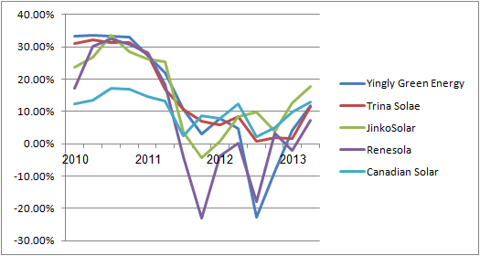
Solar Companies Groos Margin 2010-2013
http://static.cdn-seekingalpha.com/uploads/2013/...899534122_rId7.png...Recently, more and more module manufacturers have been entering the downstream side of the industry. China's recent policy guarantees a feed-in tariff (FiT) for utility scale projects for a period of 20 years, thus making them a sound investment....
..The polysilicon market is extremely oversupplied. According to SolarPVInvestor.com, the world has the capacity to produce about 550,000 metric tons of polysilicon, which translates into just over 100GW of module production per year. With polysilicon costs now above cash costs for many producers, I expect some Tier 2 and Tier 3 producers to exit the business in the coming years.
I see just a modest opportunity for polysilicon capacity to expand in the coming years, and I expect most of the CapEx to go toward equipment upgrades, which will ultimately enhance profitability for the companies that will be able to afford them.
With the global demand for solar panels on the rise, the PV industry recently returned to profitability and a few companies have even shown double-digit gross margins. To determine which company is best positioned to capture value going forward, let's look at the industry's production capacity.
Demand has been increasing in recent quarters. After a rough 2012, demand is now expected to reach ~40GW this year, up from 32GW last year.
Most demand today comes from utility scale projects. Different countries around the world have various renewable energy policies in place. In the past, companies looked for subsidized markets, as the cost of generating solar power was higher than the local selling price of electricity. Today, in most parts of the world, solar power has a lower LCOE than local electricity prices. The situation in the U.S. is such that in most states, a solar project can be implemented and generate power in a lower cost than the retail price of electricity......
In China, the leading country in terms of global demand for solar panels, a new policy was recently introduced. Under this policy, a FiT of 0.90-1 RMB (about 14¢-17¢) is offered to utility scale project owners. JinkoSolar and Yingli Green Energy have already taken advantage of this lucrative offer. Yingli recently demonstrated the IRRs it can achieve in China......
Manufacturers can choose to sell projects to investors, but in the long run, it is more profitable for them to keep projects and sell the electricity they generate. ...
Die Kapazität der einzelnen Firmen findet sich auch in einer Darstellung
http://www.ariva.de/forum/...dem-Radar-418576?new_pnr=16732716#bottom 
 Zurück

 Werbung