seekingalpha.com/article/...s-red-hot-will-it-get-hotter?ifp=0
........
The opportunity is immense
Solar is still a relatively immature industry. About 0.2% of electricity in the U.S. comes from solar generation and solar has been installed on less than 250,000 homes in the U.S. If a building or structure receives direct sunlight and uses electricity, solar could be used to generate some of that electricity. The residential market potential is immense: there are more than 90 million single family homes in the U.S. and as many as 50 million more households in multi-family structures and several million more commercial and other non-residential structures. While solar may not work on every structure in the U.S., just a small wedge of this market is worth hundreds of billions of dollars.
In some markets, it is already cheaper for a household to invest in solar than to buy electricity, and the projection is that at a $3 per watt for the cost of installed solar, about 100 GW could be economically installed today without relying on any state or federal subsidy programs. As the market closes on that $3 per watt threshold, the rate of growth will almost certainly explode. Manufacturing capacity, capital and a skilled labor force will be the only constraints on growth.
The future isn't all sunshine and excitement - subsidy erosion, attacks from utilities, a slowing of the price reductions of solar panels, an uncertain market for utility scale projects due to low wholesale power prices, and structural market challenges like a lack of adequate and low cost capital are all possible challenges to the near-term success of the solar industry........
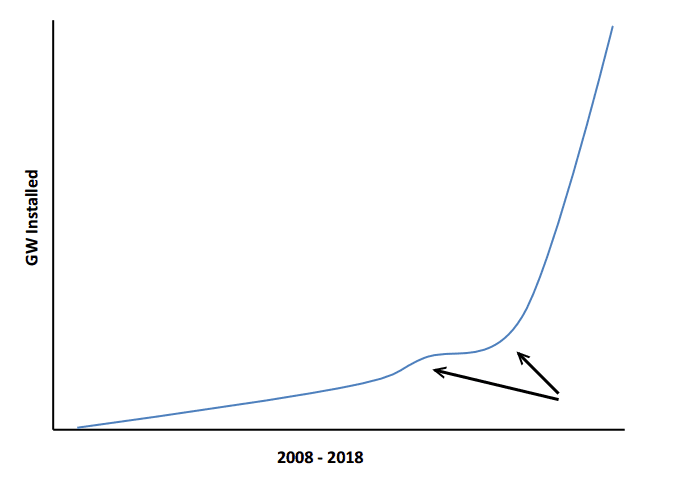
The confluence of these three near-term challenges creates the potential for some mild disruption to the still nascent marketplace. So a market evolution that looks like this:
The longer-term future of the solar industry, and especially the future of distributed solar PV, is exciting and the economic potential is simply immense. The industry will certainly go through a period of exponential growth......
(Verkleinert auf 82%)


 Zurück