Benachrichtigungen von ARIVA.DE
(Mit der Bestellung akzeptierst du die
Datenschutzhinweise)
Vielen Dank, dass du dich für unseren Newsletter angemeldet hast. Du erhältst in Kürze eine E-Mail mit einem Aktivierungslink.
Leider können wir deine Anfrage auf diesem Weg nicht entgegennehmen. Bitte schreibe uns an: portal.support@ariva.de
NEW CENTURY FINL(MD)DL-01 Termine
Keine Termine bekannt.
NEW CENTURY FINL(MD)DL-01 Prognose 2026: Einstufung & Empfehlung von Analysten
NEW CENTURY FINL(MD)DL-01 Kursziel 2026
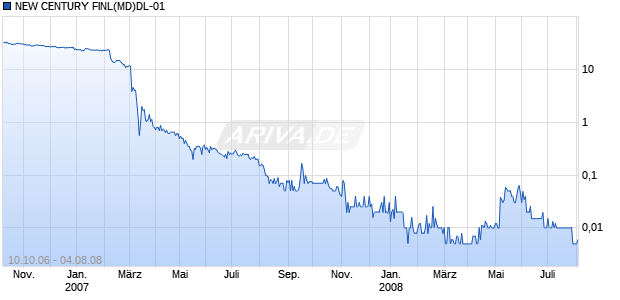
Die NEW CENTURY FINL(MD)DL-01 Kurs Performance für 2026 liegt bei -.
Stammdaten
Aktientyp
Stammaktie
Community-Beiträge zu NEW CENTURY FINL(MD)DL-01
Community-Beiträge
Aktuellste Threads
Anti Lemming
Marktkommentar
Market Features
Fed Doves Rally Bulls
By Liz Rappaport
Markets Columnist
3/21/2007 4:37 PM EDT
Traders saw only doves Wednesday, despite the hawk, or perhaps the vultures, circling high above.
The Federal Reserve kept the fed funds rate steady at 5.25%, as expected, but changed the language in the accompanying statement to soften its tightening bias. Traders read the statement as solidly dovish and indicative of a near-term rate cut, even though the Fed also took pains to emphasize that inflation is the key risk to its outlook.
The stock and bond market rallied immediately after the statement was released. Stock traders shrugged off earlier concerns about FedEx's (FDX) earnings and comments about an uncertain economy, sending major averages on their sharpest rally this year.
The Dow Jones Industrial Average jumped 160 points, or 1.3%, to close at 12,447.52. The S&P 500 gained 1.7% to close at 1435.04, and the Nasdaq Composite gained 48 points, or 2%, to close at 2455.92. FedEx ended the day down 1.2%.
The bond market likewise rallied. The 10-year Treasury bond rose 4/32 to yield 4.53%. The dollar weakened on the Fed's statement, and gold was up slightly.
While longer-duration Treasury bonds did not rally so dramatically, shorter duration bonds rallied more sharply, indicating traders' belief that the fed funds rate will soon be lower. The 2-year Treasury's yield dropped nine basis points to 4.52% -- and is no longer inverted to the 10-year's yield.
Ultimately, the Fed covered its proverbial rear end with this statement. The central bank gave itself the wiggle room to cut rates if need be -- to respond to some kind of financial crisis or fallout from the subprime mortgage market's current malaise. But it reasserted concerns about inflation, enough to maintain its credibility and to let markets know that a cut is not imminent.
"Traders may start to lean toward believing June could be the first rate cut, as opposed to August, but the market won't really start to believe that until there is more data to support it," says Marc Pado, chief market analyst at Cantor Fitzgerald. The fed funds futures market prices in a 40% chance of a cut in June, up from 24% odds prior to the FOMC statement. For August, the market now puts 85% odds of a rate cut, up from 65% before 2:00 p.m., according to Miller Tabak.
In the first part of the statement, the Fed "marked to market" its assessment of growth and inflation, as Lehman Brothers' chief economist Ethan Harris put it. On the growth side of the equation, the Fed moderated its optimism. The Fed replaced "somewhat firmer economic growth" and "stabilization" in the housing market with: "Recent indicators have been mixed and the adjustment in the housing sector is ongoing."
The central bank also tempered the inflation paragraph, which reads: "Recent readings on core inflation have been somewhat elevated." That's opposed to January's statement, which read: "Readings on core inflation have improved modestly in recent months, and inflation pressures seem likely to moderate over time."
The key changes came at the end of the statement. The Fed changed its boilerplate language, dropping the notion of further rate hikes. The new language reads: "Future policy adjustments will depend on the evolution of the outlook for both inflation and economic growth, as implied by incoming information." (Italics added.)
The old language reads: "The extent and timing of any additional firming that may be needed to address these risks will depend on the evolution of the outlook for both inflation and economic growth, as implied by incoming information." (Italics added.)
"The Fed is not eliminating their tightening bias, but they are softening it up a bit," says Harris. "It's the way you react to broader uncertainty. You want more flexibility."
Today's statement suggests a Fed that is "trying to figure out if there will be a second dip down in the housing market," Harris says. "It is difficult to assess ... the scale and economic impact of the subprime sector's problems."
The financial sector rallied sharply on the FOMC statement and on the heels of a strong Morgan Stanley (MS) earnings report. Morgan Stanley rose 7%. Goldman Sachs (GS) and Citigroup (C) both gained about 3%.
In addition to financials, major averages were led by strength in technology stocks following better-than-expected earnings late Tuesday from Oracle (ORCL) and Adobe Systems (ADBE).
Fed Doubles Down
Despite Wednesday's market fireworks, many economic data points have been somewhat weaker since the last FOMC meeting on Jan. 31. Income and labor market measures remain firm, but that strength is not feeding into solid retail sales, and regional manufacturing reports have been dim. On inflation, unit labor costs are at a six-year high, and producer prices jumped sharply, adding pricing pressure into the pipeline for consumer goods.
"We can't discount inflation," says Joe Brusuelas, chief economist at IDEAglobal. "The Fed doubled down."
As the market rallied, some traders stepped back from the excitement to question the context of the FOMC statement and whether it really is "bullish" or not. It is possible that others might wake up Thursday and do the same.
"The Fed believes the economy is slowing and inflation remains sticky -- is that not stagflation?" writes Randy Diamond, trader at Miller Tabak. "We rally on this?"
Yep. We did. Rate cuts in this environment of fear and anxiety seem a bit like catnip: tasty, but not necessarily healthy.
Pichel
Nabend
Na das wird ein Fest morgen! Ein Schein ausgeknockt (10t zu 0,33 KK) und der andere hat 100 Pkt mal mindestens drauf (10t zu 0,58 KK) das sind dann mal mit Katjuschas Idee
7 Mille, danke für den Hinweis
(außerdem sowieso lonk mit OS) *g*
Gruß und N8 Pichel
wolle 56
nicht schlecht herr specht ;-)
nacht @all
Katjuscha
Oder es heißt, das die großen Umsätze wieder
mal, erst an der oberen Umkehr kommen.
Ich erwarte zumindest vor einer neuerlichen Kultur ne Art Aufgabe der vielen Bären. Am besten noch das Überwinden der Verlaufshoch von vor 7-8 Tagen und ne Anschlussrally bis zur 38er DS, und das mit viel Umsatz.
Erst dann würd ich short gehen. Oder aber wenn wir weitere schlechte News kriegen, weil nur auf ZInssenkungen zu spekulieren, machen selbst die Amis nicht, wenn die Konjunktur den Bach runter geht und das bei Inflationsrisiken.
Häufig gestellte Fragen zur NEW CENTURY FINL(MD)DL-01 Aktie und zum NEW CENTURY FINL(MD)DL-01 Kurs
Ja, NEW CENTURY FINL(MD)DL-01 zahlt Dividenden. Zuletzt wurde am 27.12.2006 eine Dividende in Höhe von 1,44 € gezahlt.
Zuletzt hat NEW CENTURY FINL(MD)DL-01 am 27.12.2006 eine Dividende in Höhe von 1,44 € gezahlt. Dies entspricht einer Dividendenrendite von 0,00%. Die Dividende wird jährlich gezahlt.
Die letzte Dividende von NEW CENTURY FINL(MD)DL-01 wurde am 27.12.2006 in Höhe von 1,44 € je Aktie ausgeschüttet. Das ergibt, basierend auf dem aktuellen Kurs, eine Dividendenrendite von 0,00%.
Die Dividende wird jährlich gezahlt.
Der letzte Zahltag der Dividende war am 27.12.2006. Es wurde eine Dividende in Höhe von 1,44 € gezahlt.
Um eine Dividende ausgezahlt zu bekommen, muss man die Aktie am Ex-Tag (Ex-Date) im Depot haben.