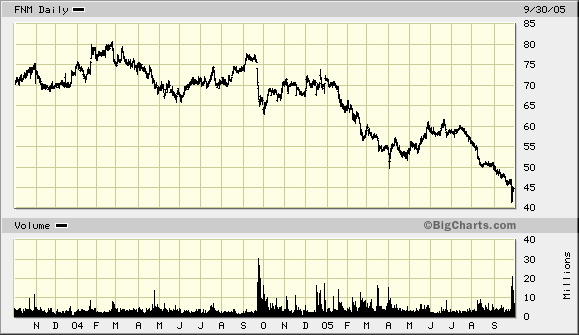
Fannie Mae hat sich wieder etwas (technisch) erholt auf 44,80 USD, nachdem die Aktie - als Reaktion auf die Meldung des des Jones Newswire - von 46 auf 41 USD abgestürzt war. Im Januar 2004 stand die Aktie noch bei 80 USD und galt als "sicherer Hafen" für Value-Investoren.
Ähnlich dürfte es im US-Housing-Markt laufen: kein Crash-artiger Zusammenbruch, sondern ein langsames "Salami-Scheiben"-Sterben. Die Aktien der Home-Builder und Baumärkte (Home Depot, Pulte, Toll Brothers, Centex) haben die zu erwartende Negativ-Tendenz bereits vorweggenommen. Nach jahrelangem Anstieg fielen deren Kurse in den letzten zwei Monaten um 10 bis 20 Prozent. Die bekannteste, Home Depot, fiel 15 % - von 44 auf 38 USD.
Der Artikel unten beschreibt, dass viele US-Konsumenten ihr Haus als ATM (automated teller machine = Geldautomat) missbraucht haben. Statt zum Geldautomaten zu gehen, haben sie immer neue Hypothekenkredite auf ihr Haus aufgenommen, dessen Beleihungswert sich in der Blase ja ständig erhöhte. Außerdem machten viele Geld mit "Appartment-Flipping", heute für 200.000 USD gekauft, nächste Woche für 210.000 USD an den Nächstdümmeren weiterverkauft. Es ist klar, dass diese Blase, wie alle anderen der Investment-Historie, auf Dauer nicht haltbar ist - zumal wenn die Fed weiter unerbittlich die Zinsen erhöht.
Bereits jetzt zeigt sich ein Überangebot: Die Zahl der zum Verkauf stehenden Immobilien ist auf dem höchsten Stand seit Juni 2000.
Verwundern kann das kaum. Der US-Konsument - bar jeglicher Ersparnisse (die Sparquote ist negativ) - ist ohnehin schon stark durch die hohen Öl-Preise gebeutelt. Rohöl stieg im letzten Quartal um 13 %, Benzin um 44 %. Hinzu kommen die hohen Gas-Preis, die sich seit Juli von 8 auf 14 Dollar fast verdoppelt haben. Rund drei Viertel aller Häuser in den USA werden mit Gas beheizt - und im Norden ist es Winter bitterkalt (-25 Grad C.). Dass dies auf die Konsumfreude durchschlägt, zeigten die gestrigen Zahlen: Die Konsumausgaben (personal spending) sanken im August auf -0,5 %, erwartet war -0,1 %. Gleichzeitig sanken die verfügbaren Einkommen um 0,1 %.
Am stärksten bekamen dieses Jahr die großen US-Autofirmen die Kaufzurückhaltung zu spüren. Sie sitzen auf riesigen Halden unverkäuflicher Karossen, einige bieten ihre Ware bereits zu "Werks-Preisen" (Mitarbeiter-Konditionen) an. Geld verdient wird so natürlich nicht, und die Ratings-Downgrades von Ford- und GM-Anleihen auf "Ramsch"-Status - allein GM hat für 300 Milliarden USD Anleihen ausstehen - waren somit fast zwangsläufig. Drohende Defaults auf dem Coporate Bond Markt sind - neben den Mauscheleien von Fannie Mae - die zweite Achillesferse der US-Finanzwirtschaft.
Dass die Hurrikane der US-Wirtschaft nun (in einer Art "Nachkriegs-Effekt") auf die Sprünge helfen, halte ich für mehr als fraglich. Ich gehe davon aus, dass viele Unternehmen ihre Gewinnwarnungen infolge der Hurrikane für die Zeit nach dem Quartalsende aufgehoben haben. Nächste Woche wird da wohl mehr zu hören sein. Auch das ist eine Art von "Window-Dressing", wie es die großen Fonds Ende September betrieben haben, um die Kurse ihrer Depotwerte rechtzeitig vor dem Quartalsabschluss-Bericht hochzupushen - erkennbar daran, dass sowohl an der Nasdaq wie an der NYSE die jüngsten Anstiege mit Volumenrückgängen einhergingen.
-------------------------
Der folgende Artikel ist von Bill Fleckenstein (ein bekannter Perma-Bär, der auch schon oft falsch lag, OBWOHL seine Argumente zutrafen - er gibt das im Text selber zu)
Contrarian Chronicles
The stock market: All risk and no reward
MSN Money, 26. Sept. 2005
A number of big economic problems are coming together -- from the tapped-out consumer and the effects of Katrina and Rita to the fizzling of the housing ATM. They all add up to trouble.
By Bill Fleckenstein
I think the stock market -- as well as the economy and housing market -- is on the verge of very serious trouble. In fact, I chose to do a fair amount of short-selling last week because I have a hard time seeing how the market can mount any sort of serious rally (though, of course, that doesn't mean I won't be wrong).
The consumer is in terrible shape. We all know that the savings rate in this country is essentially negative, and we know that folks have been living off the housing ATM. (As I put it in my April 16, 2004, daily column: "Many folks think they have found free money as their house becomes an ATM [Geldautomat, A. L.] every time they refinance.") Meantime, as I have been saying, a cogent argument could be made that the housing ATM is in the process of conking out.
Furthermore, the consumer faces some serious headwinds this fall: Not only are gasoline prices up a ton, but so are prices for heating oil and natural gas. Combine that with the prospective rise in 1) minimum credit-card payments and 2) the adjustable rate on credit cards and many mortgages, and you have the recipe for a decent-sized squeeze.
In addition, there is the matter of consumer confidence, which, based on multiple surveys, is plunging at a pretty rapid rate. Further undermining confidence, I believe, is the war in Iraq and the deteriorating situation in Iran, which have helped cause President Bush's low approval rating. (Low approval ratings are historically bearish.) In any case, with all these factors going against consumers, they can easily decide to pull in their horns -- thereby precipitating and reinforcing a decline in economic activity.
Pining for the 'P' word from the Fed
Heading into last week's Federal Reserve's Federal Open Market Committee meeting, I'd thought that the Fed would hike rates and take out its "measured" language, which might have allowed the market to bounce for a limited amount of time. But apparently, the Fed thinks the economy is in better shape than I do. (I believe that this Fed will be wrong at every inflection point, which bolsters my view that the economy is headed for trouble soon.)
Nevertheless, it will be hard for ignore-the-bad-news bulls to decide that weakness is now good when the Fed has yet to float the trial balloon about how it might be ready to pause. So, weakness will be bad, and strength may not really help.
Yonder lies yield-curve blunder
Not long ago, I suggested that we might see problems in the financial arena, due in part to the flat yield curve. I think that the recent disappointing earnings reports from a raft of financial companies like Marshall & Ilsley (MI, news, msgs), Fifth Third Bancorp (FITB, news, msgs), Commerce Bancorp (CBH, news, msgs) and Annaly Mortgage (NLY, news, msgs) show that the flat yield curve is biting. Of course, many financial companies have the ability to be clever with their accounting, so perhaps they'll be able to postpone the day of reckoning for a bit longer.
But I think the chance for serious disappointment in the financial sector is quite possible. In addition I think that any companies with back-end-loaded quarters (i.e., companies that do most of their business toward the end of the quarter, as often applies to many of them) will be affected by the disruptions caused by Hurricane Katrina and now Hurricane Rita...
Dancing at the precipice
When I look at the situation, it seems to me that the stock market is all risk and no reward. We've got a tremendously lopsided environment, where, despite the litany of problems just discussed, confidence among the other-people's-money contingent (fund managers, etc.) still reigns supreme, as measured by the Chicago Board Options Exchange Volatility Index ($VIX.X, news, msgs), aka the VIX, and the low cash levels of mutual funds.
It's no secret that hedge funds have been selling volatility. It's also no secret that we've got a huge derivatives structure built up in the financial system. Inherent in that combination is a ticking time bomb, such that when the market and the financial system begin to have problems, they could grow and spread rapidly. Basically, via all this volatility-selling, we've created the same sort of environment that preceded the 1987 stock-market crash.
To sum up: It seems extraordinarily unlikely that the market can make any material progress to the upside. Yet, there are lots of reasons to believe that the downside could turn nasty -- and quickly -- once "it" starts.
Bill Fleckenstein is president of Fleckenstein Capital, which manages a hedge fund based in Seattle. He also writes a daily Market Rap column on his Fleckenstein Capital Web site. His investment positions can change at any time. Under no circumstances does the information in this column represent a recommendation to buy, sell or hold any security. The views and opinions expressed in Bill Fleckenstein's columns are his own and not necessarily those of CNBC or MSN Money. At the time of publication, Fleckenstein did not own or control shares of companies mentioned in this column.
moneycentral.msn.com/content/P127481.asp
(Verkleinert auf 96%)












 Zurück