Anzeige
Meldung des Tages: Dieses kritische Metall bringt den Westen unter Druck – ein Junior-Explorer rückt jetzt in den Fokus
Neuester,
zuletzt geles. Beitrag
Antworten | Börsen-Forum Übersicht Zurück
Weiter
Zurück
Weiter
... 128 129 131 132 ...
Antworten | Börsen-Forum Übersicht
Zurück
Weiter ... 128 129 131 132 ...
Der Doomsday Bären-Thread
Beiträge:
3.607
Zugriffe: 519.870 / Heute: 68
Zugriffe: 519.870 / Heute: 68
|
|
| ||||||||||||||||||||
Werbung
Entdecke die beliebtesten ETFs von SPDR
eigentlich wird man von einem Sog nach unten gespült....
Und von großen Blasen nach oben.
Und von großen Blasen nach oben.
Achtung die Februardaten sind uninteressant am Monatsanfang
da noch kein Volumen aber der Trend ist erkennbar.
Viele Insiderkäufe am Tief bei kleiner Ratio und Verkäufe im
steigenden Markt bei großer Ratio.
Beachten sollte man das wegen Mitarbeiteroptionvergütungen
immer mehr Insiderverkäufer sind als Käufer.
da noch kein Volumen aber der Trend ist erkennbar.
Viele Insiderkäufe am Tief bei kleiner Ratio und Verkäufe im
steigenden Markt bei großer Ratio.
Beachten sollte man das wegen Mitarbeiteroptionvergütungen
immer mehr Insiderverkäufer sind als Käufer.
(Verkleinert auf 99%) 
obwohl doch fast alle eine Zinserhöhung ausschließen?
Gelöschter Beitrag.
Einblenden
»
#3230
Der Sub-Prime Investment Trust "New Century" (NEW) stürzt um aktuell 28 % ab. Novastar verliert 12 %, HSBC geht um 2,7 % zurück (siehe auch # 3216), ebenso Countrywide Financial (CFC). Der Hypotheken-Riese Mortgage insurance MGIC Investment (MTG) fällt um 3.7%.
All diese Firmen haben Probleme mit Sub-Prime-Housing-Hypotheken. Auch der US-Banking-Index fällt um 0,7 %. Wir bekommen jetzt die Probleme, die von den Stänker-Bullen hier im Thread immer wieder in Abrede gestellt wurden. Das ist auch Mitgrund für die Kursverluste in USA.
FINANCIAL STOCKS
New Century, HSBC stoke losses
By Steve Gelsi, MarketWatch
Last Update: 10:59 AM ET Feb 8, 2007
NEW YORK (MarketWatch) - Financial stocks fell Thursday as a warning from HSBC Holdings on bad debt charges and a leaner loan production view from New Century Financial weighed on the sector and the overall market.
The Philadelphia Banking Index fell 0.7%. The Amex Securities Broker Dealer Index ($XBD) dropped 1%. The S&P Insurance Index (IUX
IUX) fell 0.2%.
New Century Financial Corp. (NEW) dropped 27% to $21.99 after the company said it expects 2007 loan production to drop 20% verses its earlier view for a flat year. The Irvine, Calif. lender also said it's "intensified our focus on tightening our underwriting guidelines and taking other steps to further improve fraud detection and risk management."
It also said it'll need to restate several quarters because of "errors related to its allowance for loan repurchase losses."
Shares of Novastar (NFI) fell 12% to $18.06 on jitters in the sector. Countrywide Financial (CFC) fell 2.8% to $43.50. Mortgage insurance giant MGIC Investment (MTG
MTG) dropped 3.7% to $66.03.
HSBC (HBC) fell 2.7% to $89.73 after the bank warned that bad-debt charges for the group as a whole will be 20% higher than the average analyst forecast of $8.8 billion, taking the total charge for the year to about $10.56 billion.
Meanwhile, the REIT Apartment Investment and Management Co. (AIV) rose 2.4% after asset sales and higher property operating income.
Steve Gelsi is a reporter for MarketWatch in New York.
All diese Firmen haben Probleme mit Sub-Prime-Housing-Hypotheken. Auch der US-Banking-Index fällt um 0,7 %. Wir bekommen jetzt die Probleme, die von den Stänker-Bullen hier im Thread immer wieder in Abrede gestellt wurden. Das ist auch Mitgrund für die Kursverluste in USA.
FINANCIAL STOCKS
New Century, HSBC stoke losses
By Steve Gelsi, MarketWatch
Last Update: 10:59 AM ET Feb 8, 2007
NEW YORK (MarketWatch) - Financial stocks fell Thursday as a warning from HSBC Holdings on bad debt charges and a leaner loan production view from New Century Financial weighed on the sector and the overall market.
The Philadelphia Banking Index fell 0.7%. The Amex Securities Broker Dealer Index ($XBD) dropped 1%. The S&P Insurance Index (IUX
IUX) fell 0.2%.
New Century Financial Corp. (NEW) dropped 27% to $21.99 after the company said it expects 2007 loan production to drop 20% verses its earlier view for a flat year. The Irvine, Calif. lender also said it's "intensified our focus on tightening our underwriting guidelines and taking other steps to further improve fraud detection and risk management."
It also said it'll need to restate several quarters because of "errors related to its allowance for loan repurchase losses."
Shares of Novastar (NFI) fell 12% to $18.06 on jitters in the sector. Countrywide Financial (CFC) fell 2.8% to $43.50. Mortgage insurance giant MGIC Investment (MTG
MTG) dropped 3.7% to $66.03.
HSBC (HBC) fell 2.7% to $89.73 after the bank warned that bad-debt charges for the group as a whole will be 20% higher than the average analyst forecast of $8.8 billion, taking the total charge for the year to about $10.56 billion.
Meanwhile, the REIT Apartment Investment and Management Co. (AIV) rose 2.4% after asset sales and higher property operating income.
Steve Gelsi is a reporter for MarketWatch in New York.
(Verkleinert auf 96%)
Toll's Orders Plunge, Forecasts Larger Land Writedown
By Brian Louis and Peter Woodifield
Feb. 8 (Bloomberg) -- Toll Brothers Inc. reported a 33 percent plunge in first-quarter orders and said land writedowns will exceed earlier forecasts. The shares fell as much as 5.4 percent.
Orders declined to 1,027 units and homebuilding revenue slid 19 percent to $1.09 billion in the three months ended Jan. 31, Horsham, Pennsylvania-based Toll said today in a preliminary earnings statement.
Toll, the largest U.S. builder of luxury homes, said land writedowns could rise to $160 million after earlier forecasting a charge $60 million. Chief Executive Officer Robert Toll said the company is abandoning parcels ``because some deals don't make sense under current market conditions.''
``It still shows that demand is weak, especially at the high end of the market,'' John Tomlinson, an analyst at Majestic Research in New York, said in an interview.
Orders for Toll, whose houses cost three times the U.S. median, have fallen as its inventory of unsold homes swells. Lennar Corp. and D.R. Horton, the two largest U.S. home builders, have reported profit declines as incentives failed to stem cancellations and sales slumped the most in 15 years.
Shares of Toll fell $1.28, or 3.7 percent, to $33.15 at 10:31 a.m. in New York Stock Exchange composite trading, after earlier falling to $32.57. A Standard & Poor's measure of 16 homebuilding stocks dropped 3.2 percent.
Kompletter Artikel einsehbar unter
http://www.bloomberg.com/apps/news?pid=20601087&sid=amHNVirfLNa8&refer=home
Bartel den Most holen sollte und wo das gelobte Land ist. Und vor allem Dingen auch, dass ihr wohl auf keinem Thread bei ariva so belogen werdet, wie auf diesem:
Neue Märkte
Anleger-Legende warnt vor Investitionen in Schwellenländern
Seit 20 Jahren steuert John Carey den acht Milliarden Dollar schweren Pioneer Fund für nordamerikanische Standardwerte. Für Modethemen oder kurzfristige Trends kann sich der Aktienspezialist nicht erwärmen. Das schnelle Wachstum der Schwellenländer Brasilien, Russland, Indien und China ist ihm suspekt.
Von Patrizia Ribaudo
Chinesischer Börsenhändler vor der Kurstafel: Durch die anstehenden Olympischen Spiele in Peking kann es zu Überinvestitionen kommen
Foto: dpaFrankfurt - WELT.de: Laut Goldman-Sachs-Chefvolkswirt Jim O'Neill wird das Bruttosozialprodukt der BRIC-Staaten - Brasilien, Russland, Indien und China - das der sechs großen Industrienationen schon im Jahr 2035 überflügeln. Bis dahin wird auch China die USA als größte Industrienation ablösen. Warum sollen Investoren überhaupt noch US-Aktien kaufen?
John Carey: Keiner kann mit Sicherheit sagen, ob die BRIC-Staaten bis dahin tatsächlich so stabil wachsen. Ich glaube nicht an dieses Szenario. Die Volkswirtschaften sind nicht annähernd so weit entwickelt wie jene des Westens. Politische Rückschläge oder soziale Instabilitäten können diese Länder schnell wieder zurückwerfen. Auch ihr Rechtssystem bietet Kapitalgesellschaften nicht annähernd so viel Schutz.
WELT.de: Allerdings rechnen Ökonomen mit einem Abschwung der US-Wirtschaft. Auch der Dollar soll länger schwächeln.
Carey: Ich sehe das anders. Die US-Konjunktur befindet sich in einem besseren Zustand als allgemein angenommen. Wir haben die Inflation unter Kontrolle, das US-Außenhandelsdefizit wurde reduziert, und die Arbeitslosenzahlen sind rekordverdächtig niedrig. Außerdem wächst die USA immer noch schneller als Westeuropa. In diesem Jahr rechnen wir mit einem Wachstum von etwa drei Prozent.
WELT.de: Das wird einem europäischen Anleger bei einer Dollar-Schwäche aber wenig nutzen.
Carey: Ich bin zwar kein Währungsexperte, aber von der prognostizierten Dollar-Abschwächung halte ich nichts. Das, was eine Währung normalerweise beeinflusst, etwa Haushaltsdefizit und Inflation, haben wir in den USA gut im Griff. Ich sehe nicht, welche andere Währung das Potenzial hat, auf Dauer den Dollar zu überflügeln. Im Gegenteil, ich bin davon überzeugt, das sich unsere Währung bereits wieder leicht erholt. Der Dollar könnte die Überraschung des kommenden Jahres werden.
WELT.de: Dennoch werden sich Investoren fragen, weshalb sie ihr Geld in einen US-Fonds stecken sollen, wenn ein Emerging-Market-Fonds deutlich mehr Rendite bringt.
Carey: Ein Investment in solchen Ländern kann sehr riskant sein. Es ist nicht sicher, wie lange das Wachstum dort anhält. Wenn in Indien demnächst die Gehälter steigen, wird auch dieses Niedriglohnland für ausländische Investoren unattraktiver. Indien hat außerdem immer noch ein Kastensystem, das ist ein politisches Handicap. Die politischen Bedingungen in diesen Ländern sind ohnehin fragwürdig. Schauen Sie doch mal, was gerade in Venezuela, Ecuador oder Bolivien passiert.
WELT.de: China ist doch auf einem guten Weg.
Carey: China hat immer noch ein autoritäres, kommunistisches Regime. Ein Großteil der Bevölkerung lebt noch unter der Armutsgrenze. Sicher, einige Branchen florieren, aber es gibt auch Überinvestitionen aufgrund der Vorbereitung auf die Olympischen Spiele 2008, besonders in Peking. Ich denke, dass wir danach einen Rückgang des wirtschaftlichen Booms erleben.
WELT.de: Dennoch haben sich auch viele US-Investoren dafür entschieden, ihr Geld international anzulegen. Auch für den Pioneer Fund war die Bilanz 2006 negativ. Anleger zogen netto Gelder ab.
Carey: Das ist zum Teil auf Gewinnmitnahmen zurückzuführen. Viele Investoren haben ihre langjährigen Anlagen aufgelöst und Kasse gemacht. Außerdem haben wir in den USA eine Reihe etablierter Konkurrenten.
WELT.de: Im Gegensatz zu US-Investoren scheuen deutsche Anleger ein Aktieninvestment sogar in einer Hausse. Wie werten Sie das?
Carey: Meiner Meinung nach lassen sich die Deutschen entschieden zu viel Rendite entgehen. Langfristig gesehen sind Aktien immer noch das beste Investment. Allerdings gab es eine solche Scheu vor Aktien auch in den USA nach dem Platzen der Internet-Blase. Es dauert eine Weile, bis sich Investoren von einem solchen Schock erholen.
WELT.de: Die US-Notenbank Fed hat jüngst auf eine Zinssenkung verzichtet. Wann rechnen Sie mit dem nächsten Zinsschritt?
Carey: Nicht in der nächsten Zeit. Im vergangenen Sommer hatten noch viele auf eine Zinssenkung zu Anfang des Jahres gesetzt. Das hätte den Aktienmärkten und den Unternehmensgewinnen einen schönen Schub gegeben, aber das erscheint mir nun unwahrscheinlich. Ich glaube eher, dass die Fed die Leitzinsen dieses Jahr bei 5,25 Prozent belassen wird.
WELT.de: Das würde die Stimmung aber merklich eintrüben.
Carey: Dann müssen die Unternehmen eben aus eigener Kraft wachsen und die Märkte mit höheren Gewinnen überzeugen. Die Aussichten dafür sind sehr gut, besonders für Großunternehmen. Die Gesellschaften befinden sich in einer guten finanziellen Verfassung, verfügen über viel Bargeld und investieren stark in Forschung und Entwicklung. Auch die Bewertungen erscheinen mir trotz der Kursrallye noch vernünftig.
WELT.de: Welche Branchen haben in diesem Jahr die besten Aussichten, und von welchen Werten sollten Anleger lieber die Finger lassen?
Carey: Das wird ein gutes Jahr für Konsumwerte und Titel aus dem Gesundheitssektor. Auch Technologiewerte sind wieder stark im Kommen. Das wird besonders für Small- und Mid-Cap-Investoren in diesem Jahr noch sehr aufregend. Skeptisch bin ich allerdings bei Unternehmen aus dem Energiesektor. Die Kosten für die Unternehmen sind gestiegen, sie haben deshalb mit niedrigeren Margen zu kämpfen und werden voraussichtlich schlechtere Ergebnisse ausweisen. Vorsichtig wäre ich auch bei Unternehmen, die bislang stark von den gestiegenen Rohstoffpreisen profitierten.
WELT.de: Sie sind nun schon seit über 20 Jahren Fondsmanager - ist das Geschäft härter geworden?
Carey: Den Managern stehen zwar mehr und schneller Informationen über Unternehmen zur Verfügung als früher. Aber man muss mit dieser Flut auch umgehen können. Das macht es nicht leichter, zumal die Unternehmen, die aus sich selbst heraus wachsen und mit ihrem Geschäftsmodell über mehrere Marktzyklen bestehen können, immer noch rar sind.
Artikel erschienen am 08.02.2007
Neue Märkte
Anleger-Legende warnt vor Investitionen in Schwellenländern
Seit 20 Jahren steuert John Carey den acht Milliarden Dollar schweren Pioneer Fund für nordamerikanische Standardwerte. Für Modethemen oder kurzfristige Trends kann sich der Aktienspezialist nicht erwärmen. Das schnelle Wachstum der Schwellenländer Brasilien, Russland, Indien und China ist ihm suspekt.
Von Patrizia Ribaudo
Chinesischer Börsenhändler vor der Kurstafel: Durch die anstehenden Olympischen Spiele in Peking kann es zu Überinvestitionen kommen
Foto: dpaFrankfurt - WELT.de: Laut Goldman-Sachs-Chefvolkswirt Jim O'Neill wird das Bruttosozialprodukt der BRIC-Staaten - Brasilien, Russland, Indien und China - das der sechs großen Industrienationen schon im Jahr 2035 überflügeln. Bis dahin wird auch China die USA als größte Industrienation ablösen. Warum sollen Investoren überhaupt noch US-Aktien kaufen?
John Carey: Keiner kann mit Sicherheit sagen, ob die BRIC-Staaten bis dahin tatsächlich so stabil wachsen. Ich glaube nicht an dieses Szenario. Die Volkswirtschaften sind nicht annähernd so weit entwickelt wie jene des Westens. Politische Rückschläge oder soziale Instabilitäten können diese Länder schnell wieder zurückwerfen. Auch ihr Rechtssystem bietet Kapitalgesellschaften nicht annähernd so viel Schutz.
WELT.de: Allerdings rechnen Ökonomen mit einem Abschwung der US-Wirtschaft. Auch der Dollar soll länger schwächeln.
Carey: Ich sehe das anders. Die US-Konjunktur befindet sich in einem besseren Zustand als allgemein angenommen. Wir haben die Inflation unter Kontrolle, das US-Außenhandelsdefizit wurde reduziert, und die Arbeitslosenzahlen sind rekordverdächtig niedrig. Außerdem wächst die USA immer noch schneller als Westeuropa. In diesem Jahr rechnen wir mit einem Wachstum von etwa drei Prozent.
WELT.de: Das wird einem europäischen Anleger bei einer Dollar-Schwäche aber wenig nutzen.
Carey: Ich bin zwar kein Währungsexperte, aber von der prognostizierten Dollar-Abschwächung halte ich nichts. Das, was eine Währung normalerweise beeinflusst, etwa Haushaltsdefizit und Inflation, haben wir in den USA gut im Griff. Ich sehe nicht, welche andere Währung das Potenzial hat, auf Dauer den Dollar zu überflügeln. Im Gegenteil, ich bin davon überzeugt, das sich unsere Währung bereits wieder leicht erholt. Der Dollar könnte die Überraschung des kommenden Jahres werden.
WELT.de: Dennoch werden sich Investoren fragen, weshalb sie ihr Geld in einen US-Fonds stecken sollen, wenn ein Emerging-Market-Fonds deutlich mehr Rendite bringt.
Carey: Ein Investment in solchen Ländern kann sehr riskant sein. Es ist nicht sicher, wie lange das Wachstum dort anhält. Wenn in Indien demnächst die Gehälter steigen, wird auch dieses Niedriglohnland für ausländische Investoren unattraktiver. Indien hat außerdem immer noch ein Kastensystem, das ist ein politisches Handicap. Die politischen Bedingungen in diesen Ländern sind ohnehin fragwürdig. Schauen Sie doch mal, was gerade in Venezuela, Ecuador oder Bolivien passiert.
WELT.de: China ist doch auf einem guten Weg.
Carey: China hat immer noch ein autoritäres, kommunistisches Regime. Ein Großteil der Bevölkerung lebt noch unter der Armutsgrenze. Sicher, einige Branchen florieren, aber es gibt auch Überinvestitionen aufgrund der Vorbereitung auf die Olympischen Spiele 2008, besonders in Peking. Ich denke, dass wir danach einen Rückgang des wirtschaftlichen Booms erleben.
WELT.de: Dennoch haben sich auch viele US-Investoren dafür entschieden, ihr Geld international anzulegen. Auch für den Pioneer Fund war die Bilanz 2006 negativ. Anleger zogen netto Gelder ab.
Carey: Das ist zum Teil auf Gewinnmitnahmen zurückzuführen. Viele Investoren haben ihre langjährigen Anlagen aufgelöst und Kasse gemacht. Außerdem haben wir in den USA eine Reihe etablierter Konkurrenten.
WELT.de: Im Gegensatz zu US-Investoren scheuen deutsche Anleger ein Aktieninvestment sogar in einer Hausse. Wie werten Sie das?
Carey: Meiner Meinung nach lassen sich die Deutschen entschieden zu viel Rendite entgehen. Langfristig gesehen sind Aktien immer noch das beste Investment. Allerdings gab es eine solche Scheu vor Aktien auch in den USA nach dem Platzen der Internet-Blase. Es dauert eine Weile, bis sich Investoren von einem solchen Schock erholen.
WELT.de: Die US-Notenbank Fed hat jüngst auf eine Zinssenkung verzichtet. Wann rechnen Sie mit dem nächsten Zinsschritt?
Carey: Nicht in der nächsten Zeit. Im vergangenen Sommer hatten noch viele auf eine Zinssenkung zu Anfang des Jahres gesetzt. Das hätte den Aktienmärkten und den Unternehmensgewinnen einen schönen Schub gegeben, aber das erscheint mir nun unwahrscheinlich. Ich glaube eher, dass die Fed die Leitzinsen dieses Jahr bei 5,25 Prozent belassen wird.
WELT.de: Das würde die Stimmung aber merklich eintrüben.
Carey: Dann müssen die Unternehmen eben aus eigener Kraft wachsen und die Märkte mit höheren Gewinnen überzeugen. Die Aussichten dafür sind sehr gut, besonders für Großunternehmen. Die Gesellschaften befinden sich in einer guten finanziellen Verfassung, verfügen über viel Bargeld und investieren stark in Forschung und Entwicklung. Auch die Bewertungen erscheinen mir trotz der Kursrallye noch vernünftig.
WELT.de: Welche Branchen haben in diesem Jahr die besten Aussichten, und von welchen Werten sollten Anleger lieber die Finger lassen?
Carey: Das wird ein gutes Jahr für Konsumwerte und Titel aus dem Gesundheitssektor. Auch Technologiewerte sind wieder stark im Kommen. Das wird besonders für Small- und Mid-Cap-Investoren in diesem Jahr noch sehr aufregend. Skeptisch bin ich allerdings bei Unternehmen aus dem Energiesektor. Die Kosten für die Unternehmen sind gestiegen, sie haben deshalb mit niedrigeren Margen zu kämpfen und werden voraussichtlich schlechtere Ergebnisse ausweisen. Vorsichtig wäre ich auch bei Unternehmen, die bislang stark von den gestiegenen Rohstoffpreisen profitierten.
WELT.de: Sie sind nun schon seit über 20 Jahren Fondsmanager - ist das Geschäft härter geworden?
Carey: Den Managern stehen zwar mehr und schneller Informationen über Unternehmen zur Verfügung als früher. Aber man muss mit dieser Flut auch umgehen können. Das macht es nicht leichter, zumal die Unternehmen, die aus sich selbst heraus wachsen und mit ihrem Geschäftsmodell über mehrere Marktzyklen bestehen können, immer noch rar sind.
Artikel erschienen am 08.02.2007
Hawkisher Kommentar von Charles Plosser, Chef der Philadelphia Fed seit August 2006.
Plosser: Rates may have to go up
Inflation risk is increasing, the head of the Phila. Federal Reserve Bank said.
The Federal Reserve may need to raise its benchmark interest rate as recent stronger U.S. economic growth increases the risk that inflation won't moderate, Charles Plosser, president of the Federal Reserve Bank of Philadelphia, said yesterday.
"With growth prospects of the economy improving, there is some risk that we may not see a return to price stability unless monetary conditions are further tightened," Plosser said in a speech to the Greater Philadelphia Chamber of Commerce. Tightening refers to raising rates.
Plosser's comments on inflation are stronger than last week's statement by the central bank's Federal Open Market Committee, which said inflation was slowing "modestly" as the economy picks up speed. The Fed left its benchmark interest rate unchanged at 5.25 percent for a fifth straight meeting.
That is called the federal funds rate, which is what commercial banks charge one another on overnight loans. In turn, that affects the rates banks charge on loans to individuals and businesses.
Plosser, who took over at the Philadelphia Fed in August, said he was "not convinced that underlying inflation is on a downward trend." He said a recent easing of price pressures may be the temporary result of a decline in oil prices, which may rise again.
The presidents of the 12 regional Federal Reserve banks all serve on the policy-setting Open Market Committee, but they rotate as voting members. Plosser does not have a vote this year.
"Plosser cemented his reputation as one of the more hawkish members of the FOMC," Michael Feroli, an economist at JPMorgan Chase & Co., of New York, said of the Philadelphia Fed president's comments yesterday.
The Fed's favorite price gauge, which excludes food and energy, rose 2.2 percent in December from a year earlier. That is above the 1 percent to 2 percent "comfort zone" identified by Fed Chairman Ben S. Bernanke.
Inflation "remains a primary concern of mine for 2007," Plosser said. "While I think it is possible that the recent moderation of inflation will continue, and I certainly hope that's the case, I believe it is too soon to declare victory."
The economy expanded at a 3.5 percent annual pace in the last quarter, more than economists expected, compared with 2 percent in the third quarter. Plosser predicted growth of about 3 percent this year.
He said that, a month or two ago, he believed that a slower economy combined with a steady federal funds rate "might be sufficient to ensure a decline in core inflation and a return to price stability.
"But as the economy strengthens, that scenario becomes less likely, and the risk that core inflation will not moderate increases," he added.
The Philadelphia Fed was one of two regional Fed banks to request an increase in the discount rate before the Aug. 8 policy meeting, when the FOMC voted, 9-1, to leave the benchmark federal funds rate unchanged. The discount rate was left at 6.25 percent. The discount rate is what the Fed charges on loans to commercial banks.
The Philadelphia Fed board voted Aug. 3, two days after Plosser's arrival, to ask for a quarter-point increase in the discount rate. The other bank to vote for an increase in the discount rate was the Richmond Fed, whose president, Jeffrey Lacker, later opposed the FOMC decision not to change rates.
Interessant finde ich insbesondere die Punkte 2, 3 und 10.
Market Commentary
10 Things I Hate About Wall Street
By Alan Farley - Street.com Contributor
2/8/2007 11:54 AM EST
I'm an outsider looking in when it comes to myriad machinations of Wall Street. While many of my compatriots have spent their entire lives in the financial industry, I've always been a private trader sitting in my home office trying to pay the bills. This remote perspective gives me a more jaded view of the sideshow element of this strange business.
Over the years, my distrust of the information flow coming from Wall Street's financial institutions has become almost pathological. These carefully tossed cow chips advance a mutation of the American dream that feeds on the naiveté of the public investor.
Perhaps all traders are just cynics at heart. But we possess a common, anarchistic streak that understands the predator-prey relationships at work in the markets. Why would the East Hampton crew tell us the truth when they're trying to support their own accounts and upscale lifestyles?
To this end, I've put together my list of the 10 things I hate most about Wall Street.
1. End-of-the-Year Hustle: Guess what changed on Jan. 1? Wall Street doesn't have to worry about performance for another 12 months. This gives them the freedom to screw around with everything until Election Day, when the trend needs to be pushed in the direction that offers the greatest profitability for their accounts.
Forget the Fed, forget the economic cycles, just forget everything. Personal profits rule when it's time to close the annual books.
2. Program Trading: In the 1990s, program trading was something that happened at 3:00 p.m. on really active days. Now the silicon chip has invaded every wiggle on the ticker tape. The dark algorithms driving these monstrous programs apply the overriding impact of massive volume to bully prices round, regardless of technicals or fundamentals.
And private traders get crushed like tiny bugs when they stand in the way.
3. Overnight Hell: It's great to have an electronic futures market that never sleeps. But the S&P 500 and Nasdaq 100 Globex contracts have turned into complete paint jobs in recent years, as hidden forces do their best to suck in dumb capital when the American markets open for business.
Can you imagine what's going to happen after the NYSE/Euronet merger? Sleep will become a thing of the past for the private trading community.
4. Down and Dirty: I cringe whenever a big stock gets ripped apart and Wall Street comes charging to its defense, telling the bagholding public the decline represents a huge buying opportunity. These folks just want Joe Sixpack to bail out their bad decisions and poor market timing.
In truth, these stocks are going down because these same institutions pounding the tables, telling the public to buy, are dumping them aggressively.
5. The Grasso Generation: The New York Stock Exchange is finally going electronic, after years of fighting the upgrade with nonsense about the superiority of the specialist system. But the new hybrid system is so riddled with self-serving elements that it actually decreases market transparency.
It's amazing but true that public traders are spoon fed less-reliable order-flow data than they got when the Nasdaq exchange was sued for price collusion back in the mid-1990s.
6. Lilly-White League: Why does everything that disseminates from the markets to the public come from white guys in suits? OK, here's a hint: The next time you're in New York City, head over to the corner of Broad and Wall and see who's running the money. Market power has never been an equal opportunity employer.
7. Playing Alpha Dog: It's popular sport for market professionals to tear down technical trading methods and strategies even though their back rooms use price charts just like everyone else. They know the game they're playing, but get away unscathed because the financial media plays lap dog with these hypocrites, instead of junkyard dog.
The sad truth is everyone involved in the markets knows we're all just fleas on the elephant's back.
8. Asleep at the Wheel: There are a thousand systematic abuses on Wall Street, but the SEC is still chasing around daytraders and chat rooms. This governmental body is totally lost trying to manage the complexities of our modern, electronically driven markets.
As a result, they've failed miserably to regulate their top mandates: market transparency and a level playing field for the public.
9. The Bipolar Market: Have you noticed the day-to-day mood swings when one piece of economic data sounds an all-clear while the next one is greeted as a dark vision of financial apocalypse? It's all a convenient way to keep the public off-balance while the backrooms of the big boys use the artificial volatility to book profits.
Apply a follow-through strategy like buying a strong stock at the close and watch the position get cut apart when the rolling train shifts into reverse the next morning.
10. Upgrade/Downgrade Game: Is there an easier way to make fast money on Wall Street than to issue an upgrade when you're trying to dump inventory or a downgrade right after you've sold out or gone short? This is called pump-and-dump when chat rooms do it, but it's totally legal for the public's best friends in lower Manhattan.
Let's face it, folks, the game is rigged [Schwindelei - A.L.], and there's not much we can do about it ... except complain from time to time.
#6666cc; HEIGHT: 1px" width="100%" color=#6666cc noShade>
Alan Farley is a professional trader and author of The Master Swing Trader.
mit Gefühlen und Ansichten, die ein gutes Stück persönlich nachvollziehbar sind.
Außerdem ist Dein Street - Account mal wieder sehr nützlich an dieser Stelle.
Außerdem ist Dein Street - Account mal wieder sehr nützlich an dieser Stelle.
Die Zahl fauler Kredit im Sub-prime-Hypotheken-Markt wächst zurzeit noch schneller als in der Rezession von 2001. Die Zahl der wackeligen Kredite ist seitdem drastisch gestiegen: 2001 waren nur 2 % der Kredite "sub prime", 2006 bereits 15 %. Hinzu kommt, dass 2006 mehr als die Hälfte dieser Hauskäufe mit "exotischen Hypothekenverträgen" (option ARMs usw.) abgeschlossen wurden, und die Fremdkapitalquote stieg auf 86 % - eine Zeitbombe, die jetzt hochgeht.
Investing
Kass: Subpar Subprime a Growing Problem
By Doug Kass
Street Insight Contributor
2/8/2007 11:56 AM EST
Fungus Among Us
Over the last several months I have been writing on Street Insight and talking on CNBC's "Kudlow & Co." about the ramifications of the developing implosion in the subprime mortgage market.
Last night there was more evidence: HSBC Holdings (HBC) and New Century Financial (NEW) -- two of the three largest subprime mortgage lenders in the U.S. -- reported disastrous credit losses stemming from their real estate origination businesses.
HSBC announced that its allowance for bad debts will rise to $10.6 billion (more than $1.75 billion above estimates) and New Century (whose stock fell nearly 20% on the news on Wednesday evening) projected a fourth-quarter loss and the need to restate its prior quarters because it materially understated subprime delinquencies and foreclosures.
Nationwide, the subprime default rate soared to 10.09% in November 2006 -- it stood at only 6.62% a year earlier). Despite a growing economy in early 2007, November's [housing - A.L.] industry default rate exceeded the level of November 2001, which was recorded at the bottom of the last recession. However, the problem runs deeper than 5 1/2 years ago because nearly 15% of the mortgages made in 2006 were subprime. That is almost triple the penetration of subprime compared to 2000-01.
Making matters worse:
* Subprime has never been more levered -- just as the housing cycle has peaked. Loan-to-value ratios have risen from about 78% in 2000 to 86% today.
* Subprime has never been more dependent on the candor of borrowers. Low-documented loans have doubled to 42% of subprime loans over the last six years.
* Creative loans -- non-interest paying, option ARMs, etc. -- represented nearly half of all loans made over the last 12 months. At the turn of the decade these loans represented less than 2% of total mortgage loans!
Before the extraordinary start in home-price appreciation six years ago, bank charge-offs for home mortgages peaked at 45 basis points. If we simply move to that level again (and considering the above three factors, this seems reasonable), that would imply more than $40 billion in charge-offs.
However, given the alarming swiftness in recent foreclosures and delinquencies, debt downgrades of subprime pools and looser standards that accompany mortgage loan "innovation," it is hard to believe charge-offs won't exceed the 2001 levels.
Many have dismissed the subprime risk, even though originators like Sebring Capital, Ownit Mortgage Solutions and Fieldstone Investment Corp. were filing bankruptcy in late 2006 faster than you could say "five-year balloon mortgage."
For that matter, many other economic risks also have been dismissed, including the bubble in credit availability, a spent-up consumer, tightening labor markets and lower productivity, the rising CRB RIND Index and the attendant cost-push inflation.
Also dismissed are the bubble in emerging markets, a levered and vulnerable (long-biased hedge fund and fund of funds (especially of a Swiss-kind) industries, the broad and negative tax implications of the Democratic tsunami and a more hawkish Federal Reserve than many expect as being compartmentalized with little chance of a broader contagion.
After all, an investor base immersed and captivated by "Cramerica" sees no evil and hears no evil, as the market just chugs along ever higher (13 out of the last 14 months have boasted positive returns).
That fungus of subprime credits is now clearly not only among us but it is now upon us, and the implications for a tightening in mortgage credit will likely serve to contribute to the second leg down in housing over the balance of 2007.
The tidal wave of liquidity and cheap borrowing over the last seven years -- which has permeated the mortgage, private-equity and stock markets -- has created an attitude toward risk-taking unlike almost anything ever seen before.
Except for a brief period in late 1999-early 2000, the spread of risk taking to risk aversion has never been wider. Like eight years ago, this condition has produced a market that is currently priced for perfection, poorly positioned for any unpleasant surprises.
We entered 2006 with most investors holding the highest degree of confidence in rising prices for their homes. As it turns out, homeowners were materially disappointed last year.
We enter 2007 with investors having the highest degree of confidence in rising prices for their stock holdings. They too might be disappointed as the year progresses when the hidden fragility of an overpriced, overleveraged world will soon be revealed.
I have written that "in time we will undoubtedly see a mean reversion in home prices, interest rates, credit spreads (and losses), corporate profit margins ... and in the world's equity prices."
Last night's subprime mortgage news that credit losses are skyrocketing is the first shot across the bow of the boat called market optimism.
At time of publication, Kass and/or his funds had no positions in stocks mentioned, although holdings can change at any time.
Investing
Kass: Subpar Subprime a Growing Problem
By Doug Kass
Street Insight Contributor
2/8/2007 11:56 AM EST
Fungus Among Us
Over the last several months I have been writing on Street Insight and talking on CNBC's "Kudlow & Co." about the ramifications of the developing implosion in the subprime mortgage market.
Last night there was more evidence: HSBC Holdings (HBC) and New Century Financial (NEW) -- two of the three largest subprime mortgage lenders in the U.S. -- reported disastrous credit losses stemming from their real estate origination businesses.
HSBC announced that its allowance for bad debts will rise to $10.6 billion (more than $1.75 billion above estimates) and New Century (whose stock fell nearly 20% on the news on Wednesday evening) projected a fourth-quarter loss and the need to restate its prior quarters because it materially understated subprime delinquencies and foreclosures.
Nationwide, the subprime default rate soared to 10.09% in November 2006 -- it stood at only 6.62% a year earlier). Despite a growing economy in early 2007, November's [housing - A.L.] industry default rate exceeded the level of November 2001, which was recorded at the bottom of the last recession. However, the problem runs deeper than 5 1/2 years ago because nearly 15% of the mortgages made in 2006 were subprime. That is almost triple the penetration of subprime compared to 2000-01.
Making matters worse:
* Subprime has never been more levered -- just as the housing cycle has peaked. Loan-to-value ratios have risen from about 78% in 2000 to 86% today.
* Subprime has never been more dependent on the candor of borrowers. Low-documented loans have doubled to 42% of subprime loans over the last six years.
* Creative loans -- non-interest paying, option ARMs, etc. -- represented nearly half of all loans made over the last 12 months. At the turn of the decade these loans represented less than 2% of total mortgage loans!
Before the extraordinary start in home-price appreciation six years ago, bank charge-offs for home mortgages peaked at 45 basis points. If we simply move to that level again (and considering the above three factors, this seems reasonable), that would imply more than $40 billion in charge-offs.
However, given the alarming swiftness in recent foreclosures and delinquencies, debt downgrades of subprime pools and looser standards that accompany mortgage loan "innovation," it is hard to believe charge-offs won't exceed the 2001 levels.
Many have dismissed the subprime risk, even though originators like Sebring Capital, Ownit Mortgage Solutions and Fieldstone Investment Corp. were filing bankruptcy in late 2006 faster than you could say "five-year balloon mortgage."
For that matter, many other economic risks also have been dismissed, including the bubble in credit availability, a spent-up consumer, tightening labor markets and lower productivity, the rising CRB RIND Index and the attendant cost-push inflation.
Also dismissed are the bubble in emerging markets, a levered and vulnerable (long-biased hedge fund and fund of funds (especially of a Swiss-kind) industries, the broad and negative tax implications of the Democratic tsunami and a more hawkish Federal Reserve than many expect as being compartmentalized with little chance of a broader contagion.
After all, an investor base immersed and captivated by "Cramerica" sees no evil and hears no evil, as the market just chugs along ever higher (13 out of the last 14 months have boasted positive returns).
That fungus of subprime credits is now clearly not only among us but it is now upon us, and the implications for a tightening in mortgage credit will likely serve to contribute to the second leg down in housing over the balance of 2007.
The tidal wave of liquidity and cheap borrowing over the last seven years -- which has permeated the mortgage, private-equity and stock markets -- has created an attitude toward risk-taking unlike almost anything ever seen before.
Except for a brief period in late 1999-early 2000, the spread of risk taking to risk aversion has never been wider. Like eight years ago, this condition has produced a market that is currently priced for perfection, poorly positioned for any unpleasant surprises.
We entered 2006 with most investors holding the highest degree of confidence in rising prices for their homes. As it turns out, homeowners were materially disappointed last year.
We enter 2007 with investors having the highest degree of confidence in rising prices for their stock holdings. They too might be disappointed as the year progresses when the hidden fragility of an overpriced, overleveraged world will soon be revealed.
I have written that "in time we will undoubtedly see a mean reversion in home prices, interest rates, credit spreads (and losses), corporate profit margins ... and in the world's equity prices."
Last night's subprime mortgage news that credit losses are skyrocketing is the first shot across the bow of the boat called market optimism.
At time of publication, Kass and/or his funds had no positions in stocks mentioned, although holdings can change at any time.
Richard Suttmeier
Dow Theory Correction
2/8/2007 12:49 PM EST
After the Dow Industrials tested my monthly resistance at 12,700 on Wednesday the close was below last week's closing record high of 12,673.68. This is a non-confirmation of the Dow Theory Buy Signal.
I have been tracking the Dow Theory Buy Signal that occurred in October. This theory is now operating under a non-confirmation defined by the lack of a new closing high for the Industrials following a new closing high for the Transports with last Thursday's close of 5006.89.
The last non-confirmation occurred in May, and that was followed by an 8.5% correction for the Industrials and 17.5% correction for the Transports.
Dow Theory Correction
2/8/2007 12:49 PM EST
After the Dow Industrials tested my monthly resistance at 12,700 on Wednesday the close was below last week's closing record high of 12,673.68. This is a non-confirmation of the Dow Theory Buy Signal.
I have been tracking the Dow Theory Buy Signal that occurred in October. This theory is now operating under a non-confirmation defined by the lack of a new closing high for the Industrials following a new closing high for the Transports with last Thursday's close of 5006.89.
The last non-confirmation occurred in May, and that was followed by an 8.5% correction for the Industrials and 17.5% correction for the Transports.
www.marketwatch.com/News/Story/....aspx?column=Market+Snapshot
der Euch zeigt, dass Ihr auf diesem Thread nicht nur am meisten belogen werdet, sondern auch in den letzten Monaten und Jahren um viel Geld gebracht wurdet, wenn ihr den Quatsch und die gebetsmühligen Weltuntergangsnummern und Verdrehungen für bare Münze genommen habt.
WELT.de: Allerdings rechnen Ökonomen mit einem Abschwung der US-Wirtschaft. Auch der Dollar soll länger schwächeln.
Carey: Ich sehe das anders. Die US-Konjunktur befindet sich in einem besseren Zustand als allgemein angenommen. Wir haben die Inflation unter Kontrolle, das US-Außenhandelsdefizit wurde reduziert, und die Arbeitslosenzahlen sind rekordverdächtig niedrig. Außerdem wächst die USA immer noch schneller als Westeuropa. In diesem Jahr rechnen wir mit einem Wachstum von etwa drei Prozent.
WELT.de: Das wird einem europäischen Anleger bei einer Dollar-Schwäche aber wenig nutzen.
Carey: Ich bin zwar kein Währungsexperte, aber von der prognostizierten Dollar-Abschwächung halte ich nichts. Das, was eine Währung normalerweise beeinflusst, etwa Haushaltsdefizit und Inflation, haben wir in den USA gut im Griff. Ich sehe nicht, welche andere Währung das Potenzial hat, auf Dauer den Dollar zu überflügeln. Im Gegenteil, ich bin davon überzeugt, das sich unsere Währung bereits wieder leicht erholt. Der Dollar könnte die Überraschung des kommenden Jahres werden.
WELT.de: Allerdings rechnen Ökonomen mit einem Abschwung der US-Wirtschaft. Auch der Dollar soll länger schwächeln.
Carey: Ich sehe das anders. Die US-Konjunktur befindet sich in einem besseren Zustand als allgemein angenommen. Wir haben die Inflation unter Kontrolle, das US-Außenhandelsdefizit wurde reduziert, und die Arbeitslosenzahlen sind rekordverdächtig niedrig. Außerdem wächst die USA immer noch schneller als Westeuropa. In diesem Jahr rechnen wir mit einem Wachstum von etwa drei Prozent.
WELT.de: Das wird einem europäischen Anleger bei einer Dollar-Schwäche aber wenig nutzen.
Carey: Ich bin zwar kein Währungsexperte, aber von der prognostizierten Dollar-Abschwächung halte ich nichts. Das, was eine Währung normalerweise beeinflusst, etwa Haushaltsdefizit und Inflation, haben wir in den USA gut im Griff. Ich sehe nicht, welche andere Währung das Potenzial hat, auf Dauer den Dollar zu überflügeln. Im Gegenteil, ich bin davon überzeugt, das sich unsere Währung bereits wieder leicht erholt. Der Dollar könnte die Überraschung des kommenden Jahres werden.
Mark Zandis Artikel über
- die Ausfallsrate für Immobilienkredite. Diese hat vom Tief ist 2005 aus in 2006 rapide zugenommen; ein Ansteigen auf 3,5% wird in einem Jahr erwartet:
- die Hypothekenverschuldung der US Amerikaner. Sie beläuft sich auf 8,2 Billionen USD mit einer zweistellige, jährlichen Zuwachsrate. Gewöhnlich liegen die Kreditausfallraten niedriger in Zeiten starken Kreditwachstums - nicht so in 2006.
- das Kreditrisiko, das die grössten US Geschäftsbanken tragen.
Das Immobilienvermögen beläuft sich auf 1,75 Billionen USD und macht fast ein Drittel der Assets aus.
Der vollständige Artikel beinhaltet Charts über die Kreditausfallraten landesweit.
Mounting Mortgage Credit ProblemsBy
Mark Zandi in West ChesterJanuary 23, 2007
- Mortgage delinquency and default rates are surging. Credit quality started 2006 about as good as it has ever been, and ended the year as bad as it was in the worst of the 2001 recession.
- Credit problems will continue to mount in 2007 due to previously aggressive underwriting, resetting ARMs, weaker housing values and a softer job market.
- Under most scenarios weakening mortgage credit conditions will not become a broader macroeconomic problem. However, in some scenarios mortgage credit problems could lead to trouble for the U.S. economy and the global financial system.
Mortgage credit conditions are rapidly eroding. Delinquency rates are as high as they have been since the depths of the 2001 recession, and all indications are that they will rise measurably higher in 2007. This poses a threat to the sanguine
consensus view that the economy will experience only a very modest slowdown this year.The dollar delinquency rate on all mortgage debt outstanding jumped again in the fourth quarter of 2006 to 2.59%. This is based on data from
CreditForecast.com, a joint venture between Moody’s Economy.com and the credit bureau Equifax, derived from a very large random sample of credit files. This is just a couple of basis points below the cyclical peak in the delinquency rate during the fourth quarter of 2001, when the economy was struggling with recession and the immediate fallout from the 9/11 attacks. The default rate is still well below its recessionary high, but is rising quickly.http://www.economy.com/home/article.asp?cid=50450
Stöffen, dies hier steht am Ende des Artikels von dir - interessant...
....
Credit conditions are sure to weaken measurably over the coming year. Heretofore aggressive underwriting, resetting ARMs and weaker house prices will continue to fuel increasing delinquency [Zahlungsverzug] and default [Pleite] rates. Only expectations of a sturdy job market in most of the country will ensure that credit problems are not even more severe. The mortgage delinquency rate is expected to rise to a peak of close to 3.5% at this time next year.
A wildcard is how aggressively lenders and regulators respond to worsening credit quality. Regulators are contemplating extending their guidance on IO and option-ARM lending issued late last year to subprime loans. In that guidance, lenders are required to qualify ARM borrowers at the fully indexed interest rate, and not the generally much lower teaser rate. While such a move would ultimately result in fewer credit problems, the impact this year would be to substantially increase them. Many subprime borrowers struggling to stay current on their payments would not qualify under the more restrictive guidelines, and thus could not refinance into new loans and out of their currently troubled ones.
Although unlikely, there is a threat that mortgage credit quality will come unraveled to such a degree that it would become a broad macroeconomic problem. This could occur if mounting credit problems undermine the health of the nation’s banking system or spook global investors. This, in turn, would constrict the free flow of cheap credit so vital to the health of the housing market and the broader economy.
Highlighting this risk is the $1.75 trillion in residential mortgage debt that the nation’s largest commercial banks hold, either as whole loans or in the form of mortgage securities; these holdings account for nearly one-third of the total assets at these institutions. Global investors also have very sizable holdings of agency debt issued by Fannie Mae and Freddie Mac, estimated at $2.5 trillion, and securitized residential mortgages. Some one-fourth of their U.S. financial holdings are in these assets. Both the banking system and global investors have substantially increased their exposure to the mortgage market over the past decade.
The banking system is very well capitalized and profitable, and most global investors are sophisticated institutions buying highly-rated mortgage securities. It would seemingly take a very substantial erosion in mortgage credit quality to measurably infect the financial system. Given that these mortgages are so new and that the securities based on them are even newer, however, the financial system, and thus the economy, may be more vulnerable than they appear. If there is a fault line in the global financial system, it likely runs through the U.S. residential mortgage market.
Quelle: www.economy.com/home/article.asp?cid=50450 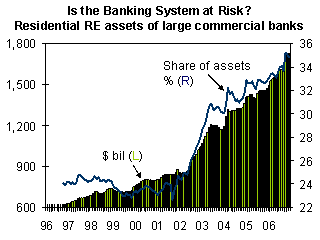
....
Credit conditions are sure to weaken measurably over the coming year. Heretofore aggressive underwriting, resetting ARMs and weaker house prices will continue to fuel increasing delinquency [Zahlungsverzug] and default [Pleite] rates. Only expectations of a sturdy job market in most of the country will ensure that credit problems are not even more severe. The mortgage delinquency rate is expected to rise to a peak of close to 3.5% at this time next year.
A wildcard is how aggressively lenders and regulators respond to worsening credit quality. Regulators are contemplating extending their guidance on IO and option-ARM lending issued late last year to subprime loans. In that guidance, lenders are required to qualify ARM borrowers at the fully indexed interest rate, and not the generally much lower teaser rate. While such a move would ultimately result in fewer credit problems, the impact this year would be to substantially increase them. Many subprime borrowers struggling to stay current on their payments would not qualify under the more restrictive guidelines, and thus could not refinance into new loans and out of their currently troubled ones.
Although unlikely, there is a threat that mortgage credit quality will come unraveled to such a degree that it would become a broad macroeconomic problem. This could occur if mounting credit problems undermine the health of the nation’s banking system or spook global investors. This, in turn, would constrict the free flow of cheap credit so vital to the health of the housing market and the broader economy.
Highlighting this risk is the $1.75 trillion in residential mortgage debt that the nation’s largest commercial banks hold, either as whole loans or in the form of mortgage securities; these holdings account for nearly one-third of the total assets at these institutions. Global investors also have very sizable holdings of agency debt issued by Fannie Mae and Freddie Mac, estimated at $2.5 trillion, and securitized residential mortgages. Some one-fourth of their U.S. financial holdings are in these assets. Both the banking system and global investors have substantially increased their exposure to the mortgage market over the past decade.
The banking system is very well capitalized and profitable, and most global investors are sophisticated institutions buying highly-rated mortgage securities. It would seemingly take a very substantial erosion in mortgage credit quality to measurably infect the financial system. Given that these mortgages are so new and that the securities based on them are even newer, however, the financial system, and thus the economy, may be more vulnerable than they appear. If there is a fault line in the global financial system, it likely runs through the U.S. residential mortgage market.
Quelle: www.economy.com/home/article.asp?cid=50450
Mortgage debt hit by HSBC sub-prime default news
By Leslie Wines, MarketWatch
Last Update: 3:06 PM ET Feb 8, 2007
NEW YORK (MarketWatch) -- News from HSBC Holdings and New Century Financial of an increase in sub-prime mortgage defaults sparked heavy selling of some types of mortgage-linked securities.
There were also reports of heavy selling of home-equity collateralized debt obligations, traders said. These are structured finance products, similar to a mutual fund, in which owners buy a stake in a pool of mortgages or home-equity loan products.
Rod Dubitsky, a fixed-income analyst at Credit Suisse, wrote in a research note that his agency is reviewing for possible downgrades 24 asset-backed securities that were created from sub-prime home-equity deals in 2006, a vintage year for such deals.
But Treasurys were higher after strong auctions of government bonds this week. The default news also had limited impact on agency-backed mortgage securities of Sallie Mae (SLM) and Fannie Mae (FNM) , according to Sally Ann Runyan, mortgages market expert at Thomson IFR Markets.
Late Wednesday New Century Financial Corp. (NEW) warned that its total loan production for 2007 will fall short of expectations. The company said it now expects loan production to be 20% below 2006 levels. Previously, New Century had forecast that it would be flat for 2007.
Early Thursday HSBC warned that bad-debt charges are set to exceed forecasts by about $1.76 billion, as higher interest rates and a lack of refinancing options in the slowing U.S. housing market leave customers unable to pay their mortgages. The bank, (HBC) in an unprecedented statement to the market, said bad-debt charges for the group as a whole will be 20% higher than the average analyst forecast of $8.8 billion, taking the total charge for the year to about $10.56 billion.
Kathleen Shanley, a GimmeCredit analyst, noted that HSBC's problems are much worse than it expected a few months ago, but said that the bank is large and diverse which gives it "a strong base of earnings to support provisioning."
The developments reignited a debate as to the extent to which deteriorating conditions in the housing market are spilling over into the financial services industry and the broader economy.
New York University economist Nouriel Roubini in his blog said the rate of sub-prime defaults and foreclosures is rapidly increasing. "The number of sub-prime lenders going belly up increases every week and even those big ones that have not closed shop are showing increasing signs of losses, retrenchment and/or willingness to sell their operations," he wrote.
"The political storm over 'predatory lending' is gaining strength," according to Roubini. "The risk of serious litigation and class action lawsuits over predatory lending is increasing."
However, Tony Crescenzi, chief fixed-income market analyst at Miller Tabak, questioned whether there is "excessive hype over sub-primes." Crescenzi cited Federal Deposit Insurance Company statistics from September, 2006 showing that "banks were very well capitalized and that non-current loans measured just 0.70% of total loans, the lowest such ratio in the 22 years these data have been collected."
Leslie Wines is a reporter for MarketWatch in New York.
By Leslie Wines, MarketWatch
Last Update: 3:06 PM ET Feb 8, 2007
NEW YORK (MarketWatch) -- News from HSBC Holdings and New Century Financial of an increase in sub-prime mortgage defaults sparked heavy selling of some types of mortgage-linked securities.
There were also reports of heavy selling of home-equity collateralized debt obligations, traders said. These are structured finance products, similar to a mutual fund, in which owners buy a stake in a pool of mortgages or home-equity loan products.
Rod Dubitsky, a fixed-income analyst at Credit Suisse, wrote in a research note that his agency is reviewing for possible downgrades 24 asset-backed securities that were created from sub-prime home-equity deals in 2006, a vintage year for such deals.
But Treasurys were higher after strong auctions of government bonds this week. The default news also had limited impact on agency-backed mortgage securities of Sallie Mae (SLM) and Fannie Mae (FNM) , according to Sally Ann Runyan, mortgages market expert at Thomson IFR Markets.
Late Wednesday New Century Financial Corp. (NEW) warned that its total loan production for 2007 will fall short of expectations. The company said it now expects loan production to be 20% below 2006 levels. Previously, New Century had forecast that it would be flat for 2007.
Early Thursday HSBC warned that bad-debt charges are set to exceed forecasts by about $1.76 billion, as higher interest rates and a lack of refinancing options in the slowing U.S. housing market leave customers unable to pay their mortgages. The bank, (HBC) in an unprecedented statement to the market, said bad-debt charges for the group as a whole will be 20% higher than the average analyst forecast of $8.8 billion, taking the total charge for the year to about $10.56 billion.
Kathleen Shanley, a GimmeCredit analyst, noted that HSBC's problems are much worse than it expected a few months ago, but said that the bank is large and diverse which gives it "a strong base of earnings to support provisioning."
The developments reignited a debate as to the extent to which deteriorating conditions in the housing market are spilling over into the financial services industry and the broader economy.
New York University economist Nouriel Roubini in his blog said the rate of sub-prime defaults and foreclosures is rapidly increasing. "The number of sub-prime lenders going belly up increases every week and even those big ones that have not closed shop are showing increasing signs of losses, retrenchment and/or willingness to sell their operations," he wrote.
"The political storm over 'predatory lending' is gaining strength," according to Roubini. "The risk of serious litigation and class action lawsuits over predatory lending is increasing."
However, Tony Crescenzi, chief fixed-income market analyst at Miller Tabak, questioned whether there is "excessive hype over sub-primes." Crescenzi cited Federal Deposit Insurance Company statistics from September, 2006 showing that "banks were very well capitalized and that non-current loans measured just 0.70% of total loans, the lowest such ratio in the 22 years these data have been collected."
Leslie Wines is a reporter for MarketWatch in New York.
Die Aktien der Hypothekenbank New Century Financial Corp. befinden sich derzeit im freien Fall. Der Eigenheimfinanzierer hatte heute gewarnt, dass seine Krediteinnahmen in diesem Jahr wegen der Krise auf dem amerikanischen Hausmarkt schwach ausfallen werden.
Merrill Lynch stufte die Bankaktie von Neutral auf Verkaufen herunter. Der Finanz-Titel bricht zur Stunde um 28% auf 21,56 Dollar ein.
Merrill Lynch stufte die Bankaktie von Neutral auf Verkaufen herunter. Der Finanz-Titel bricht zur Stunde um 28% auf 21,56 Dollar ein.
NEW steht auf 19,60 USD.
Hier noch folgender Link zum Wall Steet Journal.
FAULTY ASSUMPTIONS
In Home-Lending Push,
Banks Misjudged Risk HSBC Borrowers Fall
Behind on Payments;
Hiring More Collectors
online.wsj.com/article_email/...lMyQjAxMDE3NzAwODgwODgyWj.html
FAULTY ASSUMPTIONS
In Home-Lending Push,
Banks Misjudged Risk HSBC Borrowers Fall
Behind on Payments;
Hiring More Collectors
online.wsj.com/article_email/...lMyQjAxMDE3NzAwODgwODgyWj.html
New Century einen Buchwert von 37 $ !
Da sieht man wieder , daß selbst Buchwerte eine kurze Halbwertzeit haben können.
Deutsche Hypobanken sind total überbewertet. IMO.
Da sieht man wieder , daß selbst Buchwerte eine kurze Halbwertzeit haben können.
Deutsche Hypobanken sind total überbewertet. IMO.
nicht so richtig ;-). Die Schulden betragen 22 Milliarden.
Da sieht man schon wieder wie wichtig die Bilanzrelationen sind...
Einige Aktionäre flehen schon den Housing Kollaps herbei (Quelle ? Grins)
Die Dummbullen drehen noch ein paar Loopings und machen nen
dicken Larry mit Dummsprüchen. Der Knall wird so laut,
daß man zumindest die hehren Kursziele auf unabsehbare Zeit
nicht mehr sehen wird.
Da sieht man schon wieder wie wichtig die Bilanzrelationen sind...
Einige Aktionäre flehen schon den Housing Kollaps herbei (Quelle ? Grins)
Die Dummbullen drehen noch ein paar Loopings und machen nen
dicken Larry mit Dummsprüchen. Der Knall wird so laut,
daß man zumindest die hehren Kursziele auf unabsehbare Zeit
nicht mehr sehen wird.
| HANDELSBLATT, Donnerstag, 8. Februar 2007, 22:51 Uhr | |||
Schlussbericht New YorkSorgen um Kredite belasten US-BörsenDie US-Börsen haben am Donnerstag Kursverluste hinnehmen müssen. Zwar brachte ein Preissprung beim Rohöl die Anleger in der Energiebranche in Kauflaune, doch eine Warnung der britischen Bank HSBC vor faulen Krediten im US-Hypothekengeschäft belastete die Bankentitel.
HB NEW YORK. Im Geschäftsverlauf pendelte der Dow-Jones-Index der Standardwerte zwischen einem Hoch von 12.665 und einem Tief von 12.575 Zählern. Er verließ den Handel um 0,23 Prozent im Minus bei 12.637 Punkte. Der breiter gefasste S&P-500-Index gab 0,12 Prozent auf 1448 Zähler nach. Der Technologie-Index Nasdaq verlor 0,07 Prozent auf 2488 Punkte. US-Rohöl wurde 1,80 Dollar teurer zu 59,50 Dollar je Barrel gehandelt. „Man hätte denken können, dass die Bewegung beim Rohöl schlecht für den Markt wäre“, sagte ein Händler. „Aber das ist nicht der Fall.“ Nach dem Ölpreis-Plus griffen die Anleger vor allem bei Exxon Mobil und Chevron zu, die gegen Handelsschluss zu den größten Gewinnern im S&P gehörten. Exxon-Papiere stiegen 0,9 Prozent auf 75,46 Dollar, Chevron gewannen 1,52 Prozent auf 73,75 Dollar. Toll-Brothers-Aktien gaben dagegen mehr als drei Prozent auf 33,39 Dollar nach. Der Baukonzern musste sich im ersten Geschäftsquartal mit einem Drittel weniger Aufträge begnügen und einen Umsatzrückgang von fast 20 Prozent hinnehmen. „Ich glaube, das letzte Wort über die Schwäche des Immobilienmarktes ist noch nicht gesprochen“, sagte ein Börsianer. Es gebe einige Investoren, die noch immer fürchteten, das gesamte Wirtschaftswachstum könne durch den Immobilienmarkt gebremst werden. Schwer getroffen wurde zudem der Finanzsektor, wo auch die Riesen JPMorgan und Citigroup abgestraft wurden. JPMorgan notierten 0,55 Prozent, Citigroup 0,93 Prozent im Minus. Europas größte Bank HSBC hatte davor gewarnt, dass faule Kredite in ihrem US-Geschäft die Bilanz schmälern könnten. Die in New York notierten HSBC-Aktien verloren 2,5 Prozent auf knapp 90 Dollar. Daraufhin gaben auch die Titel des größten US-Kreditgebers, der New Century Financial Corp, drastisch nach. Die Papiere fielen um mehr als 36 Prozent auf 19,24 Dollar - der größte prozentuale Rückgang an der New Yorker Börse. „Die beiden Faktoren, die auf dem Aktienmarkt lasten, sind Toll Brothers und HSBC“, sagte Jim Paulsen von Wells Capital Management in Minneapolis. Diese Kombination vermittle den Eindruck, dass die gegenwärtigen Bedingungen schlecht seien und sogar noch schlechter werden könnten. <!-- ISI_LISTEN_STOP --> |

Gelöschter Beitrag.
Einblenden
»
#3250
Es gibt keine neuen Beiträge.


|

Neueste Beiträge aus dem BP Forum
| Wertung | Antworten | Thema | Verfasser | letzter Verfasser | letzter Beitrag | |
58 | 19.306 | BP Group | B.Helios | Heute1619 | 08.01.26 11:14 | |
| 43 | BP im Wandel | Tom1313 | Tom1313 | 02.08.22 08:44 | ||
| 80 | 3.606 | von nun an gings bergauf | 123p | 123p | 05.12.21 09:12 | |
| 5 | 170 | BP on the long run 850517 | Blackadder | Blackadder | 25.04.21 13:27 | |
| 2 | 143 | Ist BP unterbewertet? | Salim R. | HSO50 | 25.04.21 03:50 |