
gestern fielen die 10 jährigen Bonds innerhalb weniger Minuten von 106 auf 100, um dann ebenso schnell wieder auf 106 zu steigen. Heute machte der Dollar einen großen Satz nach unten von 1.3060 nach 1.2960 innerhalb kurzer Zeit. Diese Schwankungen sind die Folge der Kapitalkonzentration in immer wenigeren Händen. Es ist eben lukrativ, durch den hohen Einsatz von Futures den Markt in eine gewünschte Richtung zu katapultiern ( nach oben wie auch nach unten ), die Trader auf der anderen Seite müssen folgen oder werden mangels Nachschuss ( Margin ) zwangsenteignet. Ist dann das gewünschte Kursniveau erreicht, kann man die Futures der Ausgebluteten wieder billig einkassieren. Fundamentale Gesichtspunkte haben zumindest kurzfristig keine Bedeutung mehr.
Anzeige
Meldung des Tages: Eine der spannendsten Gold-Stories 2026 steht ganz am Anfang
Neuester,
zuletzt geles. Beitrag
Antworten | Börsen-Forum Übersicht Zurück
Weiter
Zurück
Weiter
... 123 124 126 127 ...
Antworten | Börsen-Forum Übersicht
Zurück
Weiter ... 123 124 126 127 ...
Der Doomsday Bären-Thread
Beiträge:
3.607
Zugriffe: 519.626 / Heute: 58
Zugriffe: 519.626 / Heute: 58
|
|
| ||||||||||||||||||||
Werbung
Entdecke die beliebtesten ETFs von Xtrackers
Xtrackers MSCI Korea UCITS ETF 1C
Perf. 12M: +86,53%
Xtrackers Spain UCITS ETF 1D
Perf. 12M: +59,87%
Xtrackers Spain UCITS ETF 1C
Perf. 12M: +59,38%
Xtrackers CSI500 Swap UCITS ETF 1C
Perf. 12M: +58,19%
Xtrackers Vietnam Swap UCITS ETF 1C
Perf. 12M: +56,20%
Genau so erklärt sich die Rallye seit letzten Sommer. Es gab am Anfang extrem viele Shorts. Hedgefonds sahen dies und kauften die Futures (long). Die Indizes stiegen, die Shorts mussten sich eindecken, wurden also durch den Kursanstieg zu Käufen "gezwungen". Als die Indizes "widersinnig" (fundamental betrachtet) weiter stiegen, versuchten weitere Shorts das jeweilige Top zu treffen (Motto: "höher kann das ja nun wirklich nicht mehr gehen") - um nur immer wieder neu von den Hedgefonds rausgeekelt oder ins Minus getreten zu werden. So waren die Shorter am Ende immer diejenigen, die den überteuerten Mist zum Eindecken überhaupt noch kauften. Natürlich sprangen auch noch viele Bullen auf den fahrenden Zug auf (Motto: "Hauptsache es steigt und ich verdiene Geld damit") und verstärkten das Momentum. Der perfekte "Wall of worry" also.
Mit Fundamentals, die wir hier wälzen, hat das wenig zu tun. Es geht nur um Psychologie (zu viele Shorts) und Unmengen geliehenes Geld (Hedgefond-Futurekäufe), das rein mechanisch dagegen hält.
Irgendwann aber (wann weiß der Himmel) kommt der Punkt, wo die Shorter den Mut verloren haben und wo Kurs und Bewertung derart auseinanderklaffen, dass es - meist nach einem eigentlich nichtswürdigen Ereignis (Erdbeben in xyz, Kommentar eines chinesischen Politikers, Furz von Bernanke) plötzlich sehr zügig nach unten geht (wie letzten Mai).
Die Hedgefonds wagen mit ihren Future-Käufen, hinter denen wenig Eigengeld steckt, allerdings einen riskanten Hochseilakt. 1987, als Specs auch "nur noch Futures" kauften, wurden viele am Schwarzen Montag mit einem 20-%-Minus-Gap schlagartig in den Ruin getrieben. Da sah man zum ersten Mal seit 1929 wieder die berühmten Fensterstürze im New Yorker Finanzdistrikt. Bären sieht man dort nie "fliegen", denn Index-Anstiege verlaufen langsam über lange Zeit - ist eher eine Wassertropfen-Folter. Zum Fenstersturz braucht man 20-%-Moves über Nacht. Die gibt es bei Aktienindizes NUR nach unten!
Mit Fundamentals, die wir hier wälzen, hat das wenig zu tun. Es geht nur um Psychologie (zu viele Shorts) und Unmengen geliehenes Geld (Hedgefond-Futurekäufe), das rein mechanisch dagegen hält.
Irgendwann aber (wann weiß der Himmel) kommt der Punkt, wo die Shorter den Mut verloren haben und wo Kurs und Bewertung derart auseinanderklaffen, dass es - meist nach einem eigentlich nichtswürdigen Ereignis (Erdbeben in xyz, Kommentar eines chinesischen Politikers, Furz von Bernanke) plötzlich sehr zügig nach unten geht (wie letzten Mai).
Die Hedgefonds wagen mit ihren Future-Käufen, hinter denen wenig Eigengeld steckt, allerdings einen riskanten Hochseilakt. 1987, als Specs auch "nur noch Futures" kauften, wurden viele am Schwarzen Montag mit einem 20-%-Minus-Gap schlagartig in den Ruin getrieben. Da sah man zum ersten Mal seit 1929 wieder die berühmten Fensterstürze im New Yorker Finanzdistrikt. Bären sieht man dort nie "fliegen", denn Index-Anstiege verlaufen langsam über lange Zeit - ist eher eine Wassertropfen-Folter. Zum Fenstersturz braucht man 20-%-Moves über Nacht. Die gibt es bei Aktienindizes NUR nach unten!
einrennen.
www.handelsblatt.com/news/Boerse/...de/_pv/_p/200029/_t/ft/_b/
1218502/default.aspx/unsichtbare-hand-des-staates.html
Ob s realistisch it, soll jeder selbst beurteilen. Dass sogar das handelsblatt kommentiert, sagt m.E. aber etwas aus. Es würde jedenfalls erklären, warum die Kurse heute steigen, obwohl
a)der Einkaufsmanager - Index gestern eine Rezession suggeriert
b) die Arbeitsmarktdaten deutlich schlechter ausgefallen sind als erwartet
c) der Ölpreis wieder um die 60 USD erreicht hat, es aber niemanden wirklich interessiert
d) in diesem Quartal doch einige wichtige Unternehmen mit ihren Quartalsergebnissen enttäuscht haben (es scheint fast vergessen, dass INTC, AMD, CISCO, IBM, Microsoft, Dell, die ganzen Zykler also) schlechte Zahlen geschrieben haben.
Es ist doch wie verhext.
Hatte meiner Freundin unlängst geraten, ihren Threadneedle Euro Growth abzulösen, und die Gewinne einzustreichen, bevor es eine Korrektur gibt. Ihr könnt euch vielleicht vorstellen, was bei uns zu hause los ist, weil die Kurse weiter steigen :-) Ich sag nix mehr. Im Gegenteil: Wenn irgendwo ein Flugzeug in ein Hochhaus fliegt, werd ich kaufen :-)
www.handelsblatt.com/news/Boerse/...de/_pv/_p/200029/_t/ft/_b/
1218502/default.aspx/unsichtbare-hand-des-staates.html
Ob s realistisch it, soll jeder selbst beurteilen. Dass sogar das handelsblatt kommentiert, sagt m.E. aber etwas aus. Es würde jedenfalls erklären, warum die Kurse heute steigen, obwohl
a)der Einkaufsmanager - Index gestern eine Rezession suggeriert
b) die Arbeitsmarktdaten deutlich schlechter ausgefallen sind als erwartet
c) der Ölpreis wieder um die 60 USD erreicht hat, es aber niemanden wirklich interessiert
d) in diesem Quartal doch einige wichtige Unternehmen mit ihren Quartalsergebnissen enttäuscht haben (es scheint fast vergessen, dass INTC, AMD, CISCO, IBM, Microsoft, Dell, die ganzen Zykler also) schlechte Zahlen geschrieben haben.
Es ist doch wie verhext.
Hatte meiner Freundin unlängst geraten, ihren Threadneedle Euro Growth abzulösen, und die Gewinne einzustreichen, bevor es eine Korrektur gibt. Ihr könnt euch vielleicht vorstellen, was bei uns zu hause los ist, weil die Kurse weiter steigen :-) Ich sag nix mehr. Im Gegenteil: Wenn irgendwo ein Flugzeug in ein Hochhaus fliegt, werd ich kaufen :-)
Handelsblatt.com
Fehler bei der Seitenausgabe
Lieber Handelsblatt.com Leser,
bei der Verarbeitung der von Ihnen angegebene Seite ist ein Fehler aufgetreten.
Das kann zum Beispiel an einem Systemfehler oder einer nicht interpretierbaren Eingabe liegen.
Bitte versuchen Sie, die letzte Seite erneut mit diesem Link aufzurufen:
Oder navigieren Sie zur Handelsblatt Homepage:
www.handelsblatt.com
Sollte dieser Fehler wiederholt auftreten, wenden Sie sich bitte an die Handelsblatt Infoline: handelsblatt.com@vhb.de
Ihre Handelsblatt.com Redaktion.
© Verlagsgruppe Handelsblatt GmbH - Economy.One 2007
Für die Richtigkeit der Angaben übernehmen wir keine Gewähr.
www.handelsblatt.com/news/Boerse/...bare-hand-des-staates.html
Diesen Handelsblatt-Artikel über die "Unsichtbare Hand" (PPT) habe ich oben in P. 3100 gepostet.
Doktore, umbrich die Links beim Posten nicht, das muss man sich sonst immer mühsam zusammenpasten... (Mit Firefox jedenfalls funzt es direkt nicht).
Doktore, umbrich die Links beim Posten nicht, das muss man sich sonst immer mühsam zusammenpasten... (Mit Firefox jedenfalls funzt es direkt nicht).
In den USA mehren sich weiterhin die kritischen Stimmen, welche die Märkte für klar überbewertet halten.
Das momentane P/E - Ratio des S&P500 von 21,8 wurde in den letzten 57 Jahren nur 7 mal übertroffen, und zwar in den Jahren, in denen es zu Blasenbildungen kam.
Market Still Highly Overvalued
The vast majority of market strategists believe that a goldilocks-type soft landing is almost inevitable and that the market is reasonably valued or even undervalued. In past comments we have argued that the soft-landing scenario, while possible, is a high-risk bet. In the current comment we wish to emphasize the point that the market, rather than being fairly valued or cheap, is actually highly overvalued. Measured by 2007 trendline earnings the S&P 500 at today’s close is selling at 21.8 times. To get an idea of how overvalued this is, we offer the following observations.
>For 46 years from 1950 to 1995 the market never exceeded 19.7 times earnings at its annual high and sold as low as 7 times.
>In 45 of the 57 years since 1950 the market, at some time during the year sold at under 16 times.
>In 17 of those years the market sold below 10 times earnings at some time during the year.
>In 19 of those years the market did not sell higher than 15 times at any point during the year.
>The current P/E of 21.8 was exceeded only 7 times in 57 years—all of them in the years reflecting either the Internet bubble or the housing bubble.
In addition to the significant overvaluation the market is faced with historically high investor sentiment and rising 90-day bill rates. When we add in the inverted yield curve, the major decline in building permits, the declining ISM index, and the zero year-to-year growth in the leading indicators, it seems clear that this is a high-risk market that needs almost absolute perfection to make further upside progress from this point.
staatlich beeinflusste Börsenkurse bin, gebe ich gern zu, dass eine gewisse Kontrolle offenbar nötig ist. Es kann ja wohl nicht angehen, dass einige bigboys sich durch ihre beliebigen Touren ( sitzt ein Furz quer, wird short gegangen, sonst long )die Taschen voll stecken und alle anderen ausquetschen. Soros hat uns ja schon früher gezeigt, welche Macht Fonds haben können ( selbst gegen die Bank von England ). Manch einem mag es ja sympathisch gewesen sein, selbst die Bank von England in die Knie zu zwingen; von den Tradern auf der anderen Seite spricht aber keiner. Wohl bemerkt, wer sich auf das Börsenparkett wagt, sollte auch die Risiken kenne. Wenn aber der Verlauf der Kurse nur noch von einigen bigboys je nach Lust und Laune bestimmt wird, kann man die Börse vergessen. Beim Roulette sind die Chancen dann größer; zumindest hat jeder Spieler die gleiche Chance.
McNosis, Retiring Boomers and the Silent Crash
© Michael Nystrom
February 1, 2006
Traders know that in such frenzied arenas as financial markets this is taken to the extreme. Markets do not plan their movements, but dance to a primal tune. Wednesday, for example after "da Fed" gave the market what amounted to an all clear on Wednesday, US financial markets proceeded to go ga-ga! Stocks rose and bond yields fell in a euphoric celebration. Had anything fundamentally changed to justify such a response? Only the most important thing: perceptions. A certain perception of the future (the Goldilocks future) caused an emotional market reaction, leading the Dow into record territory once again.
But these charts, from the December Elliott Wave Theorist, show that from an inflation-adjusted standpoint, what is actually going on in the stock market is a crash of historic proportions - a "Silent Crash" as Prechter calls it. The first shows the Dow measured in gold, the second measured by the CRB index.
You won't hear about this silent crash on Bubblevision, nor read about it on the scrolling CNN news ticker at McDonald's. Your coworkers won't talk about it. And though you may have a vague sense of unease that something is not right, you won't know why because everything on the surface looks so peachy. "
Something is happening, but you don't know what it is - do you, Mr. Jones?" But if history is any guide, this crash won't stay silent forever. The noisemaking should begin any time now.http://bullnotbull.com/archive/mcnosis.html
Doug Kass lag mit seinen bärischen Warnungen seit September [hier gepostet] falsch und sagt: "the timing of my pessimism couldn't be worse" - wobei ihm seine langjährige Erfahrung als Hedgefond-Manager diesmal ein Schnippchen schlug...
Aber der "bear case", meint er, ist damit noch nicht vom Tisch:
Bears Still Lurk
By Doug Kass
Street.com Contributor
2/2/2007 1:00 PM EST
This week the market has advanced into record territory as market participants' enthusiasm over a noninflationary period of growing and sustained economic growth seems to have improved.
Indeed, since mid-2006, investors have been immersed and have been captivated by a world known as Cramerica [ironische Anspielung auf den permabullischen J. Cramer, Mitgründer von Street.com und Fernseh-Börsenstar - A.L.], a world in which everything is coming up booyahs [Cramers "Brunftschrei"], as both good news and bad news are treated as good news.
According to my hedge fund contacts (an admittedly small sampling!), and despite what you may read from others, this week's ramp also resulted in the capitulation by many shorts. The short side has become, for most long/short investors, simply a hedge against profits. And in the competitive hedge fund industry's mandate to create excess returns above the market (alpha), this is rendering the appetite for hedging (read: shorting) increasingly undesirable (to put it mildly).
My Tuesday night debate with Larry Kudlow on CNBC's "Kudlow & Company" pretty much framed the bull/bear argument.
Real GDP growth is currently vigorous (and above expectations), the rate of growth in inflation appears muted, retail spending seemed to be advancing, and, to many, signs of a bottom in housing is at hand.
From my perch (which these days is increasingly taking place on that cold linoleum floor drinking cheap tequila), the dual impact of a mild November and December when coupled with an unusually sharp drop in energy costs has overstated the health of the U.S. economy.
A snapshot of the economy and the uninterrupted rise in the world equity markets is encouraging the notion of a "Goldilocks" scenario. It is supporting a positive investment landscape characterized by narrow credit spreads, record low levels on the major volatility indices, improving investor sentiment and recognition of the benefits of the emergence of new (and emerging markets) and the excessive global liquidity that this development entails.
In looking at the sustained march in equities (13 out of 14 months have recorded positive returns) and the significant records being recorded (consecutive trading days without a 2% or 10% correction), it is clear that we are in a bull market for optimism/momentum and for financial assets (particularly of a long-only kind), while we are in a bear market for skepticism/disbelief and for hedging/short-selling.
My ursine [bärisch] view is focused on the future, not the present. As such, it is less easily defended when equities move upward in an almost uninterrupted manner. It is a prospective and anticipatory view that gives less weight to the seemingly positive recent economic releases and conditions.
It is a contrarian view, because it argues that current trends should not be extrapolated. Rather, my opinion suggests that many of the core arguments that underscore the Goldilocks case will be re-examined over the upcoming weeks and months.
Underlying my fundamental concerns are:
* A tightening labor market (and rising unit labor costs).
* A likely downturn in productivity gains.
* A five-year high in the CRB RIND Index with attendant cost-push inflation implications. (This index measures spot raw-materials prices across a broad group of categories including steel and cooper scrap, tin, zinc, wheat, corn, sugar ... and even lard!)
* The expectation of rising interest rates and cost of capital.
* An implosion in the subprime mortgage market (and a consequent restriction in credit to prospective homebuyers).
* A bubble in credit availability (and private equity).
* The emerging bubble in emerging markets (e.g., over the last six years the India's Sensex has increased by about 300%, while India's total corporate profits have not even doubled -- that's P/E expansion!).
* The levered and vulnerable (long-biased) hedge fund and fund-of-funds (especially of a Swiss kind) industries.
* The broad tax implications of the Democratic tsunami.
* A spent-up American consumer, which should have broad and negative implications for consumer electronics (and the Nasdaq) and a more hawkish Federal Reserve than many expect. (Is anyone concerned about the $100 rally in gold since September 2006, or the quiet 40-basis-point rise in the yield on the 10-year U.S. note?)
To this observer, neither a recession (where my pal Larry Kudlow tries to pigeonhole [einordnen] me!) nor a Goldilocks scenario appears to be in the cards. Rather, I expect a period of lumpy and uneven economic growth in which both investment managers and corporate managers find it hard to navigate.
In time, we will undoubtedly see a mean reversion [Rückkehr zu historischen Mittelwerten] in home prices, interest rates, credit spreads (and losses), corporate profit margins ... and the world's equity markets.
But for now, it is abundantly clear that the timing of my pessimism couldn't be worse -- as my experience and historical perspective are my albatrosses.
Doug Kass is founder and president of Seabreeze Partners Management, Inc., and the general partner and investment manager of Seabreeze Partners Short LP and Seabreeze Partners Short Offshore Fund, Ltd. Until 1996, he was senior portfolio manager at Omega Advisors, a $4 billion investment partnership.
Aber der "bear case", meint er, ist damit noch nicht vom Tisch:
Bears Still Lurk
By Doug Kass
Street.com Contributor
2/2/2007 1:00 PM EST
This week the market has advanced into record territory as market participants' enthusiasm over a noninflationary period of growing and sustained economic growth seems to have improved.
Indeed, since mid-2006, investors have been immersed and have been captivated by a world known as Cramerica [ironische Anspielung auf den permabullischen J. Cramer, Mitgründer von Street.com und Fernseh-Börsenstar - A.L.], a world in which everything is coming up booyahs [Cramers "Brunftschrei"], as both good news and bad news are treated as good news.
According to my hedge fund contacts (an admittedly small sampling!), and despite what you may read from others, this week's ramp also resulted in the capitulation by many shorts. The short side has become, for most long/short investors, simply a hedge against profits. And in the competitive hedge fund industry's mandate to create excess returns above the market (alpha), this is rendering the appetite for hedging (read: shorting) increasingly undesirable (to put it mildly).
My Tuesday night debate with Larry Kudlow on CNBC's "Kudlow & Company" pretty much framed the bull/bear argument.
Real GDP growth is currently vigorous (and above expectations), the rate of growth in inflation appears muted, retail spending seemed to be advancing, and, to many, signs of a bottom in housing is at hand.
From my perch (which these days is increasingly taking place on that cold linoleum floor drinking cheap tequila), the dual impact of a mild November and December when coupled with an unusually sharp drop in energy costs has overstated the health of the U.S. economy.
A snapshot of the economy and the uninterrupted rise in the world equity markets is encouraging the notion of a "Goldilocks" scenario. It is supporting a positive investment landscape characterized by narrow credit spreads, record low levels on the major volatility indices, improving investor sentiment and recognition of the benefits of the emergence of new (and emerging markets) and the excessive global liquidity that this development entails.
In looking at the sustained march in equities (13 out of 14 months have recorded positive returns) and the significant records being recorded (consecutive trading days without a 2% or 10% correction), it is clear that we are in a bull market for optimism/momentum and for financial assets (particularly of a long-only kind), while we are in a bear market for skepticism/disbelief and for hedging/short-selling.
My ursine [bärisch] view is focused on the future, not the present. As such, it is less easily defended when equities move upward in an almost uninterrupted manner. It is a prospective and anticipatory view that gives less weight to the seemingly positive recent economic releases and conditions.
It is a contrarian view, because it argues that current trends should not be extrapolated. Rather, my opinion suggests that many of the core arguments that underscore the Goldilocks case will be re-examined over the upcoming weeks and months.
Underlying my fundamental concerns are:
* A tightening labor market (and rising unit labor costs).
* A likely downturn in productivity gains.
* A five-year high in the CRB RIND Index with attendant cost-push inflation implications. (This index measures spot raw-materials prices across a broad group of categories including steel and cooper scrap, tin, zinc, wheat, corn, sugar ... and even lard!)
* The expectation of rising interest rates and cost of capital.
* An implosion in the subprime mortgage market (and a consequent restriction in credit to prospective homebuyers).
* A bubble in credit availability (and private equity).
* The emerging bubble in emerging markets (e.g., over the last six years the India's Sensex has increased by about 300%, while India's total corporate profits have not even doubled -- that's P/E expansion!).
* The levered and vulnerable (long-biased) hedge fund and fund-of-funds (especially of a Swiss kind) industries.
* The broad tax implications of the Democratic tsunami.
* A spent-up American consumer, which should have broad and negative implications for consumer electronics (and the Nasdaq) and a more hawkish Federal Reserve than many expect. (Is anyone concerned about the $100 rally in gold since September 2006, or the quiet 40-basis-point rise in the yield on the 10-year U.S. note?)
To this observer, neither a recession (where my pal Larry Kudlow tries to pigeonhole [einordnen] me!) nor a Goldilocks scenario appears to be in the cards. Rather, I expect a period of lumpy and uneven economic growth in which both investment managers and corporate managers find it hard to navigate.
In time, we will undoubtedly see a mean reversion [Rückkehr zu historischen Mittelwerten] in home prices, interest rates, credit spreads (and losses), corporate profit margins ... and the world's equity markets.
But for now, it is abundantly clear that the timing of my pessimism couldn't be worse -- as my experience and historical perspective are my albatrosses.
Doug Kass is founder and president of Seabreeze Partners Management, Inc., and the general partner and investment manager of Seabreeze Partners Short LP and Seabreeze Partners Short Offshore Fund, Ltd. Until 1996, he was senior portfolio manager at Omega Advisors, a $4 billion investment partnership.
Es ist schon merkwürdig, dass einige Verlinkungen von US - Sites aus zu den Plunge-Protection-Infos nicht mehr funktionieren. Recht aktuelle Artikel wie "Paulson's other job as Wall St. Plunge Protector", New York Times, June 8 2006, oder auch ältere wie der legendäre Washington Post Artikel aus Februar 1997 werden bei Aufruf mit nachfolgendem Kommentar quittiert:
Page not foundThe page you are looking for might have been removed,had its name changed, or is temporarily unavailable
Direkt angeklickt funktioniert's:
http://www.washingtonpost.com/wp-srv/business/...rm/blackm/plunge.htm
Viele Dax Titel mit mehr als 10% Performance in einem Monat,sollte das so weitergehen haben wir 12000 Punkte im Dax am Jahresende. Die Vernunft müsste einem schon sagen das das nicht geht, aber Vernunft gibt es an den Welt-Börsen schon lange nicht mehr nur noch Gier. Woher kommen die weltweit steigenden Renditen der Unternehmen? Vom kleinen Bürger, der überall abgezockt wird. Da streichen wir doch einfach die übertariflichen Leistungen und ein paar Arbeitsplätze und erhöhen die Preise ein bissel, so denken viele Manager. Es wird mehr und mehr auf Pump gekauft, überall die 0% Finanzierungen in kleinen Raten über 2-3 Jahre oder mehr. Denn leisten kann sich kaum noch einer den Konsum bei einer Nettolohnquote von 38%. Soviel bleiben dem durchschnittlichen Arbeiter noch von seinem Brutto nach Abzug aller Abgaben und Gebühren an den Staat.
in anderen Laendern sieht das bei geringeren Lebenshaltungskosten
wesentlich besser aus. Dann kommen Milliarden durch die Erbengeneration
in den Witschaftskreislauf.
Klar, wesentlich hast Du Recht. Ich wundere mich auch immer ueber die 0%-
Anzahlungsfinanzierungen. "Armut" und "Reichtum" triften weiter stark aus
einander. Irgendwann schreit's nach Ausgleich und ungesunde Finanzierungen
muessen die Blase zum platzen bringen. Mal sehen wie langs noch geht.
wesentlich besser aus. Dann kommen Milliarden durch die Erbengeneration
in den Witschaftskreislauf.
Klar, wesentlich hast Du Recht. Ich wundere mich auch immer ueber die 0%-
Anzahlungsfinanzierungen. "Armut" und "Reichtum" triften weiter stark aus
einander. Irgendwann schreit's nach Ausgleich und ungesunde Finanzierungen
muessen die Blase zum platzen bringen. Mal sehen wie langs noch geht.

ob wir schon eine Blase haben. Auf jeden Fall sind wir noch sehr weit von den Verhältnissen von Anfang 2000 entfernt. Eine derartige Blase mit dem darauf folgenden Crash erlebt man bewusst kaum mehr als einmal in seinem Leben. Sollte es trotzdem zu einem großen Crash kommen, wird die Arbeitslosigkeit stark ansteigen. Das wird wohl den Abstand von Reich und Arm eher vergrößern. Auch sollte man in seiner Analyse etwas konsequenter sein. Man kann nicht in einem Posting von ausufernden Unternehmensgewinnen und im nächsten zustimmend von Aktienblase sprechen. Derartige bärische Analysen sind enttäuschend.
schlicht und ergreifend springst Du an folgender Stelle zu kurz :
Man kann nicht in einem Posting von ausufernden Unternehmensgewinnen und im nächsten zustimmend von Aktienblase sprechen. Derartige bärische Analysen sind enttäuschend.
Es dreht sich schlicht und ergreifend um die Beziehung der Unternehmensgewinne zu deren momentaner Bewertung an den Börsen. Und die ist hier im Thread mehrmals klar benannt worden, u.a. Posting # 3107 :
The current P/E of 21.8 was exceeded only 7 times in 57 years—all of them in the years reflecting either the Internet bubble or the housing bubble.
Das derlei Bewertungen Blasencharakter besitzen, dürfte aus dem historischen Kontext einleuchtend erscheinen.
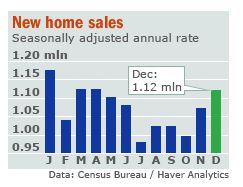
Sieht man sich die Grafik unten an, fällt auf, dass die Verkaufszahlen neuer Häuser zweimal nacheinander, im Nov. und Dez., gegenüber dem jeweiligen Vormonat gestiegen sind. Schon mehren sich die Stimmen, die US-Housingkrise sei überwunden. Auch die Fed spricht im Begleit-Statement zur letzten Sitzung nur noch von "cooling" (Abkühlung) des Housing-Markts, während zuvor noch von "substantial cooling" (beträchlicher Abkühlung) die Rede war.
Meine Einwände:
1. Es ist unseriös, aus nur zwei Datenpunkten einen neuen Trend zu fabulieren, zumal wenn nach den US-BIP-Wachstumzahlen, die letzte Woche kamen, der Housing-Sektor im 4. Quartal (Jahr zu Jahr) um 19,2 % nachgegeben hatte nach 18,8 % im 3. Quartal (Posting oben). Im Mittel zeigt der Trend daher weiter abwärts.
2. Viele Haus-Verkäufe bedurften extremer Kauf-Anreize (Gratis-Auto, Gratis-Urlaub, Gratis-Swimmingpool, Gratis-Innendekoration wie bessere Fußböden usw.). Diese "incentives" haben die Verkaufspreise weiter gedrückt.
3. Die Hauspreise fielen letztes Jahr um 1,3 %. Darin sind die Extrakosten der Kaufanreize noch gar nicht berücksichtigt. An die Regierung wurden nur die Verkaufspreise gemeldet, sonst nichts! Zu allem Überfluss wird ein Haus bereits als verkauft gemeldet, wenn der Kaufvertrag unterzeichnet ist. Rücktritte, die es in letzter Zeit reihenweise gab, werden jedoch nicht gemeldet. Wenn ich einen Kaufvertrag für 300.000 Dollar unterschrieben hätte und sehe, dass der Preis nach ein paar Monaten auf 290.000 gefallen ist, würde ich auch zurücktreten und lieber woanders einen neuen Vertrag unterzeichnen.
4. Die Regierung gibt selbst zu, dass die Zahlen statistisch wegen Standardabweichungen von 12,2 % "bedeutungslos" sind. Es ist durchaus möglich, dass die Zahlen im Dezember überhaupt nicht gestiegen sind!
5. Die Verkäufe legten nicht US-weit zu, sondern fast nur im Norden (dort um 27 %!) wo der Winter diesmal extrem mild ausfiel (deshalb fiel ja auch der Ölpreis). Im Winter läuft dort normalerweise sehr wenig. Es wurden daher Verkäufe, die sonst im saisonal starken Frühjahr erfolgen, vorgezogen. Entsprechend weniger Häuser werden dann im Frühjahr selbst verkauft. Im Süden der USA fielen die Verkäufe hingegen um 4 %! Der eigentliche "Hammer" ist, dass die Zahlen dennoch saisonbereinigt (s. u. "seasonally adjusted") wurden. Da wurden also Effekte des normalerweise strengen WInter "abgezogen", obwohl der Winter diesmal nahezu ausfiel.
6. Auf Grund dieser Vorzieheffekte erwarte ich, dass sich die "Erholung" im Verkaufs-Chart unten als Sondereffekt entpuppt. Die Zahlen im Frühjahr dürfen den Abwärtstrend fortschreiben. Hört man das "Stöhnen" der Homebuilder, erkennt man, dass die Erholungsträume von Wunschdenken gefärbt sind. Heute erschien bei CBS Marketwatch ein "Stockpicker-Artikel" für Homebuilder, der von einer Konsolidierung der Branche ausgeht. Darin wird empfohlen, sich die "Winner" herauszupicken, deren Ertragsrückgänge weniger stark ausfielen als bei der Konkurrenz. Das birgt umgekehrt aber auch die Gefahr, dass manch anderer Home-Builder in der Pleite endet (und dann evtl. die "Trümmer" aufgekauft werden).
7. Auch das unerwartet hohe US-BIP-Wachstum im 4. Quartal von 3,5 % ist teilweise eine Folge des lauen Winters sowie des daraus resultierenden niedrigen Ölpreises. Man darf daher auch hier von Vorzieheffekten und kommender Schwäche im Frühjahr ausgehen, zumal der Industriesektor (ISM = 49,3) weiterhin auf Schrumpfkurs steht.
8. Da USA hochverschuldet ist und auf Pump lebt (Konsumenten bereits "am Anschlags" - negative Sparquote; der Staat riskant mit allein 700 Milliarden USD in China verschuldet), dürfte die Tendenz zu steigender Inflation anhalten. Man erkennt sie letztlich auch recht deutlich am steigenden Gold sowie am fallenden Dollar, der letztes Jahr von EUR/USD 1,18 auf über 1,30 nachgab und sich bislang dort hielt. Dass die jüngsten Inflationszahlen etwas günstiger ausfielen als erwartet, liegt außer an "Schönrechnung" am gefallenen Ölpreis und mithin ebenfalls am lauen Winter. Volkswirtschaftlich betrachtet (Doppeldefizit) dürfte sich die postulierte "sanfte Landung", die per definition auf der Hoffnung nachlassender Inflation (hedonistisch: Kern-Inflation) basiert, als Utopie erweisen.
ECONOMIC REPORT
New-home sales rise to highest since April
Warm weather boosts sales in Northeast, Midwest
By Rex Nutting, MarketWatch
Last Update: 12:00 PM ET Jan 26, 2007
WASHINGTON (MarketWatch) -- U.S. sales of new homes jumped nearly 5% in December to the highest level since April, but all of the gains came in normally cold northern regions that basked in unseasonably warm temperatures during the month.
Sales rose 4.8% in December to a seasonally adjusted (!!!) annual rate of 1.12 million, the fourth gain in the past five months, the Commerce Department reported Friday.
Warm weather at the end of last year, along with low interest rates [wegen der inversen Zinskurve: Rendite auf 10-jährige Anleihen lag im Dez. bei 4,4 %, jetzt über 4,8 %!] and aggressive discounting by builders, boosted sales far beyond the 1.07 million rate that economists surveyed by MarketWatch had expected.
[Wenn 1,12 Mio Häuser verkauft wurden und 1,07 Mio. erwartet, sind das gerade mal 50.000 Häuser mehr, was größtenteils der warmen Witterung zu verdanken ist - "far beyond" scheint mir da etwas hochgegriffen.]
"There is less to this increase than meets the eye," said Richard Moody, chief economist for Mission Residential in Austin, Texas, who noted that the gain was not only statistically meaningless but likely represented a "false spring."
Joel Naroff of Naroff Economic Advisers said it would be wise to take "several bags" of salt with the report.
[Statt einem Körhchen Salz als gleich mehrere Säcke ;-)) - hier bitte Schmunzeln]
By region, sales gains were strongest in areas that enjoyed unseasonably warm temperatures during December. Sales rose 27% in both the Northeast and the Midwest, while sales were flat in the South and fell 4% in the West.
Compared with December 2005, last month's sales were down 11%. For all of 2006, sales plunged 17.3% to 1.061 million, the largest percentage loss since 1990. It was the weakest sales year since 2002, when 973,000 new homes were sold.
In December, the number of unsold new homes on the market slipped 0.9% to 537,000, the fewest since January 2006. That represented a 5.9-month supply at the December sales pace, the leanest inventory since last January.
"Based on the improved trajectory of new home sales [Fortschreibung eines verfälschten Trends], it would appear that sales and inventories will become better balanced by the end of the summer 2007," wrote Young Kim, an economist for Stone & McCarthy Research, in a research note to clients.
However, the inventory of completed-but-unsold homes rose to a record 172,000, up about 50% in the past year. With builders having to carry the costs of those vacant houses, housing starts should weaken further this year until the inventory is worked off, Moody said.
The median sales price of $235,000 in December was down 1.3% compared with a year earlier. [Und darin sind noch die Kaufanreize wie Gratis-Autos, Gratis-Urlaub und Gratis-Swimmingpools rausgerechnet - siehe unten.]
Moving the product
Home builders have piled on incentives, including offering free vacations and new cars, to sell homes and reduce inventories. Such incentives are not subtracted from the sales price reported to the government. Sales are reported when a contract is signed, not at the closing of the sale. What's more, many of the nation's home builders have reported a large increase in cancellations in recent months. Cancellations are not reflected in the government data, so the reported sales are likely overstated.
The government cautions that its housing data are subject to large sampling and other statistical errors. Large revisions are common. The standard error of 12.2% is so high, in fact, that the government cannot be sure sales increased at all in December. The 4.8% increase is statistically meaningless.
It can take up to six months for a trend in sales to emerge. New-home sales have averaged 1.03 million per month over the past six months, roughly unchanged for the past three months. "The results support the view that housing demand is stabilizing," said Michael Gregory, an economist for BMO Nesbitt Burns.
In a separate report Friday, the Commerce Department said orders for durable goods rose 3.1% in December, reflecting broad-based gains throughout industry. [Die ISM-Zahlen (Industrie) fielen mit 49,3 aber auf Rezessionsniveau.]
Rex Nutting is Washington bureau chief of MarketWatch.
Meine Einwände:
1. Es ist unseriös, aus nur zwei Datenpunkten einen neuen Trend zu fabulieren, zumal wenn nach den US-BIP-Wachstumzahlen, die letzte Woche kamen, der Housing-Sektor im 4. Quartal (Jahr zu Jahr) um 19,2 % nachgegeben hatte nach 18,8 % im 3. Quartal (Posting oben). Im Mittel zeigt der Trend daher weiter abwärts.
2. Viele Haus-Verkäufe bedurften extremer Kauf-Anreize (Gratis-Auto, Gratis-Urlaub, Gratis-Swimmingpool, Gratis-Innendekoration wie bessere Fußböden usw.). Diese "incentives" haben die Verkaufspreise weiter gedrückt.
3. Die Hauspreise fielen letztes Jahr um 1,3 %. Darin sind die Extrakosten der Kaufanreize noch gar nicht berücksichtigt. An die Regierung wurden nur die Verkaufspreise gemeldet, sonst nichts! Zu allem Überfluss wird ein Haus bereits als verkauft gemeldet, wenn der Kaufvertrag unterzeichnet ist. Rücktritte, die es in letzter Zeit reihenweise gab, werden jedoch nicht gemeldet. Wenn ich einen Kaufvertrag für 300.000 Dollar unterschrieben hätte und sehe, dass der Preis nach ein paar Monaten auf 290.000 gefallen ist, würde ich auch zurücktreten und lieber woanders einen neuen Vertrag unterzeichnen.
4. Die Regierung gibt selbst zu, dass die Zahlen statistisch wegen Standardabweichungen von 12,2 % "bedeutungslos" sind. Es ist durchaus möglich, dass die Zahlen im Dezember überhaupt nicht gestiegen sind!
5. Die Verkäufe legten nicht US-weit zu, sondern fast nur im Norden (dort um 27 %!) wo der Winter diesmal extrem mild ausfiel (deshalb fiel ja auch der Ölpreis). Im Winter läuft dort normalerweise sehr wenig. Es wurden daher Verkäufe, die sonst im saisonal starken Frühjahr erfolgen, vorgezogen. Entsprechend weniger Häuser werden dann im Frühjahr selbst verkauft. Im Süden der USA fielen die Verkäufe hingegen um 4 %! Der eigentliche "Hammer" ist, dass die Zahlen dennoch saisonbereinigt (s. u. "seasonally adjusted") wurden. Da wurden also Effekte des normalerweise strengen WInter "abgezogen", obwohl der Winter diesmal nahezu ausfiel.
6. Auf Grund dieser Vorzieheffekte erwarte ich, dass sich die "Erholung" im Verkaufs-Chart unten als Sondereffekt entpuppt. Die Zahlen im Frühjahr dürfen den Abwärtstrend fortschreiben. Hört man das "Stöhnen" der Homebuilder, erkennt man, dass die Erholungsträume von Wunschdenken gefärbt sind. Heute erschien bei CBS Marketwatch ein "Stockpicker-Artikel" für Homebuilder, der von einer Konsolidierung der Branche ausgeht. Darin wird empfohlen, sich die "Winner" herauszupicken, deren Ertragsrückgänge weniger stark ausfielen als bei der Konkurrenz. Das birgt umgekehrt aber auch die Gefahr, dass manch anderer Home-Builder in der Pleite endet (und dann evtl. die "Trümmer" aufgekauft werden).
7. Auch das unerwartet hohe US-BIP-Wachstum im 4. Quartal von 3,5 % ist teilweise eine Folge des lauen Winters sowie des daraus resultierenden niedrigen Ölpreises. Man darf daher auch hier von Vorzieheffekten und kommender Schwäche im Frühjahr ausgehen, zumal der Industriesektor (ISM = 49,3) weiterhin auf Schrumpfkurs steht.
8. Da USA hochverschuldet ist und auf Pump lebt (Konsumenten bereits "am Anschlags" - negative Sparquote; der Staat riskant mit allein 700 Milliarden USD in China verschuldet), dürfte die Tendenz zu steigender Inflation anhalten. Man erkennt sie letztlich auch recht deutlich am steigenden Gold sowie am fallenden Dollar, der letztes Jahr von EUR/USD 1,18 auf über 1,30 nachgab und sich bislang dort hielt. Dass die jüngsten Inflationszahlen etwas günstiger ausfielen als erwartet, liegt außer an "Schönrechnung" am gefallenen Ölpreis und mithin ebenfalls am lauen Winter. Volkswirtschaftlich betrachtet (Doppeldefizit) dürfte sich die postulierte "sanfte Landung", die per definition auf der Hoffnung nachlassender Inflation (hedonistisch: Kern-Inflation) basiert, als Utopie erweisen.
ECONOMIC REPORT
New-home sales rise to highest since April
Warm weather boosts sales in Northeast, Midwest
By Rex Nutting, MarketWatch
Last Update: 12:00 PM ET Jan 26, 2007
WASHINGTON (MarketWatch) -- U.S. sales of new homes jumped nearly 5% in December to the highest level since April, but all of the gains came in normally cold northern regions that basked in unseasonably warm temperatures during the month.
Sales rose 4.8% in December to a seasonally adjusted (!!!) annual rate of 1.12 million, the fourth gain in the past five months, the Commerce Department reported Friday.
Warm weather at the end of last year, along with low interest rates [wegen der inversen Zinskurve: Rendite auf 10-jährige Anleihen lag im Dez. bei 4,4 %, jetzt über 4,8 %!] and aggressive discounting by builders, boosted sales far beyond the 1.07 million rate that economists surveyed by MarketWatch had expected.
[Wenn 1,12 Mio Häuser verkauft wurden und 1,07 Mio. erwartet, sind das gerade mal 50.000 Häuser mehr, was größtenteils der warmen Witterung zu verdanken ist - "far beyond" scheint mir da etwas hochgegriffen.]
"There is less to this increase than meets the eye," said Richard Moody, chief economist for Mission Residential in Austin, Texas, who noted that the gain was not only statistically meaningless but likely represented a "false spring."
Joel Naroff of Naroff Economic Advisers said it would be wise to take "several bags" of salt with the report.
[Statt einem Körhchen Salz als gleich mehrere Säcke ;-)) - hier bitte Schmunzeln]
By region, sales gains were strongest in areas that enjoyed unseasonably warm temperatures during December. Sales rose 27% in both the Northeast and the Midwest, while sales were flat in the South and fell 4% in the West.
Compared with December 2005, last month's sales were down 11%. For all of 2006, sales plunged 17.3% to 1.061 million, the largest percentage loss since 1990. It was the weakest sales year since 2002, when 973,000 new homes were sold.
In December, the number of unsold new homes on the market slipped 0.9% to 537,000, the fewest since January 2006. That represented a 5.9-month supply at the December sales pace, the leanest inventory since last January.
"Based on the improved trajectory of new home sales [Fortschreibung eines verfälschten Trends], it would appear that sales and inventories will become better balanced by the end of the summer 2007," wrote Young Kim, an economist for Stone & McCarthy Research, in a research note to clients.
However, the inventory of completed-but-unsold homes rose to a record 172,000, up about 50% in the past year. With builders having to carry the costs of those vacant houses, housing starts should weaken further this year until the inventory is worked off, Moody said.
The median sales price of $235,000 in December was down 1.3% compared with a year earlier. [Und darin sind noch die Kaufanreize wie Gratis-Autos, Gratis-Urlaub und Gratis-Swimmingpools rausgerechnet - siehe unten.]
Moving the product
Home builders have piled on incentives, including offering free vacations and new cars, to sell homes and reduce inventories. Such incentives are not subtracted from the sales price reported to the government. Sales are reported when a contract is signed, not at the closing of the sale. What's more, many of the nation's home builders have reported a large increase in cancellations in recent months. Cancellations are not reflected in the government data, so the reported sales are likely overstated.
The government cautions that its housing data are subject to large sampling and other statistical errors. Large revisions are common. The standard error of 12.2% is so high, in fact, that the government cannot be sure sales increased at all in December. The 4.8% increase is statistically meaningless.
It can take up to six months for a trend in sales to emerge. New-home sales have averaged 1.03 million per month over the past six months, roughly unchanged for the past three months. "The results support the view that housing demand is stabilizing," said Michael Gregory, an economist for BMO Nesbitt Burns.
In a separate report Friday, the Commerce Department said orders for durable goods rose 3.1% in December, reflecting broad-based gains throughout industry. [Die ISM-Zahlen (Industrie) fielen mit 49,3 aber auf Rezessionsniveau.]
Rex Nutting is Washington bureau chief of MarketWatch.
schon mehrfach aus meiner Meinung nach nicht ganz seriösen Quellen berichtet worden und unhaltbare Behauptungen aufgestellt worden. Meine Quelle ist Thomson Financial/Datastream. Aus deren Daten ergibt sich z.B. ein leicht höheres KGV für den DAX bei Anwendung der aktuellen Schätzungen und Fortschreibungen gegenüber den gesicherten Daten aus 2006. Das dürfte es nach diesem Thread gar nicht geben. Eine riesige Verschwörung will doch angeblich dem Aktionär preiswerte Bewertungen vorspielen um ihn in die Falle zu locken. Auf jeden Fall ist das KGV für den DAX nach diesen aktuellen Daten etwas über 15 und damit immer noch fair bewertet. Bei deinen Angaben weiß ich nicht worauf sie sich beziehen und welche Quellen hinter den Daten stecken. Ich weiß nur, dass das was man sich so alles im Internet zusammen kopieren kann meistens fehlerhaft und manchmal unseriös ist. Mir ist auch bekannt, dass die Bewertungen in den USA höher als bei uns sind aber lange noch nicht den Stand von 2000 erreichen. Natürlich gab und gibt es immer einzelne Firmen mit Übertreibungen nach oben. Das gab es immer und wird es immer geben.
Was ich im übrigen auch nicht Verstehen kann, ist wieso man an der Börse tätig ist wenn man glaubt, dass eine geheime Clique alles manipuliert und man gleichzeitig aber nicht bereit ist diese angeblich klar erkennbare Manipulationen wenigstens in seine Spekulationen einzubeziehen.
Im Fernsehen, z.B. auch heute wieder bei Bloomberg, treten die Analysten und Analgeprofis auf und warnen, dass der Markt zu heiß gelaufen ist und demnächst stark zurücksetzen wird. Das empfinde ich nicht als Anlockungsstrategie für den kleinen privaten Anleger. Es zeigt nur, dass nicht nur Privatteute am Seitenaus stehen und das Schönste bis jetzt verpasst haben.
Was ich im übrigen auch nicht Verstehen kann, ist wieso man an der Börse tätig ist wenn man glaubt, dass eine geheime Clique alles manipuliert und man gleichzeitig aber nicht bereit ist diese angeblich klar erkennbare Manipulationen wenigstens in seine Spekulationen einzubeziehen.
Im Fernsehen, z.B. auch heute wieder bei Bloomberg, treten die Analysten und Analgeprofis auf und warnen, dass der Markt zu heiß gelaufen ist und demnächst stark zurücksetzen wird. Das empfinde ich nicht als Anlockungsstrategie für den kleinen privaten Anleger. Es zeigt nur, dass nicht nur Privatteute am Seitenaus stehen und das Schönste bis jetzt verpasst haben.
befindet, das hast Du ja noch recht moderat formuliert, Lemmi.
Andere sehen den Sektor bereits am Rand der Rezession.
US manufacturing ‘on brink of recession’
By Eoin Callan in Washington
Published: February 1 2007 16:43 | Last updated: February 1 2007 16:43
The US manufacturing sector contracted unexpectedly this month as factory activity fell to its slowest pace in nearly three years, according to a fresh survey.
The Institute for Supply Management said its manufacturing index fell into negative territory in January as it slipped below the 50 mark to 49.3.
The poor performance underlined economists’ fears that the sector could be sliding into recession.
Industry leaders have been predicting a recovery this year after a weak performance in recent months. But a fall in new orders in January suggests further weakness ahead, economists said.
Richard Iley, an economist at BNP Paribas, said: "The ISM manufacturing index was weaker than expected and dovetails with our assessment that the manufacturing sector is really very weak and on the brink of recession."
Investors largely shrugged off the poor factory performance as US stock markets touched new highs, sustaining a rally that began this week after the Federal Reserve expressed increasing confidence in the economy.
Investors were encouraged by separate data released on Thursday that showed personal incomes rose 0.5 per cent last month.
The gain adds to recent increases in Americans’ disposable income, which has lifted consumer spending and was the main driver of economic growth of 3.5 per cent in the fourth quarter.
The government figures also showed inflation pressures remained "moderate", according to Haseeb Ahmed, an economist at JPMorgan.
The core price index rose 0.1 per cent, following an unchanged reading in November and a 0.2 per cent rise in October.
http://www.ft.com/cms/s/3fef9ec6-b213-11db-a79f-0000779e2340.htmlDieser Thread widmet sich schwerpunktmäßig der Lage in USA. Der Übersichtlichkeit halber schlage ich daher vor, DAX-Diskussionen hier außen vor zu lassen. Dafür gibt es bei Ariva genügend andere Threads.
Die Nr. 1 in der Welt ist (immer noch) USA - wirtschaftlich wie militärisch - , und der Dollar ist (immer noch) die Weltleitwährung. Die Nr. 2 ist Japan. Deutschland droht demnächst von China überholt zu werden (wobei sich in China eine präkare Aktienblase gebildet hat, die gerade Luft abzulassen beginnt -> Postings oben).
Dass der DAX wegen IFRS KGV-Bewertungsvorteile erhält, hatten wir ja bereits diskutiert. Für mich ist das Entscheidende: Wenn die Indizes in USA einbrechen, wird sich der Rest der Welt nicht davon abkoppeln können. Das war in der Vergangenheit IMMER so und dürfte sich auch bis auf Weiteres fortsetzen. Freilich würde der DAX dann, wenn er trotz innerer Stärke mit runtergezogen würde, am Ende eine interessante Kaufgelegenheit bieten. Zurzeit aber ist ein Engagement von zu hoher Rückschlagsgefahr belastet.
Die Nr. 1 in der Welt ist (immer noch) USA - wirtschaftlich wie militärisch - , und der Dollar ist (immer noch) die Weltleitwährung. Die Nr. 2 ist Japan. Deutschland droht demnächst von China überholt zu werden (wobei sich in China eine präkare Aktienblase gebildet hat, die gerade Luft abzulassen beginnt -> Postings oben).
Dass der DAX wegen IFRS KGV-Bewertungsvorteile erhält, hatten wir ja bereits diskutiert. Für mich ist das Entscheidende: Wenn die Indizes in USA einbrechen, wird sich der Rest der Welt nicht davon abkoppeln können. Das war in der Vergangenheit IMMER so und dürfte sich auch bis auf Weiteres fortsetzen. Freilich würde der DAX dann, wenn er trotz innerer Stärke mit runtergezogen würde, am Ende eine interessante Kaufgelegenheit bieten. Zurzeit aber ist ein Engagement von zu hoher Rückschlagsgefahr belastet.
Aktienkurse werden fast immer von Interessengruppen (großen Fonds, Hedgefonds, letztlich auch der Fed) im Rahmen der Möglichkeiten manipuliert. Das ist Teil des normalen Börsengeschehens, und wer damit nicht leben kann, dem sei das Sparbuch mit 1,5 % Zinsen empfohlen. Diesen Manipulations-Möglichkeiten sind jedoch Grenzen gesetzt: Wenn Kurse und Bewertungen zu stark auseinanderklaffen, sind die hohen Kurse irgendwann nicht mehr haltbar. Kommen dann irgendwann "überrraschend" schlechte Daten, die nicht in das euphorische Gesamtbild passen, droht eine scharfe Korrektur wie zuletzt im Mai.
Wer dagegenhält, rechnet damit, dass die Finanzkraft der Future-Pusher (long agierende Hedgefonds) demnächst versiegt, die Fundamentals (Inflation, Housing usw.) dann wieder mehr Gewicht erhalten und Übertreibungen auf Grund des Gepushes wieder abgebaut werden. Das ist grundverschieden von der Erwartung eines Dooms-Day-Crashes. Der droht IMHO nur bei einer Schieflage im Derivatemarkt, die nicht vorhersehbar ist, aber dennoch JEDERZEIT kommen könnte.
Ich bitte Dein Urteil über das in diesem Thread Geschriebene unter diesem Aspekt zu korrigieren. Die von mir verwendeten Quellen betrachte ich als überwiegend verlässlich (hier kommt relativ wenig von "hysterischen" Gold-Bug-/Endzeit-Warnern und rabenschwarzen Doomsday-Propheten). Meinungen von Hedgefond-Profis wie Doug Kass halte ich für lesenwert und seriös, wiewohl auch Kass falsch lag.
Wer dagegenhält, rechnet damit, dass die Finanzkraft der Future-Pusher (long agierende Hedgefonds) demnächst versiegt, die Fundamentals (Inflation, Housing usw.) dann wieder mehr Gewicht erhalten und Übertreibungen auf Grund des Gepushes wieder abgebaut werden. Das ist grundverschieden von der Erwartung eines Dooms-Day-Crashes. Der droht IMHO nur bei einer Schieflage im Derivatemarkt, die nicht vorhersehbar ist, aber dennoch JEDERZEIT kommen könnte.
Ich bitte Dein Urteil über das in diesem Thread Geschriebene unter diesem Aspekt zu korrigieren. Die von mir verwendeten Quellen betrachte ich als überwiegend verlässlich (hier kommt relativ wenig von "hysterischen" Gold-Bug-/Endzeit-Warnern und rabenschwarzen Doomsday-Propheten). Meinungen von Hedgefond-Profis wie Doug Kass halte ich für lesenwert und seriös, wiewohl auch Kass falsch lag.
den DAX erwähnt hat, allerdings meistens unter der Gesinnungsrichtung dieses Threads, und nicht verwarnt wurde .....
Es wäre also empfehlenswert, wenn Du mal in diesem Thread zurückblättern würdest und dabei lesen würdest, was Du und andere geschrieben haben. Eventuell kühlt sich dann dein missionarischer Eifer etwas ab.
Zu deinen nicht stimmigen Aussagen zum DAX noch soviel. Viele die dieses Jahr nach IFRS bilanzieren haben vorher nicht mehr nach HGB bilanziert. Bei einigen erfolgte es nach US-Gap und bei anderen nach IAS. Das gilt besonders für die DAX-Schwergewichte. Bilanztechnisch ändert sich also nicht soviel im DAX. Das ist längsten alles schon gelaufen. Man sollte nicht auf jeden primitiven Journalisten herein fallen, nur weil dessen Aussagen in das eigene aktuelle Weltbild passen.
Also weiterhin viel Spaß beim Geld verbrennen. Andere Meinungen sind hier offensichtlich nicht erwünscht.
Es wäre also empfehlenswert, wenn Du mal in diesem Thread zurückblättern würdest und dabei lesen würdest, was Du und andere geschrieben haben. Eventuell kühlt sich dann dein missionarischer Eifer etwas ab.
Zu deinen nicht stimmigen Aussagen zum DAX noch soviel. Viele die dieses Jahr nach IFRS bilanzieren haben vorher nicht mehr nach HGB bilanziert. Bei einigen erfolgte es nach US-Gap und bei anderen nach IAS. Das gilt besonders für die DAX-Schwergewichte. Bilanztechnisch ändert sich also nicht soviel im DAX. Das ist längsten alles schon gelaufen. Man sollte nicht auf jeden primitiven Journalisten herein fallen, nur weil dessen Aussagen in das eigene aktuelle Weltbild passen.
Also weiterhin viel Spaß beim Geld verbrennen. Andere Meinungen sind hier offensichtlich nicht erwünscht.
Du bist herzlich eingeladen, weiterhin zur Lage in USA Einschätzungen abzugeben. Andere, nicht ich, haben hier den DAX eingebracht (ich hab dazu dann freilich auch was geschrieben). Wenn ich Dich - und andere - bitte, sich hier auf das "Hauptthema", nämlich die Lage in USA, zu konzentrieren, so ist das nicht als Maulkorb zu verstehen. Es ist auch nicht "einseitig", wie Du oft bemängelst, sondern schlicht das Thread-Thema.
Kurs-Manipulationen gibt es übrigens (um noch mal auf den DAX zu kommen) auch reihenweise nach unten: So haben britische Shortseller die Aktie der Münchner Rück an einem einzigen Tag (Frühjahr 2003) von 80 auf 50 Euro runtergeprügelt (zwei Tage später war sie wieder bei 75 E), weil sie wegen gesunkener Eigenkapitalquote das AAA-Rating zu verlieren drohte. In letzter Zeit haben sich Shortseller aus dem angelsächsischen Raum u. a. auf TUI eingeschossen. Das gehört zur Börse wie das tägliche Brot. Ebenso die jetzigen Manipulationen der (US-)Indizes nach oben, mit denen Shortseller attackiert werden sollen. Mit Verschwörungsphantasien hat das nichts zu tun - es ist der übliche Nahkampf Bullen gegen Bären.
Kurs-Manipulationen gibt es übrigens (um noch mal auf den DAX zu kommen) auch reihenweise nach unten: So haben britische Shortseller die Aktie der Münchner Rück an einem einzigen Tag (Frühjahr 2003) von 80 auf 50 Euro runtergeprügelt (zwei Tage später war sie wieder bei 75 E), weil sie wegen gesunkener Eigenkapitalquote das AAA-Rating zu verlieren drohte. In letzter Zeit haben sich Shortseller aus dem angelsächsischen Raum u. a. auf TUI eingeschossen. Das gehört zur Börse wie das tägliche Brot. Ebenso die jetzigen Manipulationen der (US-)Indizes nach oben, mit denen Shortseller attackiert werden sollen. Mit Verschwörungsphantasien hat das nichts zu tun - es ist der übliche Nahkampf Bullen gegen Bären.
Ich teile Deine Meinung im Prinzip. Allerdings gibt es keine PPT-Manipulationen zum Bremsen der Future-Pusher, die den Shorts schaden (wie jetzt), sondern in der Regel nur Schützenhilfe für die Longs nach ABSTÜRZEN (auch als Greenspan-Put bekannt).
Die Unterstützung ist daher parteiisch - zugunsten Amerikas. Da Shortseller in dem Sinne nichts nützen, gibt es auch kein Boom-Protection-Team, das euphorischen Überschwang dämpft.
Die Unterstützung ist daher parteiisch - zugunsten Amerikas. Da Shortseller in dem Sinne nichts nützen, gibt es auch kein Boom-Protection-Team, das euphorischen Überschwang dämpft.
und kann mich nicht erinnern hier Bedeutsames zum Dax gelesen zu haben
Antilemming,der hauptsächlich den Thread betreut ,hat von Anfang an deutlich gemacht,dass dies ein USA-Thread ist.Es ist nur deutlich, dass ab und an Malko gerne hier stänkert
Antilemming,der hauptsächlich den Thread betreut ,hat von Anfang an deutlich gemacht,dass dies ein USA-Thread ist.Es ist nur deutlich, dass ab und an Malko gerne hier stänkert
Es gibt zwei ISM-Datensätze, einen für die Industrie, der letzte Woche mit 49,3 auf Rezessionsniveau fiel (Werte unter 50 stehen für Schrumpfung), und einen für Dienstleistung, der im Schnitt etwas höher ausfällt (wenn ich mich recht erinnere, meist ca. 4 Punkte). Die Dienstleistung-ISM-Zahlen [Institute for Supply Management's nonmanufacturing index] kommen Montag um 16:00 h MEZ.
Da Industrie (Stahl, Autos, Chemie) in USA immer weniger Gewicht hat (geht Richtung China/Indien/Japan, siehe Mittal) und der Dienstleistungs-Sektor (z. B. Google) immer mehr Bedeutung erhält, kann man erst dann von Rezessionsgefahr sprechen, wenn auch der Dienstleistungs-ISM unter 50 steht.
Kicky: Danke, dass Du es als unparteiischer Dritter so klar auf den Tisch bringst.
Da Industrie (Stahl, Autos, Chemie) in USA immer weniger Gewicht hat (geht Richtung China/Indien/Japan, siehe Mittal) und der Dienstleistungs-Sektor (z. B. Google) immer mehr Bedeutung erhält, kann man erst dann von Rezessionsgefahr sprechen, wenn auch der Dienstleistungs-ISM unter 50 steht.
Kicky: Danke, dass Du es als unparteiischer Dritter so klar auf den Tisch bringst.
Es gibt keine neuen Beiträge.


|

Neueste Beiträge aus dem BP Forum
| Wertung | Antworten | Thema | Verfasser | letzter Verfasser | letzter Beitrag | |
58 | 19.306 | BP Group | B.Helios | Heute1619 | 08.01.26 11:14 | |
| 43 | BP im Wandel | Tom1313 | Tom1313 | 02.08.22 08:44 | ||
| 80 | 3.606 | von nun an gings bergauf | 123p | 123p | 05.12.21 09:12 | |
| 5 | 170 | BP on the long run 850517 | Blackadder | Blackadder | 25.04.21 13:27 | |
| 2 | 143 | Ist BP unterbewertet? | Salim R. | HSO50 | 25.04.21 03:50 |