- Additional exploration drilling is planned to test the underground potential at Wyoming Three, extensions to mineralisation north of Caloma and a deep structural target (thrust splay identified by 2D seismic) beneath Roswell. Underground exploration drilling continues at Roswell.
PERTH, Australia, Nov. 02, 2025 (GLOBE NEWSWIRE) -- Alkane Resources Limited (ASX:ALK; TSX:ALK; OTCQX:ALKEF) (‘Alkane’ or ‘the Company’) is pleased to announce the latest results for underground expansion and pre-mine grade control drilling around the existing resources at the Company’s Tomingley Gold Operations (‘Tomingley’) in Central New South Wales.
Alkane Managing Director Nic Earner said: “Most of Tomingley’s deposits are open at depth and along strike. This drilling further demonstrates not only the significant resource expansion potential across the mine site but the potential to discover other deposits.
“Our underground and surface drill programs throughout Tomingley continue. We look forward to continuing to add further resources and mine life.”
Tomingley
Alkane Resources Ltd 100%
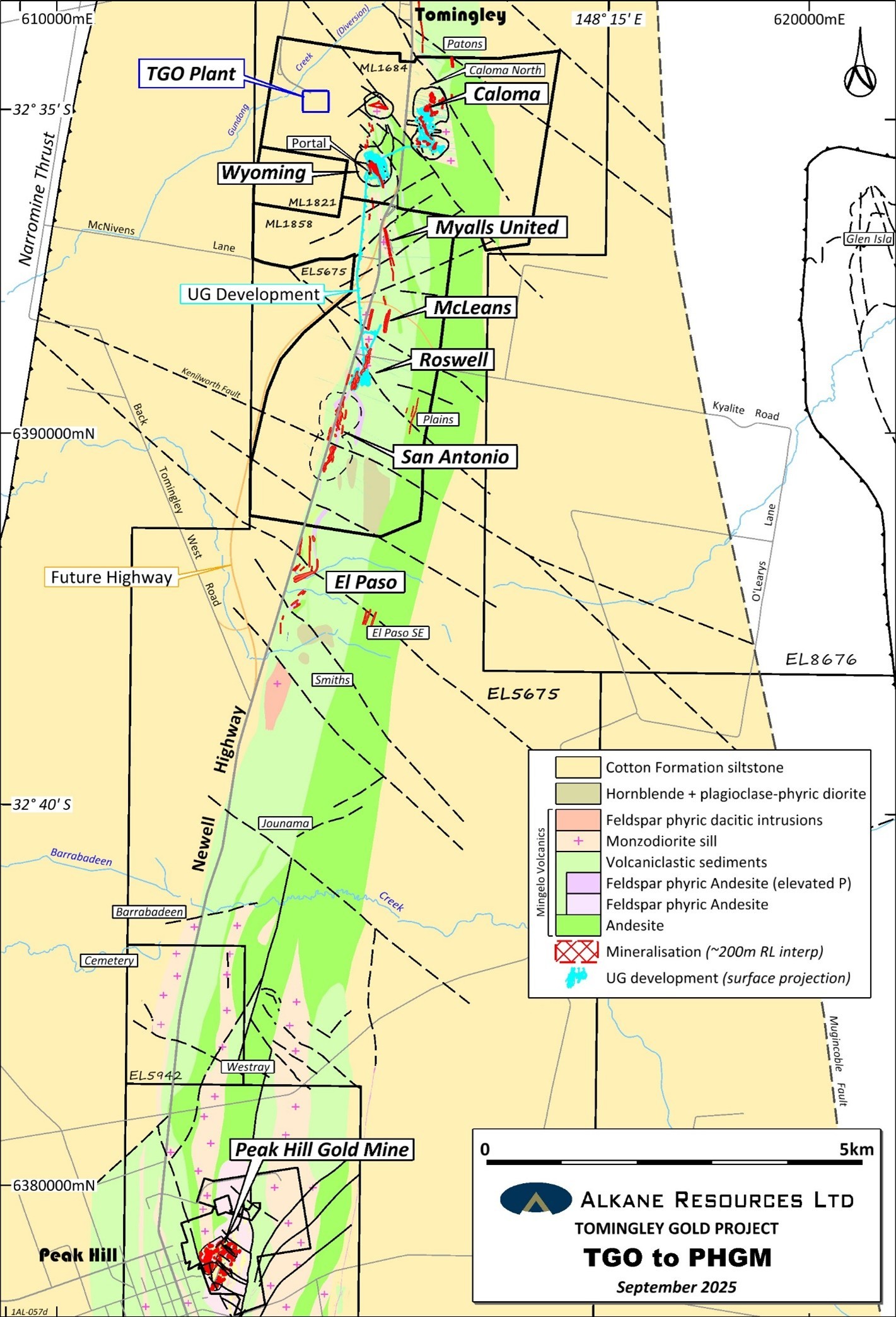
Tomingley is an open pit and underground mining development with a 1Mtpa processing facility in operation since 2014. The development is located near the village of Tomingley, approximately 50 kilometres southwest of Dubbo in Central West New South Wales. Tomingley Gold Operations Pty Ltd is a wholly owned subsidiary of Alkane.
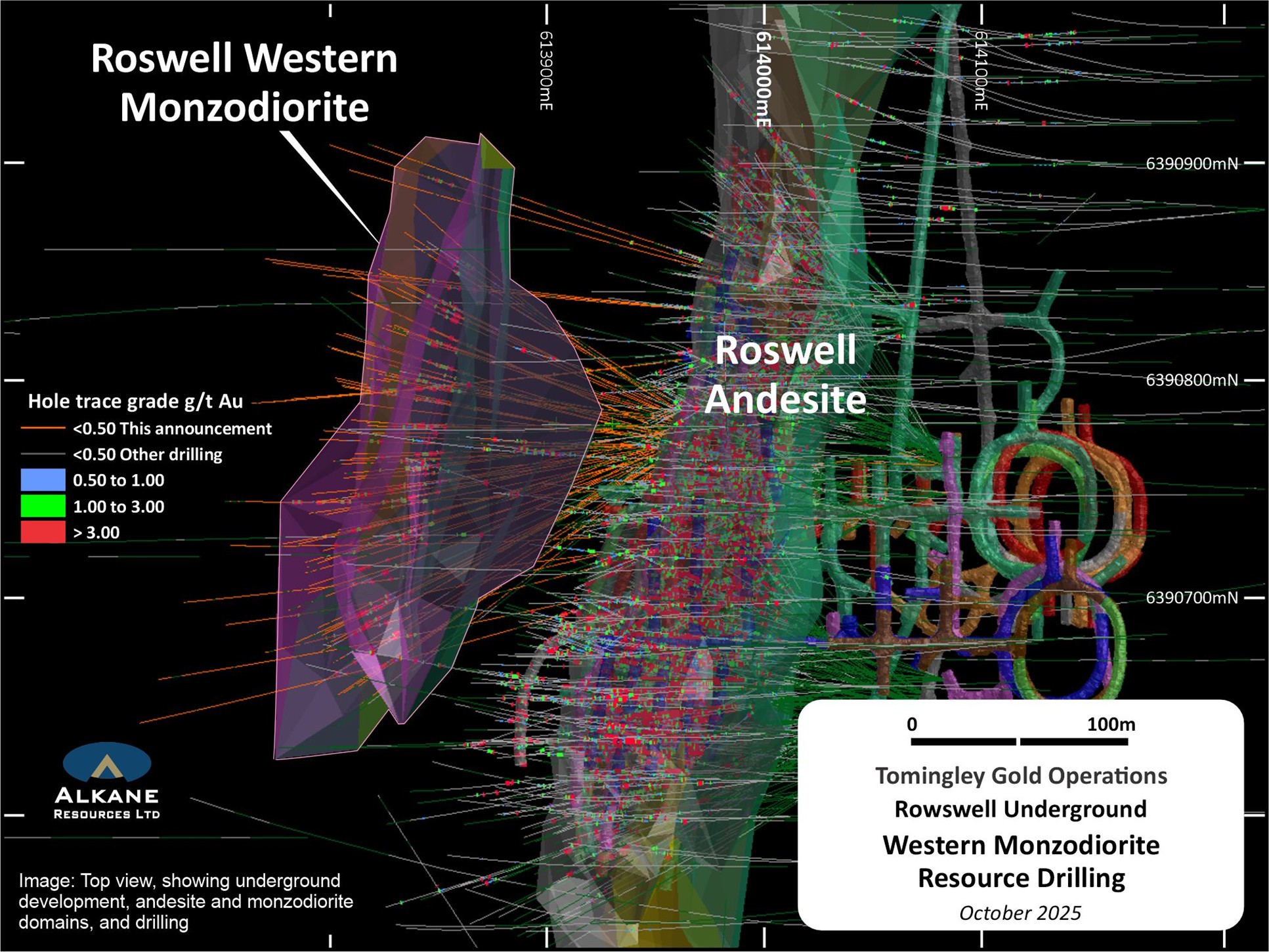
Development at Tomingley has been based on the Wyoming One, Wyoming Three, Caloma, Caloma Two and Roswell gold deposits. To date, mining occurred underground at Wyoming One, Caloma, Caloma Two and Roswell deposits. Roswell stope ore production came on stream in April 2024 (See ASX Announcement dated 22 April 2024 and titled ‘Production Ore Extraction Commences at Roswell’) via an approximately 3 km decline from the Wyoming One open cut.
The Tomingley deposits are located within a tightly folded Ordovician volcano-sedimentary sequence that has been altered to a sericite-carbonate-albite-quartz-pyrite-arsenopyrite assemblage that is typical of orogenic lode-style gold deposits. Mineralised fluids are interpreted to have been focused by differential strain in and around andesitic volcanics due to the rheological competency contrast between the volcanics and the bounding volcaniclastic sediments. The brittle nature of the volcanics often leads to the development of shear-hosted sheeted quartz vein and breccia deposits within and adjacent to the andesitic bodies. Separately, thin carbonaceous mudstone strata appear to have been a focus for shearing and a chemical trap for gold.
Since underground mining commenced in 2018, extensive underground drilling has been employed to define ore reserves for extraction and maintain exploration to define additional resources. The most recent Reserves and Resources were summarised in the ASX Announcement dated 15 October 2025 and titled ‘NSW Resources and Reserves Statements FY25’.
The exploration focus at Tomingley is to define additional underground resources that lie outside the existing Resources and Reserves for the operation.
McLeans
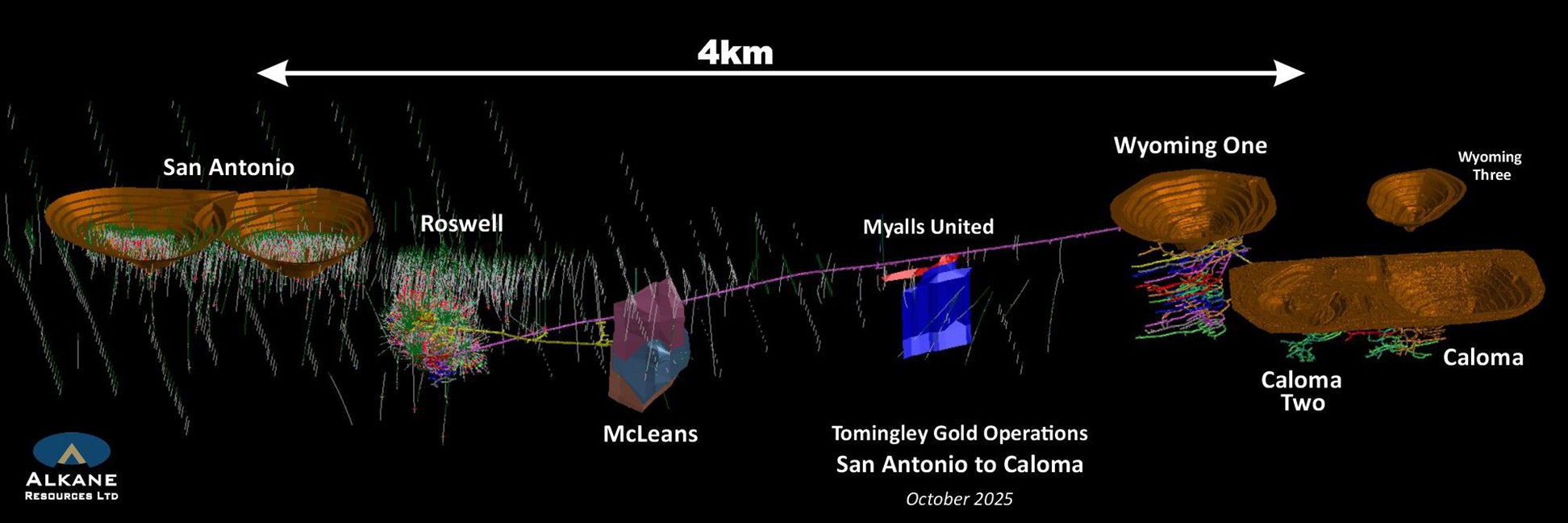
The Inferred Resource at McLeans was estimated at 0.87 million tonnes grading 2.51g/t gold for 70,000oz (See ASX Announcement dated 2 May 2022 and titled ‘Roswell Mineral Resource up 37%’). The deposit is primarily hosted by one ‘brittle’ andesite with similar texture and geochemistry as the andesite that is host to most of the mineralisation at the Roswell deposit. The host andesite begins approximately 130m below the surface, is approximately 250m in strike length and remains open at depth. The andesite averages a thickness of 60m but thins to 25m along its upper and northern margins forming a ‘keel’. The mineralisation was interpreted to form three subvertical en échelon sheeted lodes. With high-grade ore shoots focused along the ‘keel’ that remains open at depth along the northern edge of the andesite.
In September, an underground drilling program comprising of 9 holes for a total of 3,247 metres was completed to improve the confidence at the McLeans Inferred Resource by infilling the drilling pattern to 40m x 60m. This drilling has discovered a second ‘western’ andesite with significant gold mineralisation that is located 150 metres west of the current McLeans resource estimation. Significant intercepts hosted by the Western Andesite include:
The nominal drilling pattern was reduced from 80m x 80m that the Inferred Resource was based on to 40m x 60m to help improve the confidence in the estimation at McLeans. Significant intercepts into the Eastern Andesite and the Inferred Resource include:
Further drilling is planned to test both the Eastern and Western Andesite hosts at McLeans and to include the discovered Western Andesite into the McLeans Resource Estimation.
Roswell
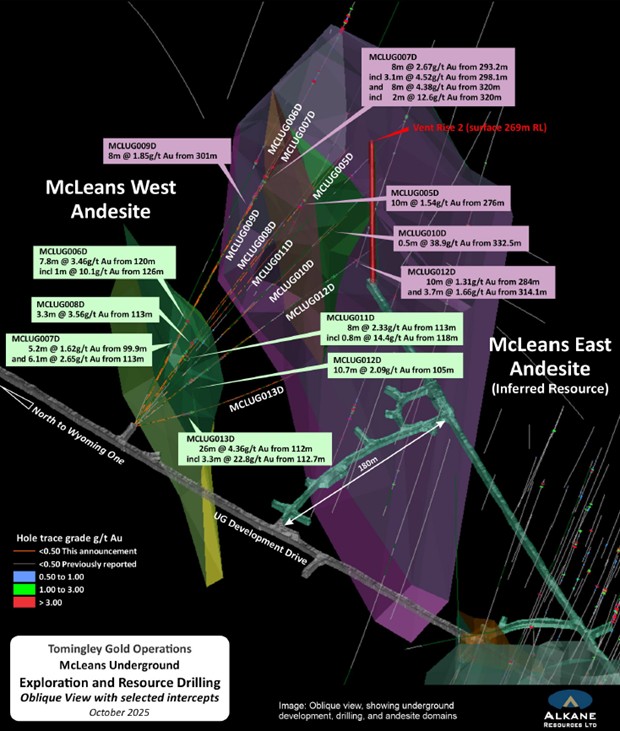
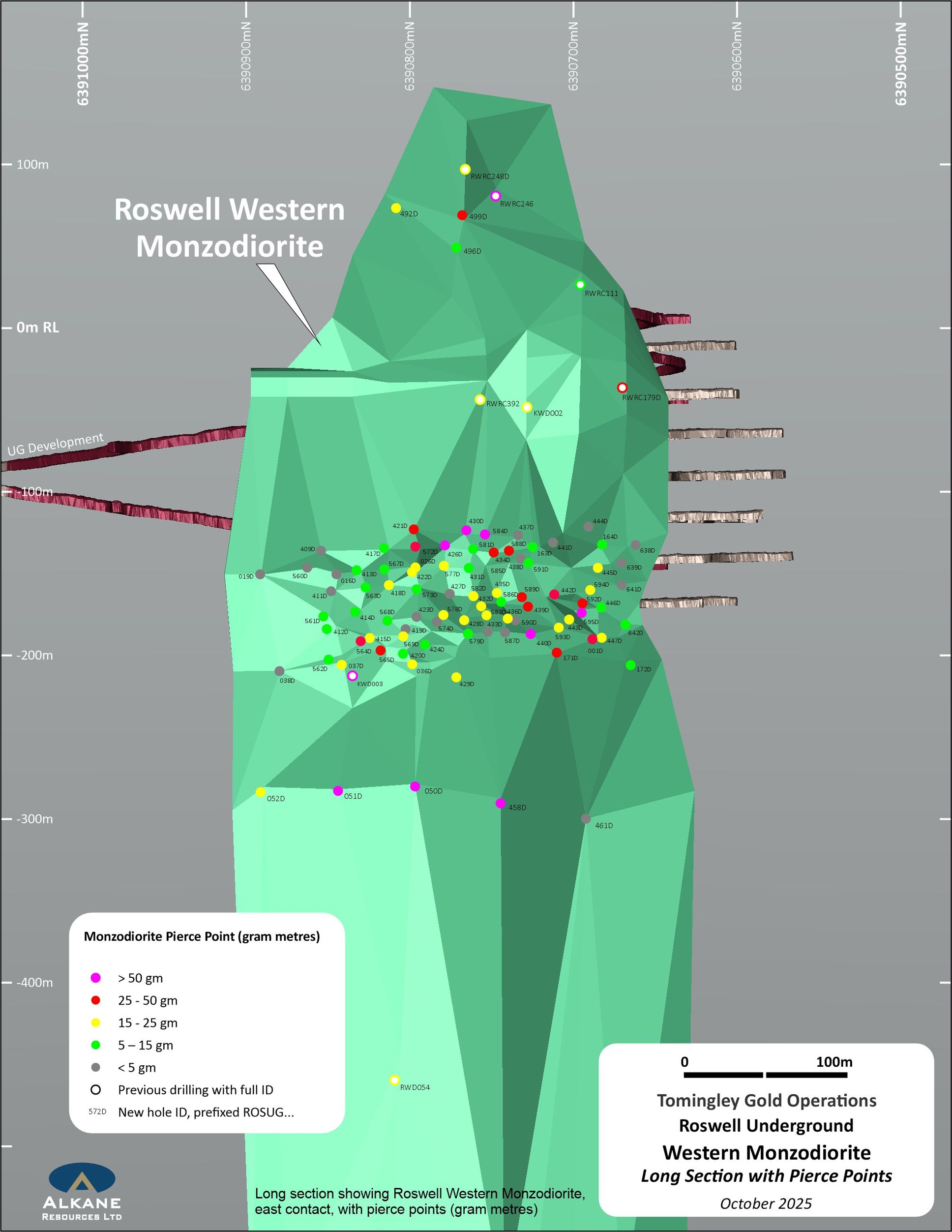
A significant portion of the Roswell underground Inferred Resources (408 kt grading 1.9 g/t Au – see ASX Announcement dated 15 October 2025 and titled ‘NSW Resources and Reserves Statement FY25’) is hosted in the Western Monzodiorite domain. An intensive underground diamond core drilling program targeting the Western Monzodiorite resource and its open extensions is in progress at Roswell. The drilling will improve the confidence of the Mineral Resource Estimation (MRE) and provide a basis for conversion to Ore Reserves.
Results have been received from 89 holes totalling 18,064 metres that are focused within the mid-portion of the monzodiorite domain infilling existing drilling to a nominal 15m x 20m grid spacing for the purpose of converting to an Indicated Resource. The drilling confirmed multiple wide, high-grade gold intercepts within the 30 m thick monzodiorite. The results received are a large part of the current drill program within the Western Monzodiorite and include best intercepts of:
Final results will be published when received and compiled.
Surface exploration drilling on the at Tomingley mine site will commence in November 2025. The diamond core drilling is planned to test the underground potential at Wyoming Three, extensions to mineralisation north of Caloma and to test a deep structural target (thrust splay identified by 2D seismic) beneath Roswell. Underground exploration drilling continues at Roswell.
Tomingley Mineral Resources
Apparent arithmetic inconsistencies are due to rounding
These Mineral Resources are wholly inclusive of Ore Reserves.
Tomingley Ore Reserves
Apparent arithmetic inconsistencies are due to rounding
The above tables were published in ASX Announcement dated 15 October 2025 and titled ‘NSW Resources and Reserves Statement FY25’.
True widths are approximately 80% of intercept width. Reported intercepts (>1.3g/t Au) are calculated using a broad lower cut of 1.0g/t Au although grades lower than this may be present internally (internal dilution).
True widths are approximately 80% of intercept width. Reported intercepts (>1.3g/t Au) are calculated using a broad lower cut of 1.0g/t Au although grades lower than this may be present internally (internal dilution).
This document has been authorised for release to the market by Nic Earner, Managing Director.
ABOUT ALKANE ‐ alkres.com ‐ ASX:ALK | TSX: ALK | OTCQX: ALKEF
Alkane Resources (ASX:ALK; TSX:ALK; OTCQX:ALKEF) is an Australia-based gold and antimony producer with a portfolio of three operating mines across Australia and Sweden. The Company has a strong balance sheet and is positioned for further growth.
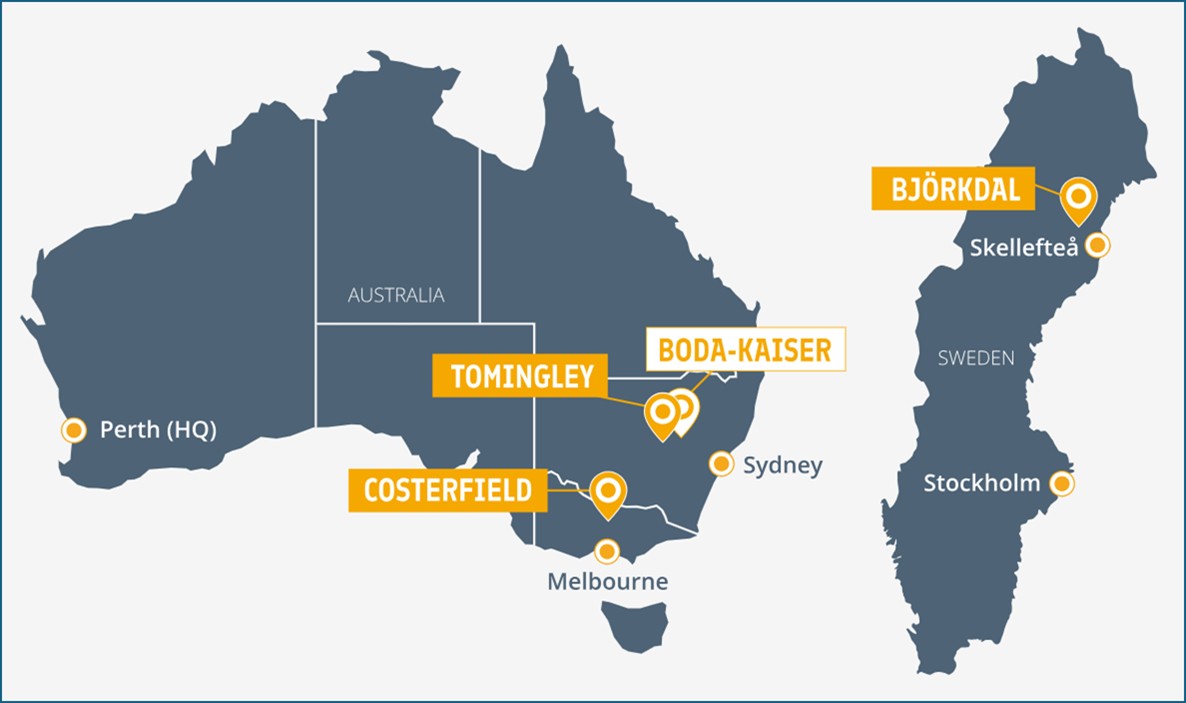
Alkane’s wholly owned producing assets are the Tomingley open pit and underground gold mine southwest of Dubbo in Central West New South Wales, the Costerfield gold and antimony underground mining operation northeast of Heathcote in Central Victoria, and the Björkdal underground gold mine northwest of Skellefteå in Sweden (approximately 750km north of Stockholm). Ongoing near-mine regional exploration continues to grow resources at all three operations.
Alkane also owns the very large gold-copper porphyry Boda-Kaiser Project in Central West New South Wales and has outlined an economic development pathway in a Scoping Study. The Company has ongoing exploration within the surrounding Northern Molong Porphyry Project and is confident of further enhancing eastern Australia’s reputation as a significant gold, copper and antimony production region.
Competent Person Statement
As an Australian Company with securities listed on the Australian Securities Exchange (ASX), Alkane is subject to Australian disclosure requirements and standards, including the requirements of the Corporations Act 2001 and the ASX. Investors should note that it is a requirement of the ASX Listing Rules that the reporting of ore reserves and mineral resources in Australia is in accordance with the 2012 Edition of the Australasian Code for Reporting of Exploration Results, Mineral Resources and Ore Reserves (the JORC Code) and that Alkane's ore reserve and mineral resource estimates and reporting comply with the JORC Code.
Alkane is also subject to certain Canadian disclosure requirements and standards as a result of its secondary listing on the Toronto Stock Exchange (TSX), including the requirements of National Instrument 43-101 – Standards of Disclosure for Mineral Projects (NI 43-101). Investors should note that it is a requirement of Canadian securities law that the reporting of mineral reserves and mineral resources in Canada and the disclosure of scientific and technical information concerning a mineral project on a property material to Alkane comply with NI 43-101.
Unless otherwise advised above, or in the relevant ASX announcements referenced, the information in this announcement that relates to exploration results, mineral resources and ore reserves is based on information compiled by Mr D I Chalmers, FAusIMM, FAIG (Alkane Technical Advisor) who has sufficient experience that is relevant to the style of mineralisation and type of deposit under consideration and to the activity which he is undertaking to qualify as a Competent Person as defined in JORC Code and as a Qualified Person under NI 43-101. Mr Chalmers consents to the inclusion in this announcement of the matters based on his information in the form and context in which it appears.
The information in this announcement that relates to previously reported exploration results, mineral resources and ore reserves is extracted from the Company’s ASX announcements noted in the text of the announcement and available to view on the Company’s website. The Company confirms that it is not aware of any new information or data that materially affects the information included in the original announcements and that the form and context in which the Competent Person’s findings are presented have not been materially altered.
Technical Reports released to the TSX or for TSX Market
Alkane has prepared the following NI 43-101 compliant technical reports which support the information contained herein, each of which is available under Alkane’s profile on SEDAR+ at www.sedarplus.ca: •
- “Boda-Kaiser Copper-Gold Project, New South Wales, Australia” with an effective date of June 6, 2025; and
- “Tomingley and Peak Hill Gold Projects, NSW, Australia” with an effective date of June 6, 2025.
Reference should be made to the full text of the foregoing technical reports for the assumptions, qualifications and limitations relating to the Mineral Resource Estimates and Ore Reserves contained therein and herein. All material assumptions and technical parameters underpinning the estimates in the technical reports continue to apply and have not materially changed.
Cautionary Note Regarding Forward-Looking Information and Statements
This announcement contains certain forward-looking information and forward-looking statements within the meaning of applicable securities legislation and may include future-oriented financial information or financial outlook information (collectively Forward-Looking Information). Actual results and outcomes may vary materially from the amounts set out in any Forward-Looking Information. As well, Forward-Looking Information may relate to: future outlook and anticipated events; expectations regarding exploration potential; production capabilities and future financial or operating performance, including AISC, investment returns, margins and share price performance; production and cost guidance and the timing thereof; issuing updated resources and reserves estimate and the timing thereof; the potential of Alkane to meet industry targets, public profile and expectations; and future plans, projections, objectives, estimates and forecasts and the timing related thereto.
Forward-Looking Information is generally identified by the use of words like "will", "create", "enhance", "improve", "potential", "expect", "upside", "growth" and similar expressions and phrases or statements that certain actions, events or results "may", "could", or "should", or the negative connotation of such terms, are intended to identify Forward-Looking Information.
Although Alkane believes that the expectations reflected in the Forward-Looking Information are reasonable, undue reliance should not be placed on Forward-Looking Information since no assurance can be provided that such expectations will prove to be correct. Forward-Looking Information is based on information available at the time those statements are made and/or good faith belief of the officers and directors of Alkane as of that time with respect to future events and are subject to risks and uncertainties that could cause actual results to differ materially from those expressed in or suggested by the Forward-Looking Information. Forward-Looking Information involves numerous risks and uncertainties. Such factors include, without limitation: risks relating to changes in the gold and antimony price.
Forward-Looking Information is designed to help readers understand Alkane’s views as of that time with respect to future events and speak only as of the date they are made. Except as required by applicable law, Alkane assumes no obligation to update or to publicly announce the results of any change to any forward-looking statement contained or incorporated by reference herein to reflect actual results, future events or developments, changes in assumptions or changes in other factors affecting the Forward-looking Information. If Alkane updates any one or more forward-looking statements, no inference should be drawn that the company will make additional updates with respect to those or other Forward-looking Information. All Forward-Looking Information contained in this announcement is expressly qualified in its entirety by this cautionary statement.
Disclaimer
Alkane has prepared this announcement based on information available to it. No representation or warranty, express or implied, is made as to the fairness, accuracy, completeness or correctness of the information, opinions or conclusions contained in this announcement. To the maximum extent permitted by law, none of Alkane, its directors, officers, employees, associates, advisers and agents, nor any other person accepts any liability, including, without limitation, any liability arising from fault or negligence on the part of any of them or any other person, for any loss arising from the use of this announcement or its contents or otherwise arising in connection with it.
This announcement is not an offer, invitation, solicitation, or other recommendation with respect to the subscription for, purchase or sale of any security, and neither this announcement nor anything in it shall form the basis of any contract or commitment whatsoever.
APPENDIX 1
JORC Code, 2012 Edition – Table 1 report – Roswell and McLeans October 2025
Section 1 Sampling Techniques and Data
(Criteria in this section apply to all succeeding sections.)
- Nature and quality of sampling (eg cut channels, random chips, or specific specialised industry standard measurement tools appropriate to the minerals under investigation, such as down hole gamma sondes, or handheld XRF instruments, etc). These examples should not be taken as limiting the broad meaning of sampling.
- Include reference to measures taken to ensure sample representivity and the appropriate calibration of any measurement tools or systems used.
- Aspects of the determination of mineralisation that are Material to the Public Report. In cases where ‘industry standard’ work has been done this would be relatively simple (eg ‘reverse circulation drilling was used to obtain 1 m samples from which 3 kg was pulverised to produce a 30 g charge for fire assay’). In other cases more explanation may be required, such as where there is coarse gold that has inherent sampling problems. Unusual commodities or mineralisation types (eg submarine nodules) may warrant disclosure of detailed information.
- Drill type (eg core, reverse circulation, open-hole hammer, rotary air blast, auger, Bangka, sonic, etc) and details (eg core diameter, triple or standard tube, depth of diamond tails, face-sampling bit or other type, whether core is oriented and if so, by what method, etc).
- Method of recording and assessing core and chip sample recoveries and results assessed.
- Measures taken to maximise sample recovery and ensure representative nature of the samples.
- Whether a relationship exists between sample recovery and grade and whether sample bias may have occurred due to preferential loss/gain of fine/coarse material.
- Whether core and chip samples have been geologically and geotechnically logged to a level of detail to support appropriate Mineral Resource estimation, mining studies and metallurgical studies.
- Whether logging is qualitative or quantitative in nature. Core (or costean, channel, etc) photography.
- The total length and percentage of the relevant intersections logged.
- If core, whether cut or sawn and whether quarter, half or all core taken.
- If non-core, whether riffled, tube sampled, rotary split, etc and whether sampled wet or dry.
- For all sample types, the nature, quality and appropriateness of the sample preparation technique.
- Quality control procedures adopted for all sub-sampling stages to maximise representivity of samples.
- Measures taken to ensure that the sampling is representative of the in situ material collected, including for instance results for field duplicate/second-half sampling.
- Whether sample sizes are appropriate to the grain size of the material being sampled.
- The nature, quality and appropriateness of the assaying and laboratory procedures used and whether the technique is considered partial or total.
- For geophysical tools, spectrometers, handheld XRF instruments, etc, the parameters used in determining the analysis including instrument make and model, reading times, calibrations factors applied and their derivation, etc.
- Nature of quality control procedures adopted (eg standards, blanks, duplicates, external laboratory checks) and whether acceptable levels of accuracy (ie lack of bias) and precision have been established.
- The verification of significant intersections by either independent or alternative company personnel.
- The use of twinned holes.
- Documentation of primary data, data entry procedures, data verification, data storage (physical and electronic) protocols.
- Discuss any adjustment to assay data.
- Accuracy and quality of surveys used to locate drill holes (collar and down-hole surveys), trenches, mine workings and other locations used in Mineral Resource estimation.
- Specification of the grid system used.
- Quality and adequacy of topographic control.
- Data spacing for reporting of Exploration Results.
- Whether the data spacing and distribution is sufficient to establish the degree of geological and grade continuity appropriate for the Mineral Resource and Ore Reserve estimation procedure(s) and classifications applied.
- Whether sample compositing has been applied.
- Whether the orientation of sampling achieves unbiased sampling of possible structures and the extent to which this is known, considering the deposit type.
- If the relationship between the drilling orientation and the orientation of key mineralised structures is considered to have introduced a sampling bias, this should be assessed and reported if material.
- The measures taken to ensure sample security.
- The results of any audits or reviews of sampling techniques and data.
Section 2 Reporting of Exploration Results
(Criteria listed in the preceding section also apply to this section.)
- Type, reference name/number, location and ownership including agreements or material issues with third parties such as joint ventures, partnerships, overriding royalties, native title interests, historical sites, wilderness or national park and environmental settings.
- The security of the tenure held at the time of reporting along with any known impediments to obtaining a licence to operate in the area.
- Acknowledgment and appraisal of exploration by other parties.
- Deposit type, geological setting and style of mineralisation.
- A summary of all information material to the understanding of the exploration results including a tabulation of the following information for all Material drill holes:
- easting and northing of the drill hole collar
- elevation or RL (Reduced Level – elevation above sea level in metres) of the drill hole collar
- dip and azimuth of the hole
- down hole length and interception depth
- hole length.
- If the exclusion of this information is justified on the basis that the information is not Material and this exclusion does not detract from the understanding of the report, the Competent Person should clearly explain why this is the case.
- In reporting Exploration Results, weighting averaging techniques, maximum and/or minimum grade truncations (eg cutting of high grades) and cut-off grades are usually Material and should be stated.
- For uncut gold grades;
- Intercepts were defined (bounded) by 1.0g/t gold outer limit and may contain some internal waste (<1.0g/t);
- Only intervals grading ≥1.3 g/t gold are reported;
- Grades were calculated by length weighted average.
- Where aggregate intercepts incorporate short lengths of high grade results and longer lengths of low grade results, the procedure used for such aggregation should be stated and some typical examples of such aggregations should be shown in detail.
- The assumptions used for any reporting of metal equivalent values should be clearly stated.
- These relationships are particularly important in the reporting of Exploration Results.
- If the geometry of the mineralisation with respect to the drill hole angle is known, its nature should be reported.
- If it is not known and only the down hole lengths are reported, there should be a clear statement to this effect (eg ‘down hole length, true width not known’).
- Appropriate maps and sections (with scales) and tabulations of intercepts should be included for any significant discovery being reported These should include, but not be limited to a plan view of drill hole collar locations and appropriate sectional views.
- Where comprehensive reporting of all Exploration Results is not practicable, representative reporting of both low and high grades and/or widths should be practiced to avoid misleading reporting of Exploration Results.
- Other exploration data, if meaningful and material, should be reported including (but not limited to): geological observations; geophysical survey results; geochemical survey results; bulk samples – size and method of treatment; metallurgical test results; bulk density, groundwater, geotechnical and rock characteristics; potential deleterious or contaminating substances.
- The nature and scale of planned further work (eg tests for lateral extensions or depth extensions or large-scale step-out drilling).
- Diagrams clearly highlighting the areas of possible extensions, including the main geological interpretations and future drilling areas, provided this information is not commercially sensitive.
CONTACT: NIC EARNER, MANAGING DIRECTOR & CEO, ALKANE RESOURCES LTD, TEL +61 8 9227 5677
INVESTORS & MEDIA: NATALIE CHAPMAN, CORPORATE COMMUNICATIONS MANAGER, TEL +61 418 642 556









 Aufrufe: 376
 Audio
 Teilen