Aufrufe: 6
The release extends digna's data analytics functionality with a new interactive charting capability that enables users to analyze time-series data directly within the platform. The feature includes built-in analytical methods such as linear, quadratic, and cubic regression, as well as piecewise regression with configurable breakpoints.
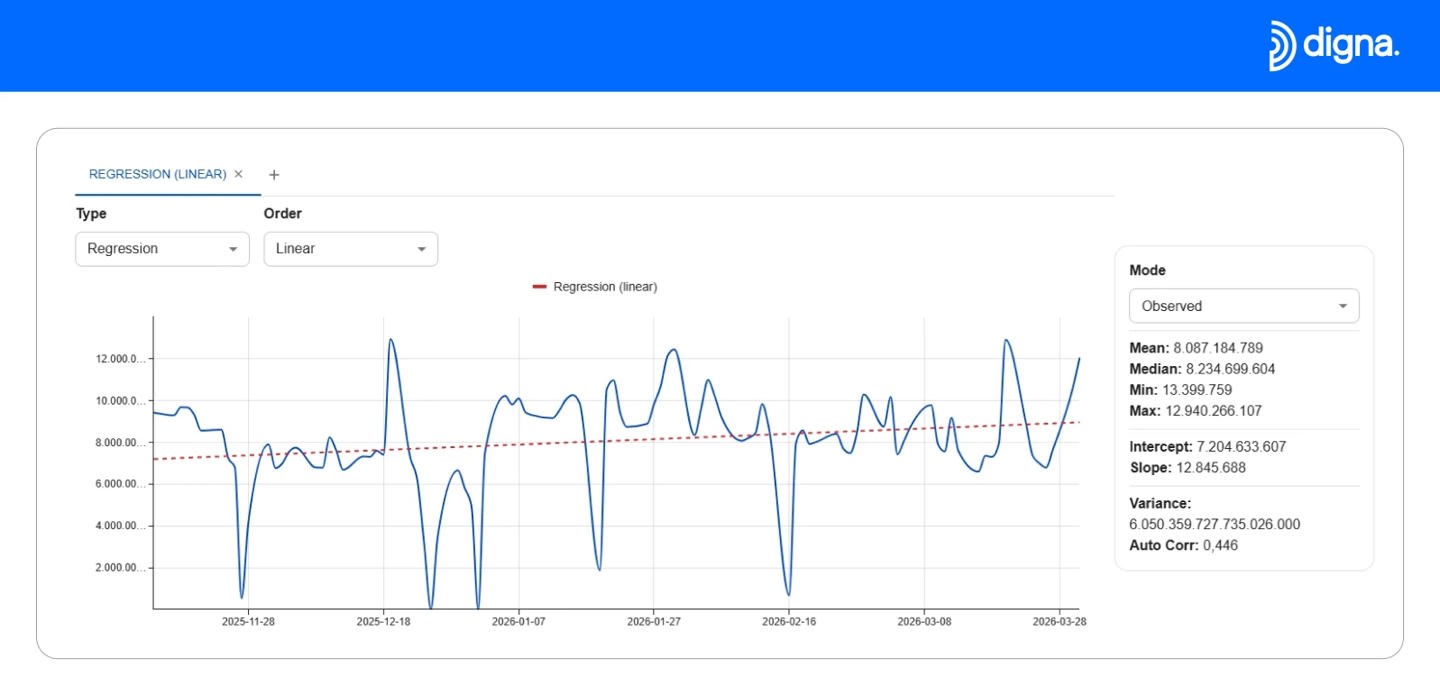
Example of time-series analysis using linear regression to identify trends and deviations in data behavior.
To view an enhanced version of this graphic, please visit:
https://images.newsfilecorp.com/files/8552/292682_091566df54125964_001full.jpg
Additional capabilities include smoothing techniques, quantile analysis, and residual analysis, allowing users to explore trends, seasonality, and deviations without requiring external tools or specialized data science expertise.
According to the company, time-series data is now automatically generated for datasets, allowing users to observe how data evolves over time and identify changes in behavior.
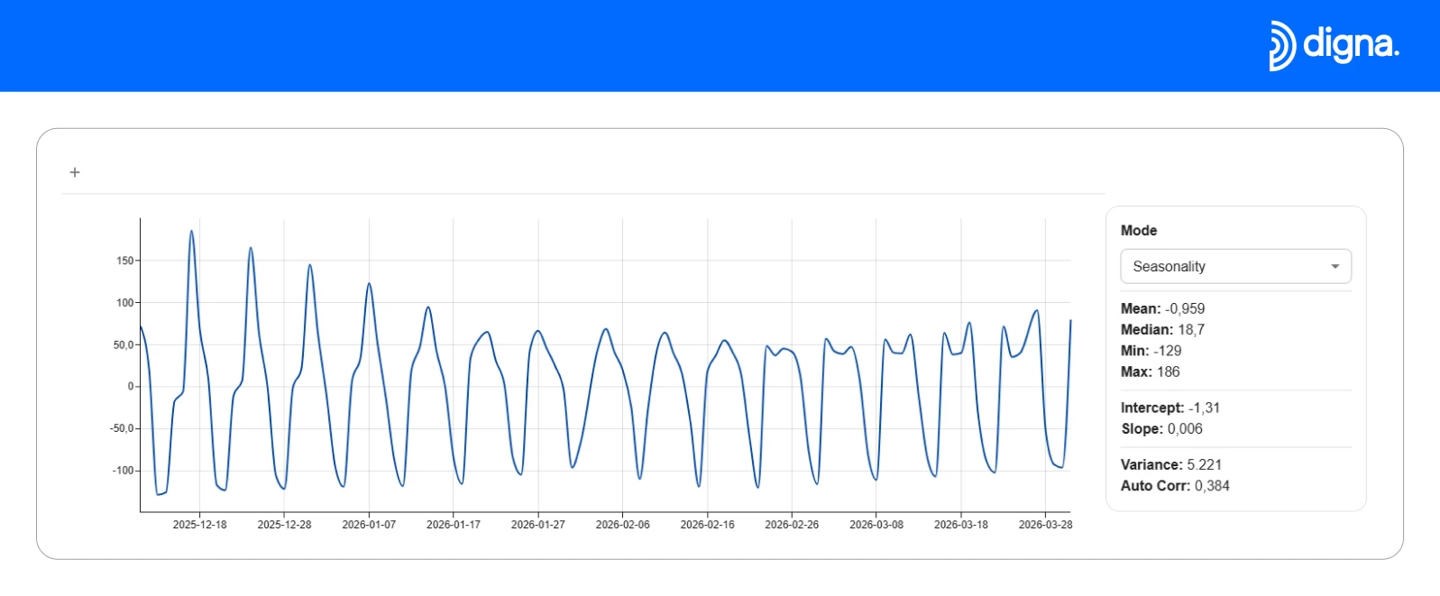
Detection of seasonal patterns in time-series data, enabling users to identify recurring behaviors without advanced statistical tools.
To view an enhanced version of this graphic, please visit:
https://images.newsfilecorp.com/files/8552/292682_091566df54125964_002full.jpg
The update is intended to make advanced analytical methods more accessible to business and data teams working with complex data environments.
In addition to analytics enhancements, the release introduces new features aimed at improving data validation consistency across enterprise systems. The platform now supports reusable enumerations, allowing organizations to define centralized sets of allowed values such as country codes or status classifications. These enumerations can be applied across projects and data sources, helping ensure consistent value validation throughout the organization.
The release also introduces validation rule templates, enabling teams to define reusable validation logic and apply it across multiple datasets. This reduces duplication and simplifies the management of data quality rules, particularly in environments where validation requirements must be applied consistently across systems.
Both enumeration checks and validation templates are executed directly within the source database, according to the company, eliminating the need for data movement during validation processes.
The update further extends the platform's monitoring capabilities with statistic-level relevance conditions. This feature allows users to define when specific statistics should be considered relevant, helping reduce noise by excluding non-critical deviations and focusing attention on meaningful changes in data behavior.
digna stated that the combined enhancements support a broader shift toward enabling organizations to not only detect data issues, but also better understand underlying data patterns and standardize validation processes across complex data environments.
The company indicated that the release is designed improve usability, scalability, and consistency across data monitoring and validation workflows.
About digna
digna develops enterprise software focused on data quality monitoring, observability, and governance automation. Its platform applies AI-driven anomaly detection and validation techniques to monitor large-scale data environments while enabling organizations to standardize and control data quality processes.
Media Contact
Mayowa Ajakaiye
digna GmbH
mayowa.ajakaiye@digna.ai
https://www.digna.ai
To view the source version of this press release, please visit https://www.newsfilecorp.com/release/292682
Hinweis: ARIVA.DE veröffentlicht in dieser Rubrik Analysen, Kolumnen und Nachrichten aus verschiedenen Quellen. Die ARIVA.DE AG ist nicht verantwortlich für Inhalte, die erkennbar von Dritten in den „News“-Bereich dieser Webseite eingestellt worden sind, und macht sich diese nicht zu Eigen. Diese Inhalte sind insbesondere durch eine entsprechende „von“-Kennzeichnung unterhalb der Artikelüberschrift und/oder durch den Link „Um den vollständigen Artikel zu lesen, klicken Sie bitte hier.“ erkennbar; verantwortlich für diese Inhalte ist allein der genannte Dritte.