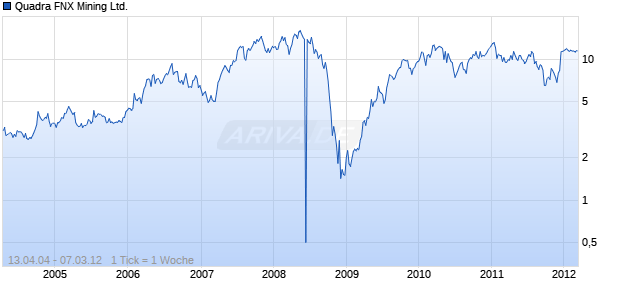
Die Quadra FNX Mining Ltd. Kurs Performance für 2026 liegt bei -.
Stammdaten
Aktientyp
Stammaktie
Community-Beiträge zu Quadra FNX Mining Ltd.
Community-Beiträge
Aktuellste Threads
videomart
Standard Bank (Johannesburg) Press Release
Africa:
Standard Bank - Ongoing economic recovery underpins strong demand for copper
9 February 2011
Cape Town — The copper mining industry will not meet global demand for 2011 or next year because demand is growing faster than supply. The copper market is facing a widening deficit until new supply comes on stream in late 2013.
Walter de Wet, Standard Bank’s Head of Commodity Research says: "After last year’s deficit, we project the deficit to grow to 385,000 metric tonnes for 2011 and 562,000 for 2012, so clearly demand is growing faster than supply and will remain strong until 2013. This may result in global reported stocks drawing down to less than one week of consumption by end-2012. Even at that stage we don’t see demand falling, but rather a case of supply starting to catch up with demand as high prices stimulate new projects.”
China and other emerging markets especially in Asia are driving the increasing copper demand where pricing is projected to average US$9,200 per metric tonne in 2011 and US$10,000 per metric tonne in 2012. Asia currently accounts for 55% of total global demand.
Of all the base metals, copper has the most bullish outlook with tin a close second. Standard Bank has largely been accurate in correctly forecasting base metals. For instance, its forecast for copper of $7,375/ton average price throughout 2010 was just 2,2% short of the eventual actual figure of $7,543.
“If we look at the break-even copper price for the most marginal of mines, they’re all making good profits at the current level,” says De Wet.
“Fundamentals and strong investor interest are likely to keep prices on an upward path overall, though we expect there to be steep corrections and pauses for consolidation along the way. Volatility is likely to remain high.”
This will present interesting buying opportunities, he says.
The rising copper price is expected to parallel the growing commodity deficit, likely to reach a peak in 2011 during the second quarter with China in particular re-stocking, but with the most severely tight market occurring during 2012.
Supply remains constrained. New copper projects are at various stages of development, but considering they take 3-4 years to come on stream, they will not alleviate the deficit or affect the copper price during the next two years. These projects are in the major copper producing countries like Chile, Zambia, the Democratic Republic of Congo, Peru and China.
On the demand side, there is no let-up in the growing demand. “We’re continuing to see good growth in copper consumption from Asia, particularly China, and don’t expect to see any slowdown in this throughout 2011, and thereafter only a slight slowdown in 2012,” explains De Wet. In addition, current low demand from the US and Europe is expected to begin picking up later this year.
“These twin themes of strong infrastructure development in emerging markets, and a resumption in manufacturing growth in developed markets are strongly supportive of copper consumption and a rising copper price,” he adds.
Although austerity rather than stimulus will be the main theme in Europe this year, modest growth will nonetheless be driven by Germany. In addition, the US economy is carrying good momentum into 2011.
The big swing factor will be China, which is believed to be fairly destocked of copper. “The government’s infrastructure spend could be front-loaded within its current five-year plan, which means that we can still expect to see restocking in the first half of 2011,” explains De Wet.
http://allafrica.com/stories/201102090746.html
videomart
"Commodity market concentration starts to worry...
...even Wall Street Journal"
"Trader Holds $3 Billion of Copper in London"
By Tatyana Shumsky and Carolyn Cui
The Wall Street Journal
Wednesday, December 22, 2010
http://online.wsj.com/article/...405274870411850457603408343693141...
As commodity prices soar to new records, the ability of a few traders to hold huge swaths of the world's stockpiles is coming under scrutiny.
The latest example is in the copper market, where a single trader has reported it owns 80% to 90% of the copper sitting in London Metal Exchange warehouses, equal to about half of the world's exchange-registered copper stockpile and worth about $3 billion.
The report coincided with copper prices soaring to new records on Tuesday. Commodities prices rallied along with stocks. The Dow Jones Industrial Average gained 55.03 points, or 0.48%, to 11533.16, its highest level since August 2008. Crude oil jumped to its highest level in more than two years and topped $90 a barrel in late electronic trading in New York. Corn and soybeans rose amid worries about hot weather in Argentina.
Copper soared to a new record of $4.2705 per pound on Tuesday in New York, and is up 28.3% this year. The LME's three-month copper contract closed at $9,353.50 a metric ton, up 1.6% on the day, a new record.
JP. Morgan Chase & Co. recently had a large position in copper, though it is unclear whether the U.S. bank increased its holdings, or whether a new player has taken dominant position.
"Regardless of who owns it, the only thing of note here is that we are being told that one person has a substantial position," said David Threlkeld, president of Resolved Inc., a metals consultancy.
Single traders also own large holdings of other metals. One trader holds as much as 90% of the exchange's aluminum stocks. In the nickel, zinc and aluminum alloy markets, single traders own between 50% to 80% of those metals and one firm has 40% to 50% of the LME's tin stockpiles.
While commodities exchanges scrutinize all holdings to ensure a single player isn't trying to corner the market, and many of the positions are owned by big firms on behalf of clients, the large holdings do result in a concentration of ownership that could skew prices.
At the same time, thousands of new investors are flooding into the commodities markets, either directly or through exchange-traded funds, seeking to take advantage of an expected rise in prices of raw materials as the global economy continues to recover.
While commodities regulators in the U.S. are considering restricting the amount of futures contracts any one trader can hold, they have no jurisdiction over physical holdings.
The LME has strict rules to prevent market squeezes but does not limit how much metal a single trader may hold. Instead, the exchange demands the dominant holder make metal available for short-term periods at very limited profit margins. The LME says it closely watches individual holdings.
Copper demand is likely to outstrip supply this year by an estimated 455,000 metric tons, says Barclays Capital. Copper inventories at the LME have been declining since February.
Consumption is growing rapidly in China, Brazil, and the U.S. And the creation of ETFs to hold physical metal is helping drive demand. On Tuesday, ETF Securities, a London-based provider, said that its newly-announced copper-backed ETF has added about 850.5 tons of copper, up 43%, to reach 1,445.5 tons.
Last month, the LME reported that a single holder owned more than 50% of the exchange's copper. People familiar with the matter at the time said J.P. Morgan was the holder. On Tuesday, the LME reported that a single holder now has as much as 90% of the stockpiles, without naming the firm. The LME reports data two days in arrears, so the position increased on Friday.
In the aluminum market, about 70% of the LME metal is locked up, MF Global base metals analyst Edward Meir said during LME Week in London in October.
LME aluminum stocks currently total around 4.3 million metric tons.
As one example, Swiss commodity trading firm Glencore International AG bought about 1.6 million tons of the metal from United Co. Rusal Ltd. earlier this year, market participants said at the time. Glencore then turned around and presold the metal. So even though the aluminum is sitting in LME warehouses, visible to all traders, it is effectively locked up.
These sorts of deals have skewed physical trading in these metals, as other consumers have paid increasing premiums to get hold of stocks, even though the metal looked like it was available in warehouses.
Holding ready-for-delivery metals on an exchange isn't a cheap undertaking for traders, who are responsible for paying insurance, storage and financing costs. And "the end game is to find somebody to buy something you have already bought for a higher price," Mr. Threkeld said.
The recent boom in metal prices has enabled traders to purchase the physical metal, sell a futures contract at a much higher price and still make a profit after paying for storage and insurance.
http://www.gata.org/node/9445
videomart
"China and Copper"
By: Richard Mills | Tue, Aug 31, 2010
http://www.safehaven.com/article/18021/china-and-copper
videomart
Artikel aus dem "Calgary Herald"
Copper offers crude warning
Risky to cut back capital spending
By Deborah Yedlin, Calgary Herald, August 28, 2010
http://www.calgaryherald.com/story_print.html?id=3454841&sponsor=