Mercury Insurance's analysis of five years of claims data found crash volume peaks at 3pm, but serious injuries rise later as traffic speeds increase
LOS ANGELES, May 19, 2026 /PRNewswire/ -- For the first time in its more than 60-year history, Mercury Insurance (NYSE/NYSE TX: MCY) analyzed proprietary claims data to identify the most dangerous moments on America's roads – and the results challenge a common assumption about rush hour driving.
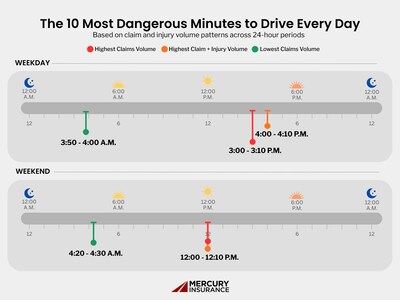
While crash volume peaks between 3:00 and 3:10pm, the risk of injury rises even higher about an hour later, between 4:00 and 4:10pm., when traffic begins moving faster and collisions become more severe. Over a five-year period, more than 61,000 people were involved in crashes during the busiest 10-minute weekday window alone.
"Rush hour doesn't play out the same way from start to finish, and that shows up clearly in the claims data," said Heather Paull, Manager, Divisional Claims at Mercury Insurance. "Earlier in the afternoon, there's more congestion with school pick-ups and people getting on the road, so you see more low-speed, stop-and-go incidents. As the drive goes on, traffic starts to move more freely, and drivers tend to pick up speed or get a little less attentive. That's when the crashes we see tend to be more serious."
The commute changes – and so does the risk.
The data points to a consistent weekday pattern driven by school schedules and work commutes:
Weekends shift the risk earlier
On weekends, both crash volume and injury risk shift earlier, peaking around 12:00 to 12:10 p.m. as midday errands and leisure travel replace structured commutes.
During this window, approximately 19,000 people were involved in crashes, with about 9 percent sustaining injuries. While slightly lower than weekday peaks, the concentration of activity still creates a clear midday risk spike.
More crashes doesn't always mean more danger
For drivers and passengers, injury rates remain relatively consistent throughout the day, generally ranging from 9 to 12 percent. Time of day primarily affects exposure, not the likelihood of injury in a single crash.
Pedestrians face a different level of risk:
A consistent pattern across regions
Across major urban and commuter-heavy areas, the same pattern emerges. Crash volume peaks around 3:00 p.m., followed by higher injury severity in the 4:00 to 5:00 p.m. window.
Some regions see heavier crash volume around noon but still experience more severe injuries later in the afternoon, likely driven by higher speeds and fatigue.
The pattern repeats almost every day
Crash risk is not random. It follows a consistent daily rhythm:
"Drivers often assume the risk stays the same throughout the commute, but the data shows the road environment changes hour by hour," added Paull. Around 3 to 4 p.m., it comes down to patience, keeping space, and avoiding distractions. Later in the commute, keeping your speed in check and staying alert becomes more important as traffic starts moving faster. Knowing that shift is coming can help drivers stay more intentional behind the wheel and make better decisions in the moment."
Mercury Insurance encourages drivers to treat the afternoon commute as a changing risk environment by reducing distractions, maintaining safe following distances, and adjusting driving behavior as traffic patterns evolve throughout the day.
For more information about driver safety, visit the Mercury Insurance Blog.
About Mercury Insurance
Mercury Insurance (NYSE: MCY) is a multiple-line insurance carrier predominantly offering personal auto, homeowners, renters and commercial insurance through a network of independent agents in Arizona, California, Georgia, Illinois, Nevada, New Jersey, New York, Oklahoma, Texas and Virginia, as well as auto insurance in Florida. Mercury writes other lines of insurance in various states, including commercial, business owners and business auto, landlord, home-sharing, ride-hailing and mechanical protection insurance.
Since 1962, Mercury has provided customers with tremendous value for their insurance dollar by pairing ultra-competitive rates with excellent customer service, through more than 4,200 employees and a network of more than 6,340 independent agents in 11 states. Mercury has earned an "A" rating from A.M. Best, as well as "Best Auto Insurance Company" designations from Forbes and Insure.com. For more information visit www.MercuryInsurance.com or follow the company on LinkedIn, Instagram or Facebook.
Media interested in receiving updates from Mercury can learn more at the Mercury Newsroom.

 View original content to download multimedia:https://www.prnewswire.com/news-releases/americas-most-dangerous-driving-window-starts-at-3pm--and-gets-worse-an-hour-later-302776116.html
SOURCE Mercury Insurance

Hinweis: ARIVA.DE veröffentlicht in dieser Rubrik Analysen, Kolumnen und Nachrichten aus verschiedenen Quellen. Die ARIVA.DE AG ist nicht verantwortlich für Inhalte, die erkennbar von Dritten in den „News“-Bereich dieser Webseite eingestellt worden sind, und macht sich diese nicht zu Eigen. Diese Inhalte sind insbesondere durch eine entsprechende „von“-Kennzeichnung unterhalb der Artikelüberschrift und/oder durch den Link „Um den vollständigen Artikel zu lesen, klicken Sie bitte hier.“ erkennbar; verantwortlich für diese Inhalte ist allein der genannte Dritte.