meint ein Analyst (unten). Dadurch steige das US-Handelsdefizit, was negativ für den Dollar sei. Das ist im Prinzip korrekt.
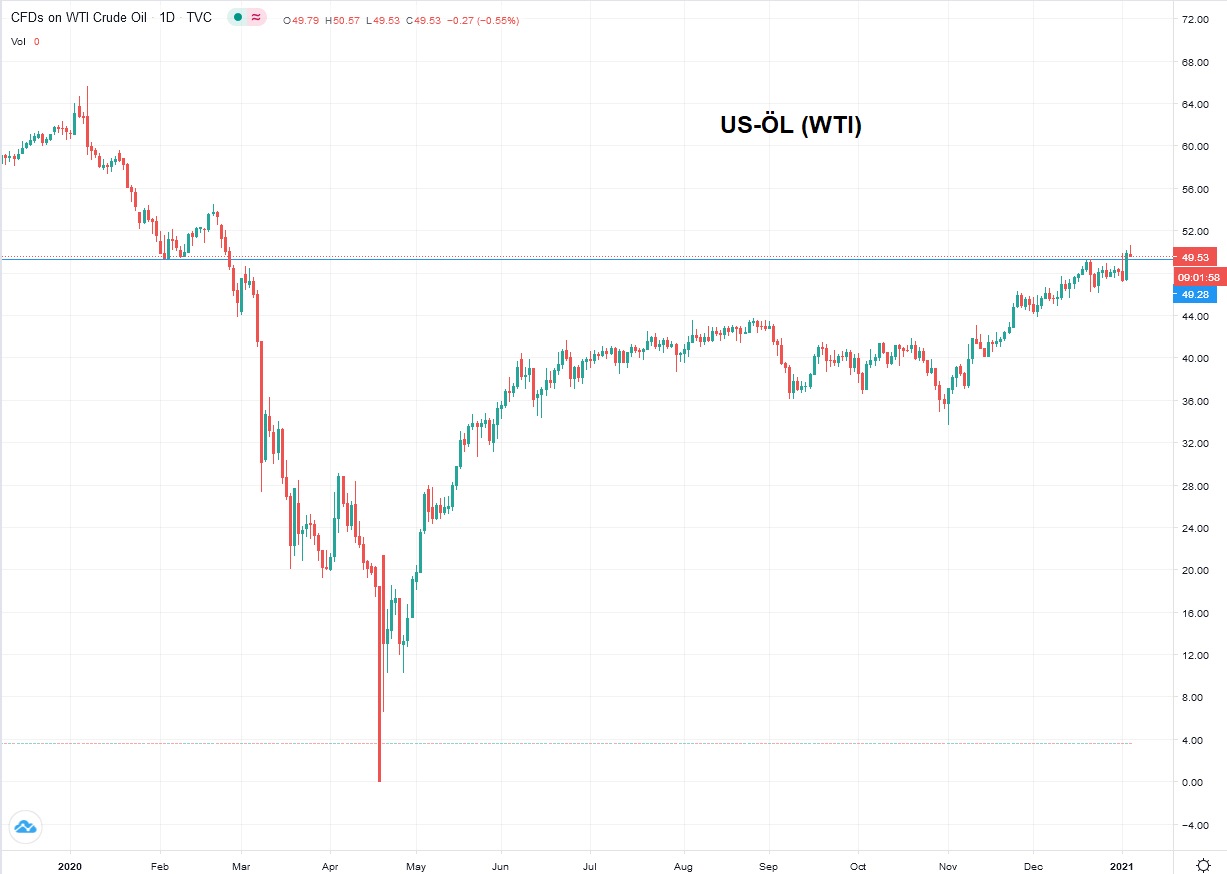
Aktuell ist US-Öl allerdings wieder auf dem aufsteigenden Ast. Gestern stieg WTI erstmals seit zehn Monaten wieder auf über 50 Dollar (Chart unten). Die Ölfirmen in Texas (inkl. Fracker) haben im Mittel einen Breakeven-Preis um die 40 Dollar.
Was der Analyst weiterhin unerwähnt lässt, ist der Dollar-Carrytrade bei Dollar-Nullzinsen. Dieser führte auch 2008 zu einer "parallelen" Rally in Öl/Rohstoffen und EUR/USD. Es handelt sich hierbei allerdings um einen dezidiert bullischen Trade, der bei Börsenschwäche radikal rückabgewickelt wird: In der ersten Jahreshälfte 2008 stieg WTI auf 147 Dollar und EUR/USD auf 1,60. Am Jahresende (nach dem Lehman-Knall) stand WTI bei 35 Dollar und EUR/USD sackte auf 1,25.
Rein intuitiv widersinnig ist ja allein schon, dass die Dollarschwäche mit ATHs an den US-"Leitbörsen" einhergeht. Entweder geht es der US-Wirtschaft gut - das sollte dann auch den Dollar stärken - oder eben nicht. Im März-Crash war EUR/USD auf bis 1,06 abgesackt.
------------------
www.marketwatch.com/story/...good-news-for-stocks-11609874436
....Squire sees more downside for the dollar — at least in coming months. Dollar weakness isn’t just about the Fed and its easy money policies, he said, arguing that its actions put it somewhere in the middle of the pack in terms of aggressiveness when it comes to global central banks.
One of the more overlooked factors is the deterioration of the U.S. trade balance, he said, a phenomenon amplified by last year’s collapse in oil prices, which is likely to keep a lid on U.S. crude output and, more important, crude exports.
Ironically, the trade deficit has expanded because a relatively robust U.S. economy compared with the rest of the world means that imports have risen more than exports. That’s translated into deterioration in the current account — a tally of a nation’s transactions with the rest of the world, including net trade in goods and services, net earnings on cross-border investments and net transfer payments.
That’s pretty unusual for a U.S. economy that fell into recession in 2020, he noted. Typically, a contraction in U.S. demand sees an improvement in the current account as imports slow, providing support for the dollar during economic slowdowns.
What’s more, this comes after roughly a decade of stability for the current account balance, Squire noted. That stability, however, was largely a function of the U.S.’s transition from a net importer of petroleum products (equal to nearly 2% of gross domestic product in 2010) to eliminating its oil trade deficit as a result of the boom in shale production.
(Verkleinert auf 45%)


 Zurück

 Werbung