The risk though is that the pandemic is inflicting a “reallocation shock” in which firms and even entire sectors suffer lasting damage. Lost jobs don’t come back and unemployment stays elevated. That would force workers to retrain or relocate, both of which are hard, and governments to do more than just try to spend their way out of trouble.
It was a theme hit upon last week by Federal Reserve Chairman Jerome Powell as U.S. central bankers forecast leaving interest rates near zero until 2022 in part because of a surge in unemployment to the highest level since the Great Depression.
There will be “well into the millions of people who don’t get to go back to their old job,” said Powell, who will testify to Congress on the economic outlook this week. “In fact, there may not be a job in that industry for them for some time.”
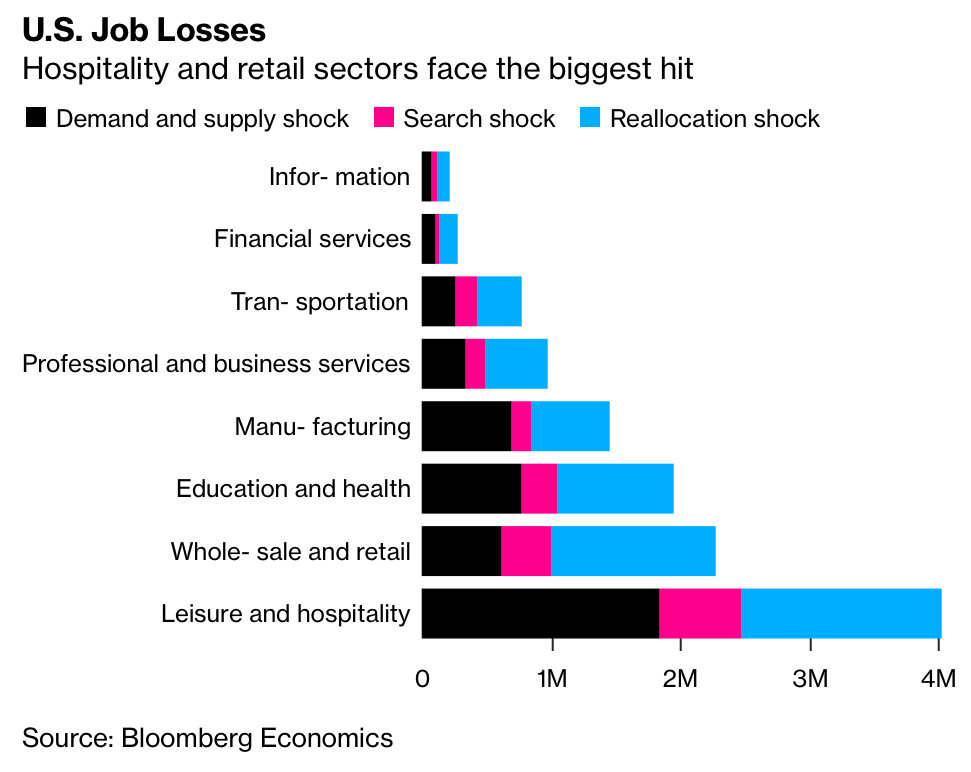
Unfortunately, new research by Bloomberg Economics reckons 30% of U.S. job losses from February to May are the result of a reallocation shock. The analysis -- based on the relationship between hiring, firing, openings and unemployment -- suggests the labor market will initially recover swiftly, but then level off with millions still unemployed.
Jobs in the hospitality industry -- like Lovely’s -- are among the most at risk, alongside retail, leisure, education and health. In many cases, the pandemic will increase the challenge for bricks and mortar companies facing off against e-commerce platforms such as Amazon.com. Inc, accelerating the pre-crisis trend.
Financial markets are already pricing in the risk, according to the Bloomberg economists. Equity market returns across different sectors and for companies of varying sizes suggests investors are betting on a shift in profits between firms similar to that witnessed after the global financial crisis of 2008. Lost profits spells lost jobs.
Other studies carry similar warnings. Research published in May by the Becker Friedman Institute at the University of Chicago estimated 42% of recent layoffs in the U.S. will be permanent.
“There’s a massive reallocation shock,” said Nicholas Bloom, professor of economics at Stanford University and one of the authors of the study. The recession “hits different sectors differently. Some benefit and some fall.”
The phenomenon puts governments under pressure to craft policies which help viable firms to survive and workers navigate to different jobs, but which ideally don’t prop up companies that are no longer sustainable and just drain resources.
Der Artikel geht noch weiter ....
www.bloomberg.com/news/articles/...lost-in-reallocation-shock
(Verkleinert auf 57%)


 Zurück