Anzeige
Meldung des Tages: Breaking News: Das “Schweizer Messer” für Diabetiker ist da!
Neuester, zuletzt geles. Beitrag
Antworten | Börsen-Forum
Übersicht ZurückZurück WeiterWeiter
... 2696  2697  2699  2700  ...

Der USA Bären-Thread


Beiträge: 156.445
Zugriffe: 26.349.075 / Heute: 3.955
S&P 500 6.909,36 +0,47% Perf. seit Threadbeginn:   +373,57%
 
permanent:

US Einzelhandel -1% ex Auto, ex Gas

7
13.08.10 14:36

Die Daten in der Handelsbilanz haben starke Importzuwächse -insbesondere aus China- ausgewiesen. Somit kann man davon ausgehen, dass die Läger des Handels bis zum Rand mit Waren gefüllt sind. Dementsprechend wird es zum Herbst Sonderverkäufe mit entsprechend schlechten Margen geben müssen.

Permanent

Antworten
musicus1:

sp500 1050 und wenn wir die

5
13.08.10 14:40
brechen, dann 1020... bei 1050 spiele ich einen long speku mit kleingeld ziel   1080                                                                                                                                                                                      
Antworten
permanent:

Korrektur zu #426

5
13.08.10 14:50

muss heißen -0,1 und nicht -1%.


Prices, Retail Sales Rise, But Consumer Remains Weak
ECONOMY, RETAIL, CONSUMER, CPI,
Reuters
| 13 Aug 2010 | 08:42 AM ET

U.S. retail sales and consumer prices rose in July in a hopeful sign for the economy.

Retail sales rose, but the gains were concentrated in auto and gasoline station sales, suggesting underlying momentum in consumer spending remains tame.


Sales climbed 0.4 percent last month following a revised 0.3 percent drop in June, the Commerce Department said on Friday.

Economists polled by Reuters had been looking for a slightly firmer 0.5 percent gain.

Excluding vehicles, sales advanced just 0.2 percent compared with a median forecast of 0.3 percent. Gasoline station receipts, which sometimes reflect price rises rather than increased demand, jumped 2.3 percent. When autos and gasoline were stripped out, sales actually fell 0.1 percent.

After emerging from its longest slump since the Great Depression, the U.S. economy has slowed in recent months, raising fears of a "double-dip'' recession. Retail sales are a key component of growth for a country where consumer spending makes up about two-thirds of total economic activity.

US Consumer Prices Rise 0.3% in July

Higher energy costs helped lift U.S. consumer prices in July, the first rise in four months, according to a government report on Friday that could ease concerns about deflation.

The Labor Department said its seasonally adjusted Consumer Price Index rose 0.3 percent last month, after falling 0.1 percent in June.

Analysts polled by Reuters had forecast consumer prices to rise 0.2 percent.

In the 12 months to July, the consumer price index rose 1.2 percent, in line with market expectations, after rising 1.1 percent in June, the report showed.

Antworten
Palaimon:

The Headline You Never Expected

16
13.08.10 15:09


The  Headline You Never Expected: Foreign Growth Could Bail Out the U.S. Economy

Editor's Note: Money Morning's Martin Hutchinson, a noted commentator, author and longtime  international merchant banker, understands the intricacies of the global economy  as well as anyone. So while you'll be surprised by the conclusion he reaches in  today's essay, be sure to take his recommendations very seriously.]


During a period of increasingly worrisome headlines about the U.S. economy,  there is one bright spot.

The rest of the world appears to be doing much  better than we are.

In the long run, that's good news for the United  States. Rapid world growth will eventually rekindle the economic fires here,  producing a growth that is more balanced than the bubbles of  1995-2008.

Still, getting to that point will be a challenge, since -  economically speaking - the home fires don't appear to be burning all that  brightly.

Trouble on the Home Front?

The U.S.  recovery appears to have slowed to a crawl - or perhaps even ground to a  halt. The "advance" estimate of U.S. second-quarter growth was reported at 2.4%,  indicating a long road to recovery - during which unemployment is likely to remain far too high.

Almost  half of the quarter's gross-domestic-product (GDP) growth projected for the  second quarter was inventory buildup. Government spending and a  temporary housing blip - caused by the homebuyer tax rebate, which expired  April 30 - accounted for the rest.

June durable goods orders, reported  July 28, were unexpectedly down 1%, suggesting that even manufacturing is  currently slowing. Add to that weak consumer confidence numbers for July and  house sales well below expectations for both May and June, and it becomes clear  that there's cause for concern on the domestic front.

While inflation  does not seem to be an immediate problem, unemployment remains appallingly high.  That's especially true of long-term unemployment, which - at 4.6% of the working  population - is at a post-World War II record. The federal budget deficit is  hovering at roughly 10% of GDP and interest rates remain close to zero, thanks  to polices that are looking increasingly eccentric when compared to the routes  that other countries have chosen to pursue.

It looks as if the U.S.  economy will be dealing with the "Great Recession" for a long time to come. But  most of the world's other major economies are experiencing fairly rapid  recoveries, meaning that they are putting the "Great Recession" firmly in the  rearview mirror.

Searching For Growth

Cast your eyes away from the United States,  however, and the picture becomes much brighter. Canada  posted first-quarter growth of no less than 6.1%, and its budget is almost  in balance. Even sluggish Britain expanded at 4.5% in the second quarter, and its heroic  effort to balance its budget will undoubtedly help growth going forward. German  industrial production was up 12.4% in the 12 months through May.

In  fact, the overall Eurozone is safely into a growth mode - although its  overall budget deficit is still dangerously high. The  Economist estimates that shortfall it will reach 7% of GDP this  year.

Turning to Latin America, we see that Mexico is something of a  basket case. But Brazil is expected to grow at 7.8% this year, with Chile not  far behind at 5%. Meanwhile, China is projected to grow at 9.9% in 2010, India  at 7.9%, and wealthy South Korea at 5.9%. Even sluggish Japan will manage 3.1%  growth.

The bottom line: The wise investor will allocate most of his  money internationally.

Modest quantities should go into Europe -  particularly Germany and Britain, where valuations are reasonable and growth  prospects good. Some should go into Canada, China, Brazil and Chile - each of  which have natural-resource-based economies. Canada and Chile also will benefit  from having thoroughly reliable governments.

A large proportion should go  into Asia: A little into Japan, where prospects appear somewhat brighter than  they did a few months ago, and a substantial amount into China. Somewhat less  should go into India, where valuations are too high and there are signs of  inflation. Finally, a substantial chunk should head for South Korea, which  boasts good growth, stability and a capable government.

America: The Global Growth Beneficiary

It's important to remember that  prospects for the U.S. economy are not universally gloomy.

The bad news  is that the Obama administration and the U.S. Federal Reserve are together  following the policies that Japan has followed for the most of its last 20  years, prolonging recession and producing dangerous bouts of deflation. (While I  don't agree with Federal Reserve Chairman Ben S. Bernanke's excessive fear of  deflation, there is no doubt that prolonged or steep bouts of deflation can be  damaging, because they discourage investors from holding anything other than  cash.)

There are, however, two bits of good news. The first is that U.S.  policies may change. Bernanke will man his post until January 2014, so rapid  change in ultra-low interest rates can't be expected. However, the movement  towards budget balancing is gathering strength in both political parties, and it  seems likely that fiscal discipline will be restored once the new Congress takes  office in January - following the midterm elections. If the budget is brought towards balance,  as is happening in Britain, resources are freed up for the private sector and  economic growth becomes easier.

The second, bigger piece of good news -  not noticed by those who fear a Japanese "Lost Decade" type of future - is that the U.S. position  differs from Japan's in one important respect: Whereas Japan has always had a  large balance-of-payments surplus, the United States currently has  an enormous balance-of-payments deficit.

The United States has a huge  advantage when world economic growth is strong, as is currently the case. With  export markets growing faster than domestic consumption, exports will tend  naturally to increase faster than imports, producing the most pleasant of all  economic states - export-led growth.

Japan couldn't grow its way out of  its malaise, because its huge international reserves made the yen too strong,  intensifying deflation. Furthermore, foreign countries became disquieted by  Japan's surpluses and erected hidden trade barriers against Japanese imports.  

Of course, in the U.S. case, rapid growth in exports would reduce global  imbalances, not increase them. The U.S. balance-of-payments deficit would  decline, reducing its need for foreign funding. That would make the world  economy more stable and increase its intrinsic growth rate. But it wouldn't push  up the dollar, because the balance of payments would still be in a deficit.  

Provided that stern action was taken to rein in the budget deficit, U.S.  economic growth would accelerate and unemployment would decline. If the budget  deficit remained huge, there wouldn't be so much money coming in from abroad,  meaning domestic savers would be forced to buy U.S. Treasuries. That would force  up interest rates and restrict the flow of funds to private-sector  borrowers.

On balance, U.S. investors should be optimistic for 2011 and  beyond. Rapid global growth should rectify the U.S. balance-of-payments problem,  so that even modest fiscal discipline will produce a quickening of U.S. growth  rates, and a full economic recovery.

Thus, we don't need to emigrate in  search of a better economy. But until the U.S. economy actually does turn  around, our money should take an overseas vacation.

(..........)


moneymorning.com/2010/08/13/u.s.-economy-4/


An der Börse ist alles möglich, auch das Gegenteil.  
André Kostolany

MfG
Palaimon
Antworten
fkuebler:

Imagine 399: Wenn einem Links-Idioten auf den Sack

8
13.08.10 15:56

"Griechische Akademiker erheben das Wort gegen den Rettungsmechanismus von IWF und EU"

... gehen, und zwar ganz fürchterlich, liegt das dann eventuell am Alter?

Ich erinnere mich daran, dass zu meinen Studienzeiten als eine Art Anti-68-er Erkenntnis galt:

"Wer mit zwanzig kein Kommunist ist, hat kein Herz,
 wer mit vierzig noch Kommunist ist, hat keinen Verstand"

Das kommt mir auch heute noch als ganz praktische Erklärung vieler Lebensumstände vor... ;-)

P.S.: Das ist natürlich keine Kritik an deinem Posting  

Antworten
Anti Lemming:

US-Lagerbestände um 0,3 % gestiegen

4
13.08.10 16:09
Aug. 13, 2010, 10:00 a.m. EDT
June inventories up 0.3%, retail ex-auto flat
By Greg Robb

WASHINGTON (MarketWatch) - U.S. business inventories rose 0.3% in June as sales fell 0.6%, the Commerce Department said Friday. The monthly inventory report rarely moves financial markets, mostly because many of the numbers have been previously reported. Economists, however, find the data useful to project quarterly growth. The only new information in the report showed that retail inventories, excluding autos, were flat in June. This may cause economists to trim their estimate of second-quarter gross domestic product a bit further.  Prior to today's report, Wall Street economists had already slashed their Q2 GDP growth estimates to about a 1.3% annual rate from the government's initial estimate of a 2.4% rise on weaker-than-expected trade and wholesale and factory inventory data for June. The preliminary government estimate projected a small increase in retail inventories ex-autos in June. The government's revised Q2 GDP estimate will be released on Aug. 27.
Antworten
permanent:

Forecasters See Weaker US Growth: Philly Fed

7
13.08.10 16:10
Forecasters See Weaker US Growth: Philly Fed
ECONOMY, PHILLY FED, PHILLY FED REPORT, PHILADELPHIA FED, US ECONOMY, US RECOVERY, PHILLY FED OUTLOOK, PHILLY FED SURVEY, MANUFACTURING, UNEMPLOYMENT, US GDP
Reuters
| 13 Aug 2010 | 10:06 AM ET

The U.S. economy is likely to grow more slowly than previously anticipated in the third quarter as it is hampered by weak conditions in the labor market, according to a survey released Friday.


The Federal Reserve Bank of Philadelphia's survey of 36 professional forecasters sees the economy growing at an annual rate of 2.3 percent this quarter, down from the previous estimate of 3.3 percent that was issued in May.

The unemployment rate is expected to average 9.6 percent this year, in line with the previous estimate. But the rate for 2011 was raised to 9.2 percent from 8.9 percent in the prior survey.

Forecasters also see nonfarm employment growing at a rate of 8,000 jobs per month in the third quarter, down sharply from 120,500 forecast previously, and 114,100 jobs a month in the fourth quarter.

Long-term inflation expectations eased but forecasters still saw little risk of deflation. Over the next 10 years from 2010 to 2019, headline consumer price index inflation was seen averaging 2.3 percent annually, down from 2.4 percent in the last survey.

Forecasters see a slightly higher chance of a contraction in real gross domestic product in the the third quarter. They predicted a 14 percent chance of negative growth, up from 9.8 percent in the previous survey.

Antworten
gogol:

ich störe euch noch einmal

13
13.08.10 17:17
Fujairah, wem sagt dieses Emirat etwas ???

es liegt ca. 200 km von Dubai entfernt und zeigt wie China sich seine Rohstoffe sichert.

Hier schrieben die Medien von der Pleite Dubai s und wie schlimm es wohl noch kommen könnte und dort ?? ( Quelle sind die gleichen Tageszeitungen )
China kauft sich einen Teil des Hafenanlage wo das Erdöl verschifft wird und ein paar Kilometer weiter ( ca 10 km) entsteht der nächste Anbau der Aluminiumhütte, es werden riesige Starkstromleitungen neu gezogen und der Bau neuer Erdöltanks hat innerhalb eines Jahres beträchtliche Ausmaße angenommen
aber wenn man auf die Firmenschilder schaut so sieht man außer Siemens und Hoch tief keine deutsche Vertretung  
und der Flughafen ???
hier landen wenig Urlaubermaschinen und wenn sind es kleinere aber dafür Frachtmaschinen und auf die Frage an unseren Begleiter was hier so angeliefert wird/ b.z.w. abgeht gab es nur eine arabische Antwort,,,, Wie schön doch die Sonne ist,,,,,,

aber einen kleinen Artikel fand ich doch ( der Inhalt kurz)
die Bodenschätze die in Afrika gefördert werden gehen zum Teil über die Emirate wo sie veredelt werden oder zur Produktion von Stahl/ Alu verwendet werden um danach als fertiger Grundstoff die Reise nach China anzutreten

und was macht Deutschlands Industrie ??

wenn ihr das nächst mal dort Urlaub macht könnt ihr euch selbst davon überzeugen
auf unserem Planeten gibt es nur Propheten
Antworten
Eidgenosse:

#433, Na und?

 
13.08.10 17:25
Was ist das Problem? Sie haben die Mittel und sie tun was, ich seh da jetzt nichts besonderes.
Über den Wolken...
Antworten
gogol:

lese einmal diesen Link BITTE

 
13.08.10 17:26
www.tradearabia.com/news/ogn_183479.html
auf unserem Planeten gibt es nur Propheten
Antworten
Eidgenosse:

Gelesen, und jetzt?

 
13.08.10 17:52
Ich versteh dich nicht. Nehmen sie dir was weg?
Über den Wolken...
Antworten
permanent:

US 'Virtually Certain' to Fall Into A New Recessio

7
13.08.10 17:54
US 'Virtually Certain' to Fall Into A New Recession: Rosenberg
ECONOMY, DOUBLE DIP, STOCK MARKET, RECESSION, DAVID ROSENBERG
Posted By: Jeff Cox | CNBC.com Staff Writer
CNBC.com
| 13 Aug 2010 | 11:28 AM ET

The US economy is almost certainly headed back into a double dip recession, and economists aren't seeing it because they're using "the old rules of thumb" that don't apply this time, well-known economist David Rosenberg told CNBC.


Consumers' focus on shedding debt rather than spending will prevent the economy from growing and bring a halt to the recovery, said Rosenberg, a former Merrill Lynch economist who now works at Gluskin Sheff, an advisory firm based in Toronto.

"The risks of a double-dip recession—if we ever got out of the first one—are actually a lot higher than people are talking about right now," he said. "I think that it's almost a foregone conclusion, a virtual certainty."

Rosenberg has long been pessimistic on the economy, believing that persistently high unemployment, weak economic indicators and massive debt-cutting—deleveraging—by consumers and businesses will send the economy into a double dip.

Though many economists disagree with Rosenberg about the chance of another recession, his views are widely followed on Wall Street and have often been accurate.

Unemployment remains stubbornly high at 9.6 percent, while Friday's economic reports showed modest gains in retail spending and the consumer price index.

In addition, a slew of leading economists, from firms including Deutsche Bank, JPMorgan Chase and Goldman Sachs have been scaling back their outlook for the gross domestic product.


On Friday, Goldman raised the chance of a double-dip happening to 25-30 percent. BMO Capital Markets, in its second-half outlook released last week, said consumer weakness has been a hallmark of weak recent recoveries, but this cycle is the worst.

Rosenberg, meanwhile, thinks other economists are relying too much on patterns from past recessions.

"Most economists, most strategists are still deploying the old rules of thumb that worked so well post-1945 where recessions were really just corrections in GDP in what was a secular expansion of credit," Rosenberg said. "People haven't wrapped around their heads what is a credit contraction all about."

While the notion that economic growth will be weak is gaining acceptance, a double-dip, where the economy enters a second phase of negative growth within a year of rebounding, remains a minority opinion.

"Where I disagree is, is the magnitude big enough to take us from a sustained expansion at a very low growth rate into a double-dip recession?" said Richard Hoey, chief economist at BNY Mellon, who appeared with Rosenberg on CNBC. "Among the reasons I don't think we have a double-dip recession is we reliquefied practically every corporation in America...The large corporations have been able to have a huge gain in profits and they're not spending it. So their cash is building up every single day."

The history of previous recoveries shows that double-dips are rare and unlikely except in extreme cases, said Sean Clark, of Clark Capital Management, another guest on CNBC.

"This 12-month recovery, since it bottomed in June of last year, has been stronger than the previous two post-recession periods," Clark said. "Double-dip recessions are very much the exception to the norm."

But Rosenberg said that line of thinking ignores how this downturn, spurred by a credit relapse and fed by a reluctance of businesses and consumers to spend money, is different than others. He pointed out that the household employment survey has declined three months in a row, a condition that indicates a recession 98 percent of the time.

"Comparing to the recessions of the post-World War II period is a total waste of time," he said. "This is a totally different animal."

Antworten
gogol:

okay

15
13.08.10 18:01
meine Meinung
China hat sich ein weltweites Netz von Rohstoffquellen/ Zwischenlagern und Veredlungen aufgebaut um sich Unabhängig zu machen, dabei ist die politische Einstellung völlig egal
und was machen wir ??
wir führen Scheindiskussionen über irgendwelche Schmiergeldzahlungen obwohl jeder weiß das es Länder gibt wo du ohne AUFMERKSAMKEITEN nicht weiter kommst
warum versuchen wir aber immer noch die ganze Welt zu bekehren und wundern uns dann wenn der Rohstoffhahn einmal zugedreht wird ??

im übrigen ziehe ich persönlich den Hut vor dieser Einstellung der Chinesen, weil es meiner Meinung nach von Weitsicht zeugt weil diese Krise noch nicht vorbei ist und die nächste schon ansteht
auf unserem Planeten gibt es nur Propheten
Antworten
Eidgenosse:

Ja Gogol,

14
13.08.10 18:46
die westliche Welt ist anscheinend der Meinung das die Chinesen auch weiterhin für einen halben Sack Reis 20 Std. am Tag arbeiten nur damit wir es uns hier mit billigen Konsumgütern gut gehen lassen können.
Mein "Na und" ist so gemeint das die Erde und ihre Rohstoffe nicht primär den entwickelten (westlichen) Ländern gehört sondern das sich das auch mal umkehren kann. Eine gewisse Weitsicht ist sicher von Vorteil. Jedenfalls weiss ich meinen Wohlstand zu schätzen und wenns mal etwas weniger wird werd ich auch nicht gleich ausrasten.
Über den Wolken...
Antworten
fkuebler:

Eidgenosse #439: Das finde ich eine so wichtige...

5
13.08.10 19:39

"die westliche Welt ist anscheinend der Meinung das die Chinesen auch weiterhin für einen halben Sack Reis 20 Std. am Tag arbeiten nur damit wir es uns hier mit billigen Konsumgütern gut gehen lassen können.
Mein "Na und" ist so gemeint das die Erde und ihre Rohstoffe nicht primär den entwickelten (westlichen) Ländern gehört sondern das sich das auch mal umkehren kann. Eine gewisse Weitsicht ist sicher von Vorteil. Jedenfalls weiss ich meinen Wohlstand zu schätzen und wenns mal etwas weniger wird werd ich auch nicht gleich ausrasten
"

... fundamentale Erkenntnis, dass ich es gleich nochmal anerkennend zitieren muss. 

Wir sind hier im Durchschnitt ja sowieso tendenziell weniger knallharte Spekulanten als Stammtischphilosophen  

Antworten
Malko07:

Der zerbrechliche Aufschwung

6
13.08.10 19:43
Der USA Bären-Thread 8468505
Das Wachstum ist eine positive Überraschung mit vielen Unbekannten. Es wäre wunderbar, könnte Deutschland die Wirtschaft des Kontinents aus der Krise ziehen - doch so einfach ist es nicht.
Antworten
wawidu:

$NYA50R

6
13.08.10 20:00
Ohne Worte:
(Verkleinert auf 90%) vergrößern
Der USA Bären-Thread 337792
Antworten
wawidu:

$NYA200R

6
13.08.10 20:03
(Verkleinert auf 90%) vergrößern
Der USA Bären-Thread 337794
Antworten
wawidu:

Ein symptomatisches Bild

3
13.08.10 20:26
für die technische Situation vieler US-Werte: ein kurzes Überschreiten von MA200 (Fakes) und dann der erneute - z.T. sehr heftige - Fall unter diesen viel beachteten Gleitenden Durchschnitt.
(Verkleinert auf 90%) vergrößern
Der USA Bären-Thread 337797
Antworten
wawidu:

Einzelstaatliche und kommunale Haushalte

5
13.08.10 21:04
am Tropf der Bundesregierung:

www.ritholtz.com/blog/2010/08/...-states-municipalities/print/

Ritholtz hat bekanntlich das sehr lesenswerte Buch "Bailout Nation" geschrieben.
Antworten
Anti Lemming:

Long TBT bei 34,10

8
13.08.10 21:55
(Verkleinert auf 80%) vergrößern
Der USA Bären-Thread 337808
Antworten
malsomalso:

@ AL, Long TBT-Position

10
13.08.10 22:19
Da bin ich ja mal gespannt, vor allem, weil es konträr zu meiner Long Longbond-Position läuft ("hallo Falk :-)"). Interessant heute ist, dass der übliche Gleichlauf von USD/JPY und Treasuries heute nicht lief. Der Dollar stieg gegen den Yen, gleichzeitig fielen die Renditen weiter. Das ist zumindest ungewöhnlich.

Da hier gestern mal auf Taleb verwiesen wurde (Short Treasuries als "Must Trade"), will ich mal mit Dave Rosenberg dagegenhalten. Ich halte seinen täglichen kostenlosen Newsletter für ein absolutes Muss. Und "Rosie" ist nun mal Treasury-Bulle. Gestern schrieb er dazu, dass er im Gegensatz zu vielen "Wall Street Pundits" nicht den Long Equities-Trade für den "Pain Trade" hält, sondern den Long Treasury-Trade.

Ich kann seiner Argumentation völlig folgen. Erfahrungsgemäß sind ist die Zinsstrukturkurve am Ende einer Rezession flach. Vorne sind wir bei Null, bleibt für die Longbonds nur die gleiche Richtung. Das wird sich alles noch hinziehen und nicht in einem Rutsch gehen (also kann dein Trade jetzt genau richtig sein), aber die Richtung ist klar. These also: das Gerede von der Staatsanleihen-Blase ist nichts als das - Gerede nämlich, und Long Treasuries ist der "Pain Trade" der nächsten Monate und Jahre. Mish betet das ebenfalls seit Jahren: Japan, wir kommen.
Antworten
Kicky:

No Reason to be Short Treasuries

7
13.08.10 22:46
globaleconomicanalysis.blogspot.com/2010/...ues-in-normal.html
In the wake of anemic retail sales in July, treasuries could have been expected to rally and they did.
Curve Watchers Anonymous notes that the biggest treasury gains (drops in yield), occurred on the longest durations. This is a normal yield curve reaction.

This is in contrast to the pattern we have been seeing for weeks, with the middle of the curve reacting the strongest.

Here is a chart over time from Front Running the Fed - Who Knew?......

The 30-year long bond has finally broken through that shelf at the 4% mark. There is plenty of room for further rallies is the economic data remains weak. There is no reason to expect anything other than weakness, thus no reason to be short treasuries here.

2.bp.blogspot.com/_nSTO-vZpSgc/TGWZErJYGDI/...oomberg.png">
(Verkleinert auf 93%) vergrößern
Der USA Bären-Thread 337821
Antworten
wawidu:

Russell 2000

6
13.08.10 22:47
Den Wochenchart dieses Small Cap Index finde ich hoch interessant. In Anbetracht der Tatsache, dass speziell Small Cap Unternehmen diejenigen sind, die sich am Anleihemarkt nur selten rekapitalisieren können bzw. von den Geschäftsbanken in zunehmendem Maße kaum noch Kredit erhalten - und wenn, dann nur zu "Wucherzinsen" - sehe ich hier für die Zukunft einen höchst wahrscheinlichen deutlichen Down-Pfad. Die Entwicklung der Preiskurve zwischen März 2009 und April 2010 basierte auf der Erwartung einer wirtschaftlichen V-Recovery, die man aktuell wohl in die Tonne treten kann.

Heutige Entwicklung:

$RUT: minus 1,21 %
$SPX: minus 0,40 %
(Verkleinert auf 90%) vergrößern
Der USA Bären-Thread 337822
Antworten
Anti Lemming:

Zu meinem Trading-Long in TBT

8
14.08.10 08:50
Wegen der unerwarteten Resonanz auf # 446 möchte ich mich zu dem Trade ausführlicher äußern. Zunächst: Die Position macht 1 % meines Depots aus, es handelt sich daher um Spielgeld.

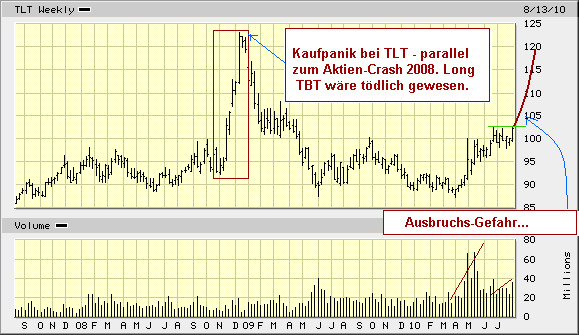
Die Gefahr, in einen intakten Uptrend (von TLT, dem Underlying von TBT) zu shorten ist evident. Mein long in TBT ist als kurzfristiger "Scalp"-Tradegedacht, der darauf abzielt, dass auf die Kaufpanik in TLT in dieser Woche  am Anfang der nächsten Woche ein Rücksetzer kommt (techn. Korrektur im Uptrend). Ansonsten bin ich im Depot in Shorts investiert, im Einklang mit dem von mir erwarteten Deflations-Szenario. TBT fliegt bei Verlusten schnell mit SL raus.

Longs oder Shorts in langlaufenden US-Staatsanleihen sind ein äußerst kompliziertes Kapitel. Man denke nur an Herbst/Winter 2008, als Aktien in Grund und Boden stürzten und TLT fahnenstangenartig auf 120 hochschoss (Chart unten). Seit April bewegt sich TLT entgegengesetzt zum SP-500, stieg also deutlich (dasselbe sieht man beim Bundfuture). TBT als Doppelshort auf TLT fiel in der Zeit entsprechend. Es gibt Leute, die sagen, dass ein Long in TBT einem Long im SPY (bzw. SSO = Doppellong auf SPY) entspricht.

Das ist aber etwas verkürzt, denn wenn in USA reale Inflation aufkommt - z. B. durch fortlaufende Nullzinsen TROTZ realen Preissteigerungen von 2 bis 3 % (was manche bereits jetzt sehen) - , dann könnte es mittelfristig für US-Langläufer nicht so toll aussehen. In der starken Inflation der 1970-er Jahre verloren US-Longbonds sogar zeitweise 50 % ihres Kurswertes. Aktien gingen damals ebenfalls in den Keller. Man kann im Fall aufkommender deutlicher Inflation also davon ausgehen, dass sich die bisherige anti-parallele Entwicklung von SPX und TLT (die typisch ist für ein Deflations-Szenario) dann in eine Parallelbewegung umkehrt (d.h. nicht nur Aktien fallen wegen Inflation, sondern auch die Longbonds).

Die Sache ist mithin äußerst kompliziert. Zur Info unten noch ein Artikel des Street.com-Bond-Spezialisten Tom Graff, der obige Inflationsentwicklung latent kommen sieht und aggressiven Tradern einen "Pair Trade" empfiehlt aus einem Long in Bonds mittlerer Laufzeiten (3 bis 7 Jahre), gehedgt durch einen Short auf Langläufer (30 Jahre).

Meine kleine Posi korrespondiert mit der "Komplikation" dieses Trades. Als Zock (wie von mir geplant) ist das egal (bei engem SL), nicht aber bei einer strategischen Posi - die manche hier im Thread ja mit "long US-Longbonds" haben...

Graff ist, wie viele US-Bondspezis, eher bullisch, was die US-Wirtschaftsentwicklung betrifft. Ich stimme seinen Thesen in vielen Punkten nicht zu (unten jeweils in Klammern). Es ist aber interessant zu lesen, wie die US-Bonds-Profis zurzeit ticken. Sie gelten zwar als smart (und smarter als Aktienanleger), doch auch Sie sind vor Irrtümern nicht gefeit. Zu den realistischeren Bond-Profis zählen für mich die Leute von PIMCO. Doch das bärische Zeug, was Gross und Co. seit Monaten von sich geben, könnte auch Sell-Side-Gewäsch sein, um die Meute in die falsche Richtung zu schicken. Graff ist in dem Punkt wohl ehrlicher.


Bonds
Bondlife: A License to Kill
By Tom Graff
Street.com Contributor
8/13/2010 5:15 PM EDT

Although many think the Federal Reserve is out of bullets, it actually has unlimited firepower when it comes to its inflation-fighting ability. And now the Fed is telling us that it is about to unleash its super-weapon: the printing press.

The Fed is on a path that will inevitably lead to additional quantitative easing (QE). In this week's Bondlife, we'll examine how another round of QE will work, and what you should (and should not) own to profit from it.

Interest Rates and the Fed: You Only Live Twice

It is often said that the first round of quantitative easing failed because the printed money just got stuck at the banks in the form of excess reserves. We know that as the Fed was purchasing more and more assets for its own balance sheet, the level of excess bank reserves was rising in an almost-one-for-one fashion. If one buys this argument, it would follow that additional QE would do nothing more than generate even more excess reserves and not create any kind of monetary stimulus at all.

This view shows a fundamental misunderstanding as to how QE works. First, the banks didn't get the QE money directly. This is clear once one considers the actual process the Fed used for buying bonds. When the Fed was buying government-sponsored-enterprise debt, it would announce the range of maturities it was going to buy on a given day and would take offer levels from investors. I participated in this process myself. I would call up a primary dealer and tell them what bond I was willing to sell and at what price.

I never got lifted by the Fed (because I was hoping at some point the Fed wouldn't get enough offerings and would lift an off-the-market level). But had I been, the Fed would have paid my clients for the purchase. The primary dealer I used was just an intermediary. Once my clients had the cash, they could have spent it on anything they chose. [Ähnliches gilt im Prinzip für die Aktienkäufe der Zockerbanken... A.L.]

No matter what a recipient of Fed cash actually does with the capital, the money eventually winds up in the banking system. Say, for instance, that I sell a bond to the Fed and then choose to buy a new Chevy Malibu. Some of that money would go to the dealer, some of it to the dealer's employees, and some of it to GM. Those recipients, in turn, deposit the money in their banks.

Here's another example. Instead of buying that new car, say I choose to reinvest the proceeds from my Fed sale in another bond -- a new issue for IBM. Where does that money go? Into IBM's bank account. Or say I just want to sock the proceeds away for a rainy day. It the money would then just go into my own bank account. This is a bit of an oversimplification, as some of these transactions would have several iterations, but you can see that ultimately all money flows through the banking system.

You can see that the Fed's newly printed money could flow through several hands before making it to the banking system. In the scenario where I bought a car, perhaps the car salesman buys a new TV with his commission check, then perhaps the retailer who sold the TV spends his profits on buying more inventory, then the manufacturer spends its profits on the company Christmas party, the caterer sends her daughter to college with her profits, etc., etc.

Notice that a bank's willingness to lend doesn't come into the equation at all. It is consumers' willingness to spend that determines whether or not the money flows through the economy productively. [Das ist DAS Argument für "unser" Deflations-Szenario... - A.L.]

The fact that neither consumers nor businesses are willing to spend/invest, and instead are holding large cash balances, tells us all that we need to know about interest rates. They are too high. [MMn ein Monetaristen-Irrtum - A.L.] Economic agents know the rate of return on cash is zero, and they are happy with that. If we want this cash to be utilized in the economy, we have to make the return on cash less than zero.

Only through creating inflation is this possible. Nominal interest rates can't fall below zero, but real interest rates can if we get enough inflation. Put another way, if the nominal rate on cash is zero, but inflation is 2% or 3%, then there would be a clear disincentive to just hold cash. In real terms, cash is a sure loser.


All the Fed needs to do is create expectations of higher inflation and spending will follow. [Da hab ich meine Zweifel, warum sollten Babyboomer ihre Rente mit Flat-TVs und Reisenv verpulvern? - A.L.] With the right QE program, creating these expectations should be fairly easy. What if the Fed simply told the world they would buy as many Treasuries as necessary to push inflation above 2%? They announce no limit in size, no timing of purchases, just that they want to push inflation higher by any and all means necessary. You don't think inflation expectations would rise?

Treasury Bonds: Die Another Day

The consequence of all this for Treasury bonds is eventually going to be a bear steepening of the yield curve. As a practical matter, the Fed will hold short-term interest rates at the current level, but long-term inflation expectations will cause long-term bonds to increase in yield. Turning this into a trade gets a bit tricky, though.

With the Fed holding short-term rates so low, could we see five-year to seven-year bonds hold in (or even rally) while 30-year bonds sell off? Absolutely. So a generalized bond short is a mistake. But moving money more into the middle of the curve, say three to seven years, should significantly outperform holding the tails. A more aggressive trade would be to buy five-year to seven-year bonds vs. a 20-year to 30-year-bond short position.

Corporate Bonds: Dr. No

Corporate bonds are the tell for whether the Fed's efforts are working. We are looking for a surge in corporate bond issuance as the indicator that companies are re-allocating away from cash and into real investments. [Warum sollten Firmen investieren, wenn die Umsätze sinken wg. hoher AL und bereits jetzt Überkapazitäten drücken? - A.L.]  As long as corporations refuse to borrow, I can only conclude that interest rates aren't low enough to make an equilibrium. [erneut: Monetaristen-Irrtum]. Again, this gets back to the need for some inflation. Even a slew of stock buy-backs would be hugely positive for the economy.

High-yield would be a clear winner in a mild inflation uptick. Inflation benefits debtors and hurts lenders, but in the case of high-yield companies, a little inflation would help improve revenues and thus credit quality. [Was passiert, wenn die steigende Inflation Leute aus Junkbonds aussteigen lässt - Abwärtsspirale? A.L.] Investment-grade corporate bonds would get some credit-quality benefit but it would be relatively small. I think it is actually safer to be a bit lower on the quality scale. [Das scheint mir eine Schnapsidee, aber dennoch interessant zu wissen, wie US-Bondprofis hier ticken - A.L.]

Mortgage-Backed and Agency Bonds: Live and Let Die

With the Fed now letting its portfolio of mortgage-backed securities (MBS) die, does this have a large impact on MBS trading? It Shouldn't.

I estimate that the MBS run-off amounts to about $10 billion to $20 billion per month. Not a very large amount in the scheme of a $9-trillion mortgage market. The bigger problem faced by the MBS world is a potential increase in interest-rate volatility. Right now, volumes are extremely low as the world is pricing in a Fed on perma-hold. But aggressive QE changes the equation. [Meint Graff damit "Weimarer Geldgedrucke?" - A.L.]

Even if the direction of yields in uncertain, clearly the level of uncertainty would go up. Since MBS are essentially a covered-call trade, rising volatility will impact prices directly. But perhaps more important is that the market will start pricing the possibility of rising rates, and thus the extension of the average lives in MBS.

There is very good value here in low-coupon 15-year MBS, where the variance in potential average life is more contained. But readers who are hanging out in a broad MBS fund may want to look elsewhere.

TIPS: Goldfinger

Treasury inflation-protected securities (TIPS) had a poor week, up about 0.25 points for the week vs. the 10-year Treasury, which was up 1.25 points. Breakevens fell to 1.67% in the 10-year area, the lowest since September 2009.

Despite this, I remain bullish on TIPS. With the Fed clearly becoming more aggressive, I doubt breakevens fall materially from here. So you have little downside. Your upside comes if the next round of QE really works and we get an inflation spike. No matter how you set the odds of either scenario, TIPS make a ton of sense.

Municipals: The Living Daylights

Its muni lag time again. That is, the Treasuries have rallied so aggressively that municipals have become unusually cheap. [Die US-Bundesstaaten sind auch "ungewöhnlich pleite" - A.L.] Ten-year-and-longer munis are widely available at 100% or more of Treasuries. When Treasury bonds are rallying, retail investors choke on the absolute yield. They look at how low the yield is and just refuse to buy.

But after a few weeks of earning nothing in cash, they give in and buy a mutual fund. Last week we saw just under $1 billion in new flows into muni funds and, despite this, munis kept lagging Treasuries. Note also that the 10-year to 15-year segment of the yield curve is much cheaper than the front-end. Again, this is related to retail flows. Most investors are afraid to push out the curve. Don't be. I suspect that, as Treasury rates rise, intermediate-term munis will just hold in place, and you'll earn so much more yield in the interim.


Chart von TLT

Bei einer Wiederholung des Aktiencrashs von 2008 (gemäß "Hindenburg-Omen" nicht unwahrscheinlich) könnte TLT erneut in Kaufpanik "durch die Decke" gehen. Long TBT wäre dann tödlich (außer man hat eine kleine Posi und lässt sie laufen, denn 2009 ging es ja auch stark wieder runter...). Besser freilich ist ein enger SL in TBT. Käme überraschend Inflation auf (im Tom-Graff-Szenario durch extremes QE der Fed), könnte TLT allerdings im 1970-er Stil [Stagflatons-Szenario] in die Knie gehen und im Extremfall bis zu 50 % verlieren. Long TBT wäre dann eine Goldgrube, vermutlich ebenfalls Longs in Gold. Leute, die gleichzeitig long in Gold sind und long in US-Langläufern, würden dann in zumindest einem der Trades falsch liegen.
(Verkleinert auf 96%) vergrößern
Der USA Bären-Thread 337856
Antworten
Auf neue Beiträge prüfen
Es gibt keine neuen Beiträge.

Seite: Übersicht ... 2696  2697  2699  2700  ... ZurückZurück WeiterWeiter

Börsen-Forum - Gesamtforum - Antwort einfügen - zum ersten Beitrag springen

Neueste Beiträge aus dem S&P 500 Forum

Wertung Antworten Thema Verfasser letzter Verfasser letzter Beitrag
29 3.792 Banken & Finanzen in unserer Weltzone lars_3 youmake222 13:21
469 156.444 Der USA Bären-Thread Anti Lemming ARIVA.DE 25.12.25 10:01
  55 PROLOGIS SBI (WKN: 892900) / NYSE 0815ax ARIVA.DE 19.10.25 10:00
    Daytrading 15.05.2024 ARIVA.DE   15.05.24 00:02
    Daytrading 14.05.2024 ARIVA.DE   14.05.24 00:02

--button_text--