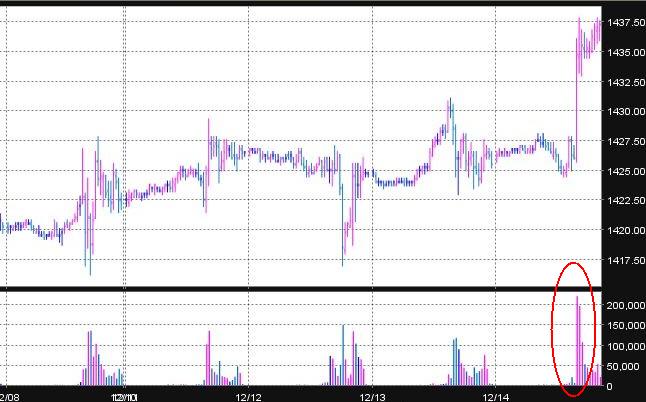
Future-Buy-Programme der großen Fonds, angeworfen zur Markteröffnung, katapultierten den SP-500 zum Marktbeginn in die Höhe und ließen ihn später haargenau bei 1425 schließen - "zufällig" zeitgleich mit dem Verfall von US-Indexoptionen.
Market Features
Stocks Programmed for Big Gains
By Liz Rappaport
Markets Columnist
12/14/2006 5:34 PM EST
URL: www.thestreet.com/markets/marketfeatures/10328023.html
There were probably several meetings going on Wednesday afternoon to discuss the bond market's sell-off. At least one of the meetings was probably at a large institution and the action plan at the end must have been: decrease bond allocation, increase stock allocation.
And so a program was born.
Only a program could send 468 of the 500 stocks in the S&P 500 up at the opening bell, says Marc Pado, chief market analyst at Cantor Fitzgerald.
[Ich hab den Chart der gepushten SP-500-Futures (e-mini, März 07) unten gepostet. Man sieht den untypischen Volumenanstieg.]
The surge of buying that sent the major indices up in the morning went unabated throughout the day Thursday, despite an equally impressive jump in the price of oil. Investors were single-mindedly focused on shoving the bears out of the way and making last-ditch, year-end allocations into stocks that sent major averages soaring.
The Dow Jones Industrial Average reached a new all-time high Thursday, closing up 0.8% at 12,416.76, while the S&P 500 closed at a new six-year high, up 0.9% at 1425.49. The Nasdaq Composite had an impressive gain as well Thursday, finishing up 0.9% to close at 2453.85.
"I think a lot of investors were waiting for a big fall correction, and it never came, but those people would have been more fully invested or aggressively invested right now if we'd had that correction," says Margaret Patel, portfolio strategist at Pioneer Investments. "There is some repositioning of money going on that will help the market in the last couple of weeks of the year."
The day's economic data and email boxes filled with soft-landing and strong stock market outlooks for 2007 goosed the move.
"The path of least resistance is higher from here," says Michael Driscoll, head of listed trading at Bear Stearns.
The market's strength was broad-based as the Dow Jones Transportation Average rebounded Thursday, finishing up 1.5%. The semiconductor sector staged a comeback as well with the Philadelphia Semiconductor Sector Index gaining 1.9% Thursday while the Merrill Lynch Semiconductor HOLDRs (SMH) exchange traded fund gained 1.6% on the day. Chips were led by Advanced Micro Devices (AMD) , which soared 12.6% after saying its recent merger with graphics chip maker ATI should have a "wildly" positive impact on earnings in 2008.
Ciena (CIEN) was another standout in the tech sector, rising 11.5% after returning to profitability in the fourth quarter and forecasting first-quarter earnings of 12 cents a share.
In the brokerage industry, shares of Bear Stearns (BSC) gained 2.6% as the brokerage firm reported a record quarter, but Lehman Brother's (LEH) shares slipped 0.4%. Lehman merely beat estimates.
Discount retailer Costco (COST) also beat estimates Thursday, which sent its shares up 1.8% as the rest of the retail complex also registered gains. The S&P Retail Index jumped 2.1% Thursday -- still rallying on Wednesday's strong retail sales report and the outlook for strong consumption going forward.
Ford Motor's (F) unexpected ability to raise massive amounts of liquidity in the debt markets garnered an analyst upgrade from Merrill Lynch to neutral from sell. Ford's shares surged 3.3% on the day.
Unexpected liquidity is the theme for the year, as cash continues to flood the financial markets, giving stocks little reason to pull back.
[Offenbar füllt das überreichlich vorhandene Private-Equity-Cash jetzt die Lücken, die der durch die Housing-Krise gebeutelte Normalo-Amerikaner hinterlassen hat. So kommt es zu dieser "unerwarteten" Liquidität. Private Equity kommt allerdings nur in Boom-Zeiten leicht an Investorengelder ran (zuletzt 1999/2000). Fallen die Kurse, versiegen die Quellen, also gibt es dann auch weniger Übernahmen - der Rallye-"Grund" fällt doppelt weg.]
To wit, Citigroup chief U.S. equity strategist Tobias Levkovich increased his 2007 targets for the S&P 500 and Dow in part due to the cash supporting stocks from corporate balance sheets and private equity activity. He upped his Dow target to 14,000, and the S&P 500 to 1,600.
There seemed no reason not to buy stocks Thursday even as oil prices surged too. Often a reason to hit the sell button, oil rose 1.9% Thursday to close at $62.51 per barrel on Nymex. The catalyst was OPEC's decision to cut production by 500,000 barrels per day come February 2007. OPEC announced production cuts of 1.2 million barrels per day in October.
OPEC and oil refining companies are united in putting a floor of $60 per barrel on oil, says Cantor Fitzgerald's Pado. He notes that OPEC may be cutting production to reduce supply, but oil refiners aren't buying as much either. Refiners want to eat through inventories to sustain high prices as well. The refiners had ramped up their oil inventories through the summer at higher prices on fears of escalating geopolitical turmoil. Recent Energy Department data shows a slowing of refining activity lately to below 90% of capacity, which is unusually low for this time of the year, says Pado.
"The market is beginning to get used to this story," says Pado. Also, if oil is priced slightly higher because of economic strength, the stock market can handle it, he says. More especially given the positive influence of energy stocks such as ExxonMobil (XOM) , ConocoPhilips (COP) and Halliburton (HAL) .
On the other hand, the economic story continued to punish the bond market Thursday. A day prior than expected, the New York Fed released a stronger-than-expected survey of business conditions in December. The NY Empire State Index read 23.1, well above consensus expectations for a reading of 18.
Also, initial jobless clams fell by 20,000 in the week ended Dec. 9. It was the second week of declining claims, suggesting the late November spike in claims was a seasonal anomaly. However, the four-week moving average is 327,000, above the range of between 306,000 to 318,000 that persisted from June through mid-November.
Still, fixed-income traders focused on the latest data points, which point to stronger economic growth and less likelihood of a Fed rate cuts. The 30-year Treasury bond slipped 10/32 to yield 4.72%, while the 10-year note fell 4/32 to yield 4.59%, and the two-year note fell 2/32 to yield 4.73%. Bond prices move inversely to their yields.
"Yesterday the bell rang for bonds," says Pado.
Indeed, Wednesday was the gong show for Treasuries. On Thursday, they rang a more pleasant-sounding bell for stocks.
[P.S. Der Dollar profitierte auch von der gesunkenen Zinssenkungserwartung, er stieg auf EUR/USD = 1,3150 (gestern: 1,3290 im Hoch.]
5-Tages-Chart des SP-500-Futures (e-mini, März 07). Man sieht den extremen Volumenanstieg heute zum Marktbeginn, der auf das Program-Buying der großen Fonds zurückgeht. Kein Zufall, dass Citibank GLEICHZEITIG das Kursziel für den SP-500 für Ende 2007 auf 1600 hochgesetzt hat. Vortreffliche Redundanz, sozusagen: Citibank stellt die Behauptung auf und liefert über die programmierten Future-Käufe den Beweis gleich mit. (Verkleinert auf 86%)


 Zurück
Weiter
Zurück
Weiter
 Werbung