Zurück
Weiter
Zurück
Weiter
 Werbung
| Strategie | Hebel | |||
| Steigender Mercedes-Benz Group AG-Kurs | 5,00 | 9,88 | 14,88 | |
| Fallender Mercedes-Benz Group AG-Kurs | 7,78 | 10,59 | 14,51 | |
|

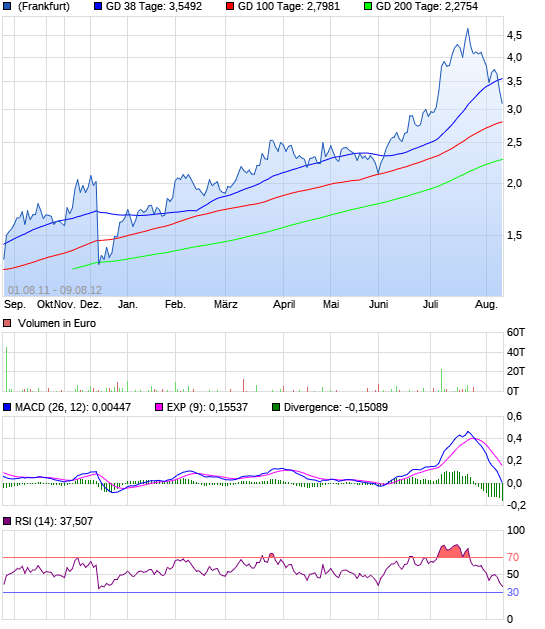
hat sich Antares mit den Q2-Zahlen verdient: Hier eine aktuelle Analyse von Antares Pharma:
Aber Antares Pharma bleibt interessant, nicht wegen der Q2-Ergebnisse, sondern wegen der Pipeline und den Partnterschaften - das sagt auch der nachstehende Bericht..."But, we feel it is poised for EPS growth in the coming year."
NEW YORK (TheStreet) -- Antares Pharma (Nasdaq:ATRS) has been downgraded by TheStreet Ratings from hold to sell. Among the areas we feel are negative, one of the most important has been unimpressive growth in net income over time.
Highlights from the ratings report include:
Antares Pharma Inc., a pharmaceutical company, engages in the development and marketing of self-injection pharmaceutical products and technologies, and topical gel-based products. Antares has a market cap of $485.9 million and is part of the health care sector and health services industry. Shares are up 111.8% year to date as of the close of trading on Thursday.
In this article, I will discuss why Antares Pharma (ATRS) (Pps: $3.67 Market Cap: 383.71M) is one of the best small cap long investment opportunities in the entire stock market that could provide huge returns in the next 3 to 5 years, according to my due diligence (dd).
I would first like to address a recent downgrade to the stock done by a well known online publication. Last Friday, The Street.com downgraded Antares to a sell using a metrics only computer based report. Based on this system, at least 3 out of 4 small cap biopharmas would be a strong sell. I find it curious as to why Antares was singled out from among the hundreds of small cap biopharmas.
Key points The Street.com mentioned to downgrade the stock is in bullet points. My reply follows each point.
Antares is not about performance in earnings now--in fact, the company is focused on re-investing its royalty earnings back into top line proprietary growth, so less net income is to be expected. If it just focused on net income now, without any top line future plans, then Antares would be worth under $2 a share. If Antares is going to be a top line focused company, it needs to invest in this future growth now. Two earnings calls before the current one, the company mentioned that R&D expenses would be on the rise, which CEO Dr. Paul Wotton called " an investment."
Current ROE is moot, notice how the downgrade focuses only on 'the now.' In order for Antares to reach $20 a share in 3 years, again, it has to focus on top line investment. Antares will never reach $20+ a share on its current royalty drive revenue, and this is not the company business plan - to remain a royalty base company.
The Street again is focusing only on current fundamentals as if the company is only about its current business model--which clearly it is not. Notice there is no mention of the Vibex injector line, no mention of the NDA filing expected soon for Vibex MTX, Vibex QS-T, management's stated long term goals, etc.
The Street's thesis does not mention top line growth, top line plans, top line potential which is what small cap growth investment is all about - getting the company to eventually become a mid to large cap.
Did The Street consider the upcoming Vibex MTX NDA filing, which is virtually assured FDA approval, and do they assume there will be no catalyst run-up for this?
Have they done the dd on top line proprietary products which include Vibex QS-T, QS2, and QS3? Do they know about the regulatory easing many are proposing - foregoing efficacy as long as the data shows complete safety? Have they run the numbers and modeling on revenue and profit on these future products?
The Street feels that investing in Antares now "does not compensate for any future upside potential." Ok, let's see if what they say holds water.
The VIBEX self-injector system:
The VIBEX system is designed to economically provide highly reliable subcutaneous injections comfortably and conveniently in conjunction with the enhanced safety of an integrated shielded needle. VIBEX employs a proprietary coil-spring power source to rapidly deliver the prescribed medication. This spring is combined with a tiny hidden needle in a disposable, single-use injection system compatible with conventional syringes. After use, the device can be disposed of without the typical "sharps" disposal concerns. Antares and its development partners have successfully tested the device in patient preference and clinical bioavailability studies. Antares continues to explore product extensions including multiple dose and variable dose applications, integrated reconstitution systems for lyophilized drugs, and is designed to provide highly reliable subcutaneous injections comfortably and conveniently in conjunction with the enhanced safety of a shielded needle.
Used in an estimated 70% of patients alone and in combination with biological therapies, methotrexate (MTX) is a foundational disease-modifying anti-rheumatic drug for RA. Generally initiated orally at lower doses and titrated up, published studies have reported as many as 30% to 60% of patients experience gastrointestinal side effects with oral MTX. This can prevent further dose escalation or require discontinuation in some patients, which can be avoided by subcutaneous administration.
The extent of oral absorption of MTX varies considerably between patients and has been shown to decline with increasing doses. Studies have also reported that switching patients from oral to parenteral MTX improves absorption, providing superior therapeutic response, resulting in longer duration of use. The VIBEX MTX system is designed for rapid subcutaneous self-administration of MTX in three simple steps.
Market research to date shows MTX, which can be self-injected, is preferred by patients and caretakers. As a promising pre-biologic treatment, it is anticipated that the VIBEX MTX system could play an important role in lowering healthcare costs in RA by delaying the use of biologic agents and expanding the use of MTX. The availability of the VIBEX MTX system would give patients and physicians a new option before making the jump to expensive biologics, which are associated with serious and increased safety risks for RA patients.
VIBEX QS T for Testosterone Replacement Therapy:
QS T is potentially the first self-injectable testosterone product for men suffering from symptomatic testosterone deficiency (Low T). Most of this market currently is made up of gel treatments, which most men really do not like. I am sure many of you have seen the commercials on TV advertising these testosterone gels.
Rx's for current treatment options equal two-thirds topical gel testosterone and one third intramuscular injections, and according to recent reports, U.S. sales of testosterone replacement therapies exceeded $1.6 billion* in 2011- 5.6 million Rx's. Studies have shown that gel patients do not achieve adequate absorption or therapeutic response; injection patients bear the cost and inconvenience of in-office injections every 2 to 4 weeks.
Projected future earnings:
The following numbers have been calculated by me and an analyst who posts on my stockboard.
VIBEX MTX:
The equation produced the following high/low MTX earnings projections for 2014 and 2015 assuming 120M shares outstanding in 2014 and 125M in 2015, the increase in shares based solely on share-based compensation.
$203M-$406M ($1.70- $3.40 eps)/$135M-$270M ($1.13- $2.26 eps).
$405M-$810M ($3.24-$6.48 eps)/$270M -$540M ($2.16-$4.32 eps).
VIBEX QS T:
Assuming 15% market share, I believe Antares (and its domestic QST partner) will earn combined revenues of up to $374M in 2015 (mid-year launch) and $1.7B in 2016 for QST sales in the U.S. Here is the breakdown:
Based on the limited information available and my relatively conservative market and market capture estimates, I am assuming QS will capture 4% of the testosterone therapy market in 2015 (assuming mid-year launch) and 8% in 2016. Accordingly, here are my QST U.S. revenue estimates for 2015 and 2016:
2015: 1.85M patients X 4% X $2,500 (cost for 6 months of weekly QST injections) = $185M.
2016: 2.25M patients X 8% X $5,000 (cost for 12 months of weekly QST injections) = $900M. Considering the global market for LowT therapy in 2016 will be approximately $4B (half of which likely would be attributed to the U.S. market), I believe $900M in annual QST revenues is too high. Perhaps 4% U.S. market penetration is a more appropriate estimate for now. I'm willing to endorse $450M for now.
Also, assuming a 50/50 partnership with big pharma, 60% pre-tax profit margin, 30% effective corporate tax rate, and 120M total outstanding shares (due to exercise of remaining warrants and annual stock-based employee compensation), my earnings/EPS projections related solely to sales of QST in the U.S. are as follows:
2015 -- $72.9M / $0.61 eps (PPS ~$9.15 with conservative PE of 15)
2016 -- $357M / $2.98 eps (PPS ~$44.70 with conservative PE of 15)
Total pps on both Vibex products, 2015-2016-- $30 to $70 a share. I am estimating lower on purpose when I say $20 a share in 3 years. I can back up my estimates with market studies, modeling, etc - why doesn't The Street even mention these products?
Boston Scientific (BSX) started out listed on the market as a somewhat obscure medical device company back in the early '90s at a price around what Antares is selling for today. Boston Scientific went public in May 1992 with an IPO of 23.5 million shares priced at $17 a share. Comparing this to Antares with 103M shares, cutting roughly 1/4th off the IPO price of $17 and adding about 75 million shares to BSX's original IPO, would equate to an IPO price around $4.50 a share if BSX had 103M shares outstanding as Antares currently does.
In 1993, BSX's sales reached $380 million, while net income rose to nearly $70 million, and in-between 1994 and 1995 sales rose from $449 million to $1.2 billion. In this article, I will try to show why I believe Antares could eventually surpass BSX's 1993-1995 in roughly the same time period.
After a few forward stock splits, BSX currently has 1.43B shares outstanding with a market cap of $8.20B, and a stock price of $5.74 a share. If BSX currently had 103M shares outstanding, its stock price would be over $80 a share. Antares is just beginning the move to become a top line company, and I feel in 10 years or less, if it is not bought out, Antares will be another Boston Scientific.
It is my strong opinion that 5 years from now, Antares will be at least a $5B dollar company--$50 a share.
If we valuate Antares on what the company earns now, the stock would appear to be overvalued which is what The Street and others seem to want to focus on.
Antares will likely bring in around $25 million dollars in revenue this year. These revenues will primarily come from royalty deals the company has made in the last few years with larger pharmas such as:
I've made the long term future stock appreciation case here; The Street has not. Obviously, its computer system did not factor in top line growth and the business model for Antares before stating, "Regarding the future course of this stock, we feel that the risks involved in investing in ATRS do not compensate for any future upside potential."
My YouTube Audio below explains why I believe The Street chose to single out Antares out of the 100s of small cap biopharmas. Give it a listen, do your own dd, and decide for yourselves if investing in Antares now is wise for future upside potential.
It is up to investors to do the proper due diligence with Antares, but let's say my estimates are too high, does what The Street says really hold water?
The system The Street used on Antares should only be used on fully developed larger cap biopharmas who have already established themselves as top line companies, not on a smaller cap company who is just about to begin its trek into a top line growth company from a royalty based one.
I consider this downgrade from The Street to be unwarranted along with the stock being oversold. However, this happens in the market because investors these days tend to be apathetic, don't do their own dd, and listen to whoever barks the loudest. Furthermore, many investors get too aggressive with small cap stocks, over-margining their positions which bring in unnecessary risk and inviting a coordinated short sell manipulative attack. It is my opinion that large short positions got caught off-guard with the strong move to over $5 in the stock, and turned to someone to help them out of the position while making money short in the process. This will have no effect on the Antares long term story - only a misstep by management can affect Antares from becoming a multi bagger in the years to come.
I have seen these same types of short attacks in Spectrum Pharma (SPPI), Ariad Pharma (ARIA), and Jazz Pharma (JAZZ) when they were in the price range of Antares. Short sellers frequently get themselves upside down in growth stocks when they underestimate the long term potential. The one advantage longs have over shorts in Antares is if they are cash positions they can wait it out while shorts are 100% on margin - they cannot wait it out.
Conclusion: Antares presents a great opportunity at its current price level to return long term multi bagger gains, but it will take time and patience. Those reading this and wanting to make an investment in Antares have to decide whether they want to make the investment now, and can afford to tie up money for the long term, or wait until the company is actually bringing in the large revenues that I foresee by 2015. Investing in a small cap like Antares is not about current fundamentals, but future ones.
Consider a stock like Microsoft (MSFT) in the late 70s - $2 a share. Microsoft was barely an idea back then without the fundamentals at the time to support what it later became - a mega tech monster. If you bought 10,000 shares of Microsoft back then and held it to now, the position would be worth tens of millions. I can support the long thesis for Antares to be a $20 stock by 2015, and clearly have done so in this article.
Antares Pharma erklärt: warum es das Beste Small Cap Long Term Investitionen im Markt ist
http://seekingalpha.com/article/802671-antares-pharma-explained-why-it-s-the-best-small-cap-long-term-investment-in-the-market?source=yahoo
In diesem Artikel werde ich diskutieren, warum Antares Pharma ( ATRS ) (PPS: $ 3,67 Marktkapitalisierung: 383.71M) ist einer der besten Small-Cap lange Investitionsmöglichkeiten im gesamten Aktienmarkt, die riesige Renditen in den nächsten 3 bis 5 Jahren könnte nach meiner Due Diligence (DD).
Ich möchte zunächst ein Downgrade auf die letzte Lager von einem bekannten Online-Publikation getan anzugehen. Am vergangenen Freitag, die Street.com herabgestuft Antares zu einem Ausverkauf mit Hilfe eines Computer Based nur Metriken Bericht. Basierend auf diesem System, mindestens 3 von 4 Small-Cap-biopharmas wäre ein starkes Verkaufssignal sein. Ich finde es neugierig, warum Antares wurde aus unter den Hunderten von Small-Cap-biopharmas hervorgehoben.
Die wichtigsten Punkte erwähnt Street.com ein Downgrade der Aktie ist in Stichpunkten. Meine Antwort folgt jedem Punkt.
Antares geht es nicht um die Leistung im Ergebnis jetzt - in der Tat, das Unternehmen auf neu zu investieren, seine Lizenzgebühren Gewinne wieder in obere Linie proprietäre Wachstum ausgerichtet, so dass weniger Nettoeinkommen zu erwarten. Wenn es auf den Jahresüberschuss nun, ohne obere Linie gerade Pläne für die Zukunft fokussiert, dann wäre Antares unter 2 Dollar pro Aktie wert. Wenn Antares wird ein top line fokussiertes Unternehmen sein, muss es in diesem künftiges Wachstum zu investieren. Zwei Ergebnis nennt vor der aktuellen, erwähnt das Unternehmen, dass F & E-Ausgaben würden auf dem Vormarsch, die Geschäftsführer Dr. Paul Wotton aufgerufen werden "eine Investition."
Aktuelle ROE ist fraglich, bemerken, wie die Herabstufung konzentriert sich nur auf "Jetzt." Damit Antares zu 20 Dollar pro Aktie in 3 Jahren zu erreichen, wieder, muss es auf Linie Investitionen zu konzentrieren. Antares nie erreichen $ 20 + eine Aktie auf der aktuellen Royalty höheren Umsätzen und dies ist nicht das Unternehmen Business-Plan - auf eine Lizenzgebühr Basis Unternehmen verbleiben.
Die Straße wird wieder nur auf aktuelle Grundlagen, als ob das Unternehmen ist nur über seine aktuelle Geschäftsmodell - was klar ist es nicht. Beachten Sie, gibt es keine Erwähnung der VIBEX Injektor Linie, keine Erwähnung des NDA-Antrags bald für VIBEX MTX, VIBEX QS-T,-Management Das erklärte langfristige Ziele, etc. erwartet
Der Street-Arbeit nicht erwähnt, Umsatzwachstum, oberste Zeile Pläne, oberste Zeile Potenzial, das, was Small Cap Growth Investment eigentlich geht - immer das Unternehmen, um schließlich ein Mittelklasse geworden, um mit hoher Marktkapitalisierung.
Hat die Straße betrachten die kommenden VIBEX MTX NDA-Antrag, die praktisch die FDA-Zulassung gewährleistet ist, und nehmen sie an, wird es keinen Katalysator Anlauf sein dafür?
Haben sie den dd am oberen Linie proprietäre Produkte, die VIBEX QS-T, QS2 und QS3 gehören getan? Haben sie über die regulatorischen Lockerung wissen viele schlagen - vorstehenden Wirksamkeit, solange die Daten aller Sicherheit zeigt? Haben sie laufen die Zahlen und die Modellierung auf Umsatz und Ergebnis auf diese zukünftigen Produkte?
Die Straße der Ansicht, dass die Investition in Antares nun "sieht keine Zukunft Aufwärtspotenzial zu kompensieren." Ok, mal sehen, ob das, was sie hält Wasser sagen.
Die VIBEX Selbst-Düse-System:
Die VIBEX ist darauf ausgelegt, wirtschaftlich und sehr zuverlässig subkutane Injektionen bequem und komfortabel in Verbindung mit der Erhöhung der Sicherheit von einer integrierten abgeschirmt Nadel. VIBEX verwendet einen proprietären Coil-Feder-Stromquelle, um schnell liefern die verordneten Medikamente. Diese Feder ist mit einem winzigen versteckter Nadel in einem Einweg-, Einweg-Einspritzsystem mit herkömmlichen Spritzen kombiniert. Nach dem Gebrauch kann das Gerät von ohne die typischen "Sharps" Beseitigung Sorgen entsorgt werden. Antares und ihren Entwicklungspartnern haben sich erfolgreich in das Gerät Präferenzen des Patienten und klinische Untersuchungen über die Bioverfügbarkeit getestet. Antares weiterhin Produkterweiterungen einschließlich mehrerer Dosis und variabler Dosierung von Anwendungen, integrierte Rekonstitution für lyophilisierte Medikamente zu erforschen, und ist für zuverlässige subkutane Injektionen bequem und komfortabel ermöglicht in Verbindung mit der Erhöhung der Sicherheit von einem abgeschirmten Nadel.
Wird in einem geschätzten 70% der Patienten allein und in Kombination mit biologischen Therapien, Methotrexat ist (MTX) eine grundlegende krankheitsmodifizierenden anti-rheumatischen Medikamenten für die RA. Im allgemeinen oral bei niedrigeren Dosen eingeleitet und titriert up, veröffentlichte Studien haben so viele gemeldet als 30% bis 60% der Patienten gastrointestinale Nebenwirkungen erleben mit oralem MTX. Dies kann verhindern, dass weitere Dosissteigerung oder erfordern das Absetzen bei einigen Patienten, die durch subkutane Verabreichung vermieden werden können.
Die orale Resorption von MTX variiert von Patient zu Patient und wurde gezeigt, dass mit zunehmenden Dosen sinken. Studien haben auch berichtet, dass die Umstellung der Patienten von der oralen zur parenteralen MTX verbessert die Resorption, die überlegene therapeutische Reaktion, was zu einer längeren Dauer der Nutzung. Die VIBEX MTX-System ist für eine schnelle subkutanen Selbstinjektion von MTX in drei einfachen Schritten entwickelt.
Die Marktforschung zeigt auf dem neuesten Stand MTX, die selbsterklärend sein injiziert werden, wird von Patienten und Betreuern bevorzugt. Als vielversprechende vor biologischen Behandlung wird erwartet, dass die VIBEX MTX-System eine wichtige Rolle bei der Senkung der Gesundheitskosten bei RA durch Verzögern der Verwendung von biologischen Wirkstoffen und erweitert die Verwendung von MTX zu spielen. Die Verfügbarkeit des VIBEX MTX System geben würde Patienten und Ärzten eine neue Option, bevor der Sprung zu teuren Biologika, die mit schweren und erhöhten Sicherheitsrisiken für RA-Patienten assoziiert sind.
VIBEX QS T für Testosteronersatztherapie:
QS-T ist potenziell das erste selbsttätige injizierbaren Testosteron Produkt für Männer leiden unter Symptomen Testosteronmangel (Low-T). Die meisten von diesem Markt derzeit setzt sich aus Gel-Behandlungen, die die meisten Männer überhaupt nicht gefällt hat. Ich bin sicher, viele von Ihnen haben die Werbespots im Fernsehen Werbung diese Testosteron-Gels zu sehen.
Rx ist für den derzeitigen Behandlungsoptionen gleich zwei Drittel topisches Gel Testosteron und ein Drittel intramuskuläre Injektionen, und nach den jüngsten Berichten, überschritten den USA einen Umsatz von Testosteron-Ersatz-Therapien $ 1600000000 * in 2011 bis 5600000 Rx. Studien haben gezeigt, dass Gel-Patienten erreichen nicht ausreichende Absorption oder therapeutische Reaktion; Injektion Patienten tragen die Kosten und Unannehmlichkeiten des In-Office-Injektionen alle 2 bis 4 Wochen.
Erwartete Einnahmen:
Die folgenden Zahlen wurden von mir und einem Analysten, die Beiträge in meinem berechnet worden stockboard .
VIBEX MTX:
Die Gleichung ergab folgende high / low MTX Ergebnisprognose für 2014 und 2015 unter der Annahme 120M im Umlauf befindlichen Aktien in 2014 und 125M im Jahr 2015, die Aufstockung der Anteile ausschließlich auf aktienbasierte Vergütung basiert.
$ 203M-$ 406 Millionen ($ 1,70 $ 3,40-eps) / $ 135M-270M $ (1,13 $ 2,26 $-EPS).
$ $ 405M-810M ($ 3,24-$ 6,48 EPS) / $ 270M - 540M $ ($ 2,16-$ 4,32 EPS).
VIBEX QS T:
Unter der Annahme, 15% Marktanteil, glaube ich, Antares (und deren inländischen Partner QST) wird kombiniert einen Umsatz von bis zu $ 374 Mio. in 2015 (Mitte des Jahres Launch) und $ 1,7 Mrd. im Jahr 2016 für QST-Verkäufe in den USA Hier ist die Gliederung zu verdienen:
Auf der Grundlage der wenigen verfügbaren Informationen, und meine relativ konservativen Markt-und Markt-Capture Schätzungen, gehe ich davon aus QS 4% der Testosteron-Therapie-Markt im Jahr 2015 zu erfassen (vorausgesetzt, Mitte des Jahres Launch) und 8% im Jahr 2016. Dementsprechend sind hier meine QST US-Umsatz-Schätzungen für 2015 und 2016:
2015: 1,85 m X 4% Patienten X $ 2500 (Kosten für 6 Monate von wöchentlichen Injektionen QST) = $ 185M.
2016: 2,25 m X 8% Patienten X $ 5.000 (Kosten für 12 Monate von wöchentlichen Injektionen QST) = $ 900M. In Anbetracht des globalen Marktes für LowT Therapie im Jahr 2016 wird etwa $ 4B (die Hälfte davon würde wahrscheinlich zum US-Markt zugerechnet werden) sein, glaube ich, $ 900M in jährlichen Einnahmen QST ist zu hoch. Vielleicht 4% US-Marktdurchdringung ist ein geeigneter Schätzwert für den Moment. Ich bin bereit, $ 450M für jetzt zu billigen.
Auch unter der Annahme einer 50/50 Partnerschaft mit Big Pharma, 60% Gewinn vor Steuern Marge, 30% effektiven Körperschaftsteuersatz und 120M insgesamt ausstehenden Aktien (aufgrund der verbleibenden jährlichen Optionsscheine und aktienbasierte Mitarbeitervergütung ausüben), meine Einnahmen / EPS Vorsprünge ausschließlich auf den Verkauf von QST in der US Suchbegriffe sind wie folgt:
2015 - $ 72.9M / 0,61 $ EPS (PPS ~ 9,15 $ mit konservativen PE von 15)
2016 - $ 357m / 2,98 $ EPS (PPS ~ 44,70 $ mit konservativen PE von 15)
Insgesamt pps auf beiden VIBEX Produkte, 2015-2016 - $ 30 bis $ 70 pro Aktie. Ich bin untere Schätzung mit Absicht, als ich 20 Dollar pro Aktie in 3 Jahren sagen. Ich kann eine Sicherungskopie meiner Schätzungen mit Marktstudien, Modellierung, etc - warum nicht auch The Street erwähne diese Produkte?
Richtung Norden...die Pause hat gut getan..-)
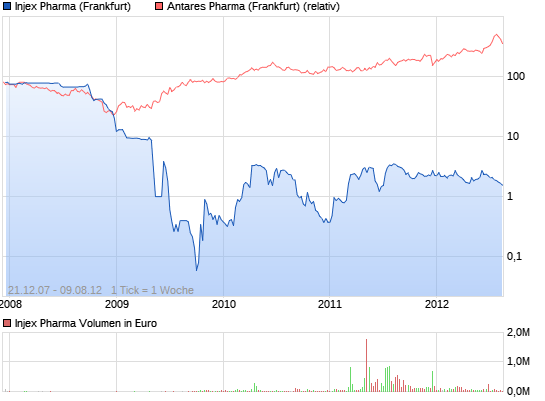
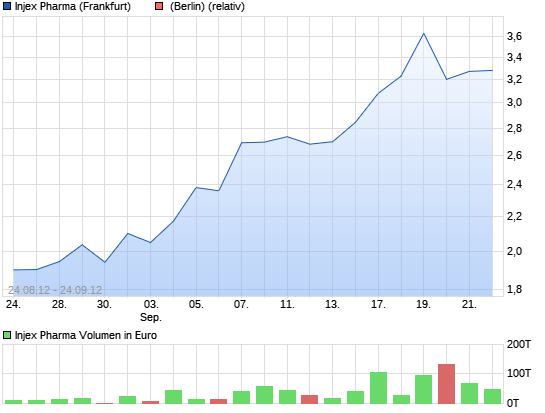
Wes du hast völlig vergessen diesen Monat den Vergleich Injex und Antares zu posten.
Ich übernehme das mal für dich... nach den Zahlen poste ich den nächsten Vergleich... Du solltest ja wissen, wie man in den Wald reinruft...
ups..... @Archon, schön das du mal ein vergleich eingestellt hast. da haben vielleicht so einige; ihre shares gewechselt ? schaun wir mal und beobachten mal die ganze sache weiter .... ;-)
|
Werbung
| Strategie | Hebel | |||
| Steigender Mercedes-Benz Group AG-Kurs | 5,00 | 9,88 | 14,88 | |
| Fallender Mercedes-Benz Group AG-Kurs | 7,78 | 10,59 | 14,51 | |
| Wertung | Antworten | Thema | Verfasser | letzter Verfasser | letzter Beitrag | |
4 | 281 | Antares ein kurzfristiger Vervielfacher? | Magnetfeldfredy | copywrites | 14.04.22 09:41 | |
| Eine Biotechakte was für die Wachlist | Biotecfan | 29.08.19 12:28 |