Anzeige
Meldung des Tages: 15 Mrd. USD für Polymarket – 16,5 Mio. USD für diesen Newcomer: Entsteht hier die nächste Blue-Chip-Story?
Neuester, zuletzt geles. Beitrag
Antworten | Börsen-Forum
Übersicht ZurückZurück WeiterWeiter
... 3142  3143  3145  3146  ...

Der USA Bären-Thread

Vontobel Werbung

Passende Knock-Outs auf DAX

Strategie Hebel
Steigender DAX-Kurs 5,00 10,00 15,02
Fallender DAX-Kurs 5,00 9,98 15,00
Den Basisprospekt sowie die Endgültigen Bedingungen finden Sie jeweils hier: DE000VM5A3V0 , DE000VG93YH8 , DE000VG93XM0 , DE000VJ13E13 , DE000VJ7C0K1 , DE000VJ8CKG8 .Bitte informieren Sie sich vor Erwerb ausführlich über Funktionsweise und Risiken. Bitte beachten Sie auch die weiteren Hinweise zu dieser Werbung.

Thema
abonnieren
Beiträge: 156.463
Zugriffe: 26.653.834 / Heute: 190
S&P 500 6.347,6 -0,74% Perf. seit Threadbeginn:   +335,07%
 
Anti Lemming:

Simon Johnson - US-Banken bald "too big to save"

2
30.03.11 14:04
d.h. die mit Nullzinsen dauer-alimentierten US-Banken sind bald "zu fett, um sie noch retten zu können".

Simon Johnson - Gefährlicher Giftcocktail in der Schuldenkrise

Amerikas Banken, die zu groß sind, um sie scheitern zu lassen, befinden sich auf gutem Weg zu groß zu werden, um sie zu retten. Letztlich kommt diese Entwicklung zu einem Ende, wie wir es in Island, Irland oder Griechenland erlebt haben - und diese Länder sind erst der Anfang...

www.ftd.de/politik/international/...chuldenkrise/60030222.html
Antworten
Dreiklang:

Kübi #573 Unterschätzung der FED

4
30.03.11 14:17

Aus dem verlinkten FTD-Artikel:

Amerikas Banken, die zu groß sind, um sie scheitern zu lassen, befinden sich auf gutem Weg zu groß zu werden, um sie zu retten. Dieser Punkt wird erreicht sein, wenn die Rettung großer Banken, der Schutz der Gläubiger und die Stabilisierung der Wirtschaft die USA so tief in Schulden stürzen, dass ihre Zahlungsfähigkeit in Frage gestellt wird, die Zinssätze drastisch ansteigen und eine Haushaltskrise ausbricht.

Das stimmt eben nicht. Die FED würde sich jeder Refinanzierungskrise mit jedem notwendigen Festplattengeld entgegenstellen. Solange die eigenen Bürger den $ als Zahlungsmittel akzeptieren, wirkt das auch.

Antworten
permanent:

ADP 201.000 Stellen in der Privatwirtschaft

5
30.03.11 14:18

geschaffen, leicht unter Erwartungen die bei 210.000 lagen.

In diesem Zusammenhang:
 

siebten Rückgang in Folge – fällt

die Erholung am Arbeitsmarkt weiter bescheiden aus. In der Spitze (1. Jahrshälfte

2008) waren in den USA über 146 Millionen Bürger erwerbstätig. Im Rahmen der

Krise sank diese Zahl auf knapp unter 138 Millionen (Dezember 2009). Bis zum Februar

dieses Jahres wurde immerhin eine Verbesserung auf 139,6 Millionen erreicht.

Bis die historischen Spitzenwerte wieder in Reichweite rücken, wird es aber wohl noch

einige Quartal dauern.

Antworten
Maxgreeen:

Ende Mai sieht alles wieder gut aus

6
30.03.11 14:20
Bis Ende März Weindow Dressing, dann Berichtsaison und Ende Mai Hausboom. Sell im Mai kann man vergessen.  :))

Home prices slide, but the end may be in sight
www.marketwatch.com/story/...be-in-sight-2011-03-28?link=kiosk


Und ausserdem,  nach dem Tief kann es nur steigen. Falls es doch noch tiefer geht ist das halt "unexpected". Und danach geht es aufwärts.
* Qualitätsposting ohne Zusatz von haarsträubenden Behauptungen
Antworten
permanent:

US Mortgage Applications Fall as Rates Rise

5
30.03.11 14:22
US Mortgage Applications Fall as Rates Rise
MORTGAGES, HOUSING, REAL ESTATE, CREDIT, LOANS, LENDING, ECONOMY, RECESSION, GOVERNMENT, FORECLOSURES, CONSUMERS
Reuters
| 30 Mar 2011 | 07:04 AM ET

Applications for U.S. home mortgages tumbled last week as higher interest rates sapped demand for loan refinancing, an industry group said on Wednesday.


The Mortgage Bankers Association said its seasonally adjusted index of mortgage application activity, which includes both refinancing and home purchase demand, fell 7.5 percent in the week ended March 25.

"As rates climb back to 5 percent, fewer homeowners have both the incentive and the ability to refinance," Michael Fratantoni, MBA's vice president of research and economics, said in a statement.


"Purchase volume remained roughly flat as we enter what is typically the peak home-buying season."

The MBA's seasonally adjusted index of refinancing applications dropped 10.1 percent, while the gauge of loan requests for home purchases slipped 1.7 percent.

Fixed 30-year mortgage rates averaged 4.92 percent in the week, up from 4.80 percent the week before.

Antworten
fkuebler:

Dreiklang #577: Bei Gas oberhalb von 10 USD/Gln...

7
30.03.11 14:25

"Das stimmt eben nicht. Die FED würde sich jeder Refinanzierungskrise mit jedem notwendigen Festplattengeld entgegenstellen. Solange die eigenen Bürger den $ als Zahlungsmittel akzeptieren, wirkt das auch"

... ginge es eben nicht mehr so einfach. DIe Amis sind zwar innovativ und brutal marketing-orientiert, andererseits aber (auch) insofern konservativ, dass niemand so offensichtlich in ihr Portemonnaie greifen dürfte.

Antworten
Anti Lemming:

Nein, die Gelddruckerei der Fed lässt sich

9
30.03.11 14:38
nicht beliebig fortsetzen, sie bleibt ein Spiel mit dem Feuer. Die Autorität und Glaubwürdigkeit der Fed wird dabei immer stärker infrage gestellt. Ich stimme fk in # 581 zu, ebenso den Ausführungen von Simon Johnson.

Für # 577 habe ich versehentlich "gut analysiert" gegeben. Es sollte "interessant" werden.

Die Schnapsidee, die Fed könne mit Billiggeld alle Probleme wegdrucken, steht ja auch im Brennpunkt von Johnsons Kritik. Er schreibt:

"Ein höherer Grad an Fremdkapital ermöglicht den Bankern höhere Verdienste, aber für die Aktionäre kann sich dies als gefährlich erweisen - weil die Bank dadurch anfälliger für den Zusammenbruch wird. Für den Steuerzahler und für alle Bürger ist dies furchtbar, weil sie die enormen Kosten zu tragen haben. ...Diesen Giftcocktail bezeichnen Mervyn King, früherer Wissenschaftler und gegenwärtig Gouverneur der Bank of England, und seine Kollegen als "Teufelskreis". Dahinter steht die Vorstellung, dass das Finanzsystem in jedem Fall durch Zentralbanken und staatliche Gelder gestützt wird, sobald es in Schwierigkeiten gerät. Dadurch werden die Verluste für die Aktionäre vermindert und beinahe alle Gläubiger verschont.

Infolgedessen haben Banken einen noch stärkeren Anreiz zur Kreditaufnahme (wie Admati argumentiert) und wenn steigende Vermögenspreise für eine Erholungsphase der Wirtschaft sorgen, können die Banken noch mehr Kredite aufnehmen (wie Bernanke weiß). In Wirklichkeit läuft das darauf hinaus, noch größere Risiken einzugehen und zwar ohne Regulierungen und Überwachung - und mit sehr wenig effektiver Kontrolle innerhalb der Banken... Natürlich werden sich die Wirtschaft in den USA und die Weltwirtschaft erholen. Aber diese Erholung wird wieder nur eine Phase in einem Boom-Bust-Rettungszyklus sein.
Antworten
Dreiklang:

Kicky 562

7
30.03.11 14:47

Schiff blames the Federal Reserve's loose monetary policy for the debasing of the U.S. dollar, rock-bottom interest rates coupled with QE1 and then QE2. If the Fed keeps this up, and continues to print money, he says the U.S. dollar could be worth less than toilet paper.

Dann würden $-Noten  in Rollenform mit Abreißperforation ausgegeben werden, evtl. auch mehrlagig. Damit wäre eine Gebrauchssteigerung erreicht. Der Dollar würde dann als "MPP" (multi-purpose-paper) in Umlauf gebracht.

Doch soweit wird es nicht kommen, solange Notenbanken und Politik der Auffassung sind, dass ein Absturz des $ unter allen Umständen zu vermeiden sei. Solange nämlich kann die FED Inflation  exportieren. Sehen wir an  der EMU - obwohl hier Sparen und Haushaltsbeschränkungen (teilweise) angesagt sind, findet sich die Inflation im Euro-Raum wieder.

Im BT wird die inflagene Politik der FED gerne ignoriert bzw. bezweifelt. Das ist mMn ein Fehler. Sollten Notenbanken wirklich eine Beschränkung der in $ gehandelten Werte durchsetzen (d.h. eine Verbuchung in Dollar bzw. Austauschwährung begrenzen) würde die FED für den gesäten Wind Sturm ernten. Doch es passiert aus politischen Gründen nicht. Aus Sicht der FED stellt QV sogar eine Aufwertung des Dollar dar (wegen der komplementären Wertbereitstellung im Außenhandel), was die Terms of Trade für die USA ständig verbessert, zum Schaden der eigenen Realwirtschaft. Die FED ist eben Diener des Staates und der Finanzwirtschaft, mit Helfern weltweit.


Antworten
Dreiklang:

Ach,

10
30.03.11 14:50

Für # 577 habe ich versehentlich "gut analysiert" gegeben. Es sollte "interessant" werden.

was hatte ich mich schon gefreut

Antworten
permanent:

Kreditanträge in Posting 580 zeigen wie

9
30.03.11 15:40

dünn das Eis ist auf dem sich die FED bewegt.

Sobald die Zinsen nur leicht steigen fallen die Kreditanträge sofort drastisch. Hier sieht man deutlich die Zinssenivität der Verbraucher.

Permanent

Antworten
Anti Lemming:

Dreiklang - die drei Lager hier im BT

13
30.03.11 15:46
sind

1. Deflations-Bären/Bond-Bullen (Schiene von David Rosenberg)

2. Inflations-Bullbären (Katastrophen-Hausse wegen Gelddruckens, teils auch Glaube an echten Aufschwung)

3. Doomsdayer (Goldapostel, Erwartung des Totalzusammenbruchs inkl. "Papiergeld wird wertlos").


Gruppe 1 (zu der fk und ich zählen) glaubt nicht, dass sich die Deflationstrendenzen (Unwind nach Platzen der Mega-Finanz-/Assetblasen) mit Gelddrucken der Fed kompensieren lassen. Soviel Geld, wie dazu nötig wäre, kann die Fed gar nicht drucken, ohne Weimar-/Zimbabwe-Assoziationen zu wecken und dabei komplett ihre Glaubwürdigkeit (offizielle "Politik des starken Dollars") zu verlieren. Wenn die Weltöffentlichkeit bemerkt, dass die Fed "das Lied vom Dollar-Tod" spielen will, geht ganz Amerika den Bach runter.

Gruppe 2 profitiert mMn von der gezielten Inflationsproganda (vor allem von den Rohstoff-Preistreibern) und von den dadurch geweckten starken inflationserwartungen, die weit höher sind, als es der tatsächlichen Inflation entspricht. Die Erwartung der "Inflationisten" - die zurzeit die Mehrheit bzw. den Konsens stellt und der Größen wie Warren Buffett das Wort reden - wird schon allein deshalb zur sich Selbst-erfüllenden-Prophezeihung, weil diese Gruppe über viel Geld/Macht verfügt, die Fed auf ihrer Seite hat und sich entsprechend positioniert (raus aus Bonds, rein in Aktien und Rohstoffe). Hinzu kommen intellektuelle (und teils böswillige) Verdrehungen. So behauptet etwa die Fed, die Erholung erzeuge eine hohe Rohstoff-Nachfrage, und nur deshalb würden die Rohstoffpreise so stark steigen - mMn eine Notlüge.

Die aus der Inflationserwartung resultierende "Katastrophen-Hausse" wird mMn aber nur temporär sein und sich auf längere Sicht als weitere Bärenmarkt-Rallye entpuppen. Grund: Die Masse aller einem Unwind harrenden Assets ist erdrückend groß, Zentralbanken haben nicht die Mittel, diese "wegzuinflationieren". Hinzu kommt, dass "der Konsens" meist falsch liegt. Das wird allerdings meist erst dann offenbar, wenn jeder Blödi und Hedgefonds "voll investiert" auf weitere Anstiege wartet, die dann aus eben diesem Grund nicht mehr kommen. Wir sind diesem Punkt nicht mehr fern. Die Cashquote der großen Fonds ist rekordtief, und die Lombard-Kredite (Spekulationen auf Kredit) sind nur ca. 10 % unter dem ATH von 2007.

Gruppe 3 ist ein Sonderfall mit teils religiösen Zügen - und nicht immer logischen Argumenten zugänglich. Was freilich nicht ausschließt, dass Gold nicht dennoch eine Zeitlang weiter steigt. Das wären aber mMn lediglich Anstiege im Kontext der laufenden "allgemeinen Assetblase" inkl. Rohstoffen. In einer wirklich schweren Krise wird auch Gold wieder abkacken - wie zuletzt 2008. Ein Grund dafür sind u. a. Margin-Calls in anderen gehebelten Long-Posis wie Öl und Kupfer, die Hedgefonds zur Liquditation aller flüssigen Assets (inkl. GLD) zwingen.
Antworten
Anti Lemming:

Und dann gibt es noch die

7
30.03.11 16:04
Vollidioten, die Neuemissionen wie Qihoo (QIHU) am ersten Handelstag auf mehr als das Doppelte des Emissionspreises treiben.

Die Aktie wurde mit 14,50 Dollar herausgegeben und steht aktuell bei 31,50 Dollar.

Solche Höhenritte zeigen in der Regel, dass die laufende Rallye sich in einem überreifen (d.h. grundfaulen) Zustand befindet, ebenso wie der Geisteszustand dieser Käufer. So etwas sah man zuletzt im Frühjahr 2000.

Qihoo 360 Technology shares double in first Nasdaq trades after IPO
(Verkleinert auf 97%) vergrößern
Der USA Bären-Thread 391972
Antworten
Anti Lemming:

Shark zur aktuellen Börsen-Lage

5
30.03.11 16:15
Rev Shark Blog
Straight-Up Action Is Hard to Trade
By Rev Shark
Street.com Contributor
3/30/2011 8:34 AM EDT


One thing this market has proved over and over again is how dangerous it is to try to anticipate a top. Once again we have a very strong gap-up opening brewing -- which isn't all that surprising, except for the fact that we have already gone straight up seven of the past nine days, ignoring bad news and technical resistance as if it didn't exist. A further extension mainly due to a weaker yen and better action in Japan isn't all that logical.

This is the same sort of one-way action that marked the rally from the end of August 2010 to mid-February 2011. Other than a correction in November, there was very little ebb and flow. The dip-buyers would jump in on the slightest pullbacks, and we went up in almost a straight line. The action caused a lot of consternation, not just for the serial top-callers who were endless squeezed, but also for active traders who were constantly trying to stay ahead of a market that offered so few entry points. If you weren't willing to chase extended chart patterns, you ended up staying quite underinvested.

Since the breakdown on the earthquake and nuclear issues in Japan, this market has acted in a similar fashion as it bounced. The negative news is now being totally ignored, higher crude oil doesn't matter, sovereign debt issues in Europe have had no impact and terrible housing news has been deemed irrelevant.

Market players who were shaken out on the spate of bad news now see the market going right back up, and fear that they will be left behind has kicked in once again. Since the bottom in the market two years ago, it has been tremendously easy to be underinvested if you harbor any doubts at all. Buy-and-hold bullishness has worked, although most everyone you talk with has a very hard time reconciling the positive action on Wall Street with their view of the economic health of Main Street.

Trying to make sense of this market has not been easy. In fact, if you think too hard, it is very easy to talk yourself out of some good trades. The way to deal with action is to stick with the uptrend as long as you possibly can and not try to call tops or reversals [D.h. man soll gefälligst über das Stöckchen, dass Fed/Goldman der Tradergemeinde vorhält (via Future-Gepushe) springen. Die Spielchen werden aber immer irrsinniger und unglaubwürdiger - selbst für Bullen - A.L.]

Of course it is never as easy as it sounds, and even if you do stick with trends and avoid calling tops, you are likely to find yourself underinvested if you make sales into strength and resist buying extended charts. That's bound to happen if you have a disciplined trading methodology -- there isn't any way to avoid it unless you want to reinvent your trading approach.

The strength this morning appears to be due mainly to a sharp pullback in the yen, which boosted Japanese stocks and spilled over to Europe. Also with the quarter quickly winding down, the window dressing pressures are at their peak, and that is likely helping as well. (Über die fragwürdige "Qualität" der Japan-Hausse hatte ich mich bereits heute morgen in meinem ersten Posting ausgelassen - A.L.)

Watch for an intraday reversal. Keep your eyes on the early lows. If we breach them, there is danger that profit-taking will pick up ... but also keep in mind that we have a strong tendency to make first-hour lows and then trade higher the remainder of the day.

The folks in the media love this straight-up action, but it is lot more challenging for the folks who have to actually trade it.
Antworten
permanent:

Foreclosure Aid Fell Short, and Is Fading

4
30.03.11 16:41
Foreclosure Aid Fell Short, and Is Fading
FORECLOSURE, PRESIDENT OBAMA, OBAMA, FORECLOSURES, FORECLOSURE RELIEF, MORTGAGES,
The New York Times
| 30 Mar 2011 | 08:56 AM ET

Last summer, as President Obama’s premier plan to save millions of Americans from foreclosure foundered, the administration tossed a new life preserver to homeowners.


Officials unveiled a $1 billion program to offer loans to help the jobless pay their mortgages until they could find work again. It was supposed to take effect before the end of the year, but as of today, the program has yet to accept any applications.

“We wait and wait, and they keep saying it’s coming,” said James Tyson, 50, a Philadelphia homeowner who lost his job a year ago.

That could be an epitaph for the administration’s broader foreclosure prevention effort, as tens of billions of dollars remain unspent and hundreds of thousands of homeowners have been rejected. Now the existence of the main program, the Home Assistance Modification Program, is in doubt.

Saying it is a waste of money, the Republican-controlled House voted on Tuesday night to kill the foreclosure relief program. The Senate, which the Democrats control, will pursue a rescue. But Democrats, too, consider the program badly flawed.

The effort has failed to stanch a wave of foreclosures and a decline in home prices, which have fallen for six consecutive months and are now just barely above their recession low, according to a key index updated on Tuesday. All of this threatens the fragile economy, which is also being buffeted by foreign crises.


“The banking industry fought us tooth and nail, and we ended up with a program that is failing homeowners,” said Representative Zoe Lofgren, a Democrat from California. “The administration doesn’t give us real enforcement or answers; we just get the old yokey-doke.”

Yet the need remains great. There were 225,000 foreclosure filings in February, according to RealtyTrac. About 145,000 homeowners are in trial modifications under the Obama program. An examination of federal documents and lawsuits, and interviews with legislators, state attorneys general, housing counselors, homeowners and regulators, reveal a federal mortgage modification program crippled by weak oversight, conflicts of interest, mind-numbing complexity and poor performance by many participating banks.

For example:

  • Congress set aside $50 billion for foreclosure prevention, amid administration projections that three million to four million homeowners would benefit from modifications. So far, the Treasury Department, which oversees the program, has spent slightly more than $1 billion, and just 607,000 homeowners have received permanent loan modifications (of those, 11 percent have defaulted).
  • The companies that service mortgages, typically large banks, continually lose homeowner paperwork and incorrectly tell homeowners that they must be delinquent to qualify.
  • Treasury officials have not fined any servicers, and the government-controlled company hired by the Treasury to oversee the program has expressed reluctance to crack down on banks.

    Interviews with a dozen homeowner applicants in four states reveal a familiar pattern: Banks deny many who, by income and credit scores, appear to qualify. And homeowners end up weighed down by legal fees and facing foreclosure.

    “I call constantly, they lose all my paperwork, and the same guy never gets on the phone,” said Ada Caceres, 53, who owns a modest home in Staten Island.

    Ms. Caceres has struggled to make mortgage payments since her hours as a bartender were cut. She applied for relief, and her bank, JPMorgan Chase, twice granted temporary modifications. She made every payment.


    Last August, Chase promised a permanent modification. Then it rescinded the offer, documents show.

    “I love my house,” said Ms. Caceres, who is still negotiating. “It’s a good neighborhood. But oh my God, you want to just give up.”

    Homeowners can appeal denials, but the odds are not in their favor, says the program’s inspector general. A first step is a hot line providing counseling, from an agency created by mortgage servicers.

    Treasury officials argue that the mortgage program has kept more than half a million American homeowners out of foreclosure and has pressured banks to offer in-house modifications. These private modifications, however, typically offer terms significantly less favorable to homeowners than what the government program offers.

    Michael S. Barr, who was a top Treasury official involved with the program, says the Obama administration sought to help homeowners and encourage banks even as it protected taxpayers.


    “We tried to bring some order out of the chaos,” said Mr. Barr, now a University of Michigan law professor. “Taxpayer money was only used for successful modifications. I think that was directionally the right thing to do.”


    In the winter of 2009, the Obama administration’s urgency to address foreclosures was palpable. Hundreds of thousands of families had lost homes, and in towns from Florida to California to Nevada, foreclosure slums took root, marked by boarded-up homes and uncut grass.

    Treasury officials invited Neil M. Barofsky, the special inspector general for the bank bailout, to discuss a rescue plan. They told him details of the plan were still weeks away. “That night, I was driving home and I heard on the radio that the president was going to announce it next Wednesday,” Mr. Barofsky recalled. “It was a ‘ready, fire, aim’ approach.”

    Ready or not, President Obama announced the housing assistance program on Feb. 18, 2009. Banks and mortgage brokers could extend mortgages, or cut the amount of the loan or the interest rate. A monthly payment could not exceed 31 percent of gross income.

    In return, the administration offered payments to banks and servicers.

    “It will give millions of families resigned to financial ruin a chance to rebuild,” Mr. Obama said. “By bringing down the foreclosure rate, it will help shore up housing prices for everyone.”


    None of those hopes came to pass.

    In fairness, Mr. Obama confronted a daunting challenge: a foreclosure crisis without precedent since the Great Depression. The Bush administration already had tried several weak foreclosure relief programs.

    In October 2008, as financial calamity loomed, President Bush signed the $700 billion bank bailout known as the Troubled Asset Relief Program, or TARP. At the insistence of Congressional Democrats, he agreed to plow billions of dollars into foreclosure prevention.

    When the newly elected Obama administration drew up program guidelines, officials concluded they could neither force servicers to participate nor fine them for poor performance.

    This, critics say, was a mistake.

    “The banks were so despised, and TARP was so front and center, you could have actually done something,” said Katherine M. Porter, a visiting law professor at Harvard. “In the midst of real boldness in bailing out the banks, we get this timid, soft, voluntary conditional program.”

    Treasury officials say this is an unfair accounting. In those harried days in early 2009, no one knew how much stress near-insolvent banks could withstand. And officials tried to fine-tune the mortgage program, adding elements and redirecting unused billions of dollars into the most distressed regions.

    Each new version, however, added layers of complication.

    Administration officials also cite unrealistic expectations, saying they underestimated the complexity of modifying millions of troubled loans. “I wish the three to four million had never been uttered,” said Peter Swire, a former special assistant to Mr. Obama for economic policy.

    Critics wave off such arguments. The Obama administration, they say, could have flexed its muscles.


    The president could publicly challenge bank officials. Treasury officials could withhold payments. The administration could buy troubled mortgages at a discount and modify loans on its own.

    “We needed to go out and fine the five worst offenders,” said a former administration official familiar with internal discussions, who was not allowed to talk publicly given his current position. “In hindsight, I’m almost certain we would have been well served by taking the risk and being challenged in court.”

    To listen to a handful of Bank of America employees speak candidly about the mortgage program is to hear deep frustration with their bank’s performance. Their accounts, offered on the condition of anonymity as they are not allowed to talk to the press, dovetail with lawsuits filed by state attorneys general in Nevada and Arizona. (A coalition of state attorneys general is pushing an expanded foreclosure rescue plan that would impose fines on recalcitrant banks.)

    Bank of America, these employees say, routinely loses documents. One department does not talk to another. Applications drag on for more than a year. Sometimes the bank forecloses while homeowners are paying modified loans. And homeowners who are denied face an imposing bundle of late fees and back-payments.


    A bank employee says she often advises homeowners not to apply, given the slim chances for success.


    “Many of these people are losing their homes,” she said. “The paperwork that sets them up is not detailed enough. It does not tell the customer the consequences of going forward with this.”

    Dan B. Frahm, a Bank of America spokesman, acknowledged that the bank had made its share of mistakes, including losing too many documents. But it faced a narrow window to carry out a complex and ever-changing program, he said.

    “We have completed more modification under HAMP (106,000) than any other participating servicer, and have more active modifications than other participants as well,” Mr. Frahm wrote in an e-mail, using the program’s shorthand name. “We continue to improve performance.”

    For years, loan servicing departments acted as money machines for banks. They collected payments and foreclosed on the occasional delinquent homeowner.

    But a foreclosure flood rolled in by 2007, and servicers all but drowned. The government’s program added to the problem. At first, Treasury allowed homeowners to apply without proof of income, figuring that quick relief might save homes. It later demanded income verification, loosing another flood, as homeowners sent in piles of documents by fax.


    Federal regulators added their own confusion of overlapping authority and conflicts of interest.

    Treasury hired Fannie Mae and Freddie Mac, two government-controlled mortgage finance giants, to oversee the program. This decision was problematic. As the Congressional Oversight Panel noted, these agencies “are highly conflicted because they hold the credit risk on most mortgages in the United States and have their own operational concerns.”

    As if to underscore that point, Freddie Mac filed documents with the Securities and Exchange Commission noting that imposing penalties on banks could “negatively impact our relationships with these sellers/servicers, some of which are among our largest sources of mortgage loans.”

    Treasury has paid the agencies a combined $212 million to administer the program.

    The Treasury Department, too, was a reluctant enforcer, declining to impose fines or demand repayments. “This was structured as a voluntary program,” said Timothy Massad, acting assistant secretary. “We do not have the power to impose fines.”

    Mr. Barofsky, the special inspector general, waves off protestations of powerlessness. How, he asked, could Treasury sign agreements to pay billions to banks without penalties for failure to comply?

    “Treasury wasn’t willing to kick them in the only place that matters: in the pocketbook,” he said.


    In private conversations, senior Treasury officials offer an often-heard critique: Homeowners failed the program. That is, Americans were in far worse shape — jobless, underwater on mortgages and with terrible credit — than anyone realized in 2009.

    Daily encounters in county courthouses suggest this is overstated. Homeowners bring in foot-high piles of paper documenting income, credit reports and loan payments. Some missed a payment or two, but many are not deadbeats.

    Yet they cannot obtain a modification.

    In Staten Island, The New York Times examined eight cases where homeowners seemed to possess the income and credit scores to qualify for the program. Yet after months of trying, even with the help of Staten Island Legal Services, not one has obtained a permanent modification.

    Any single case speaks as eloquently as another.

    Eric and Annette Padilla bought their home in 2003. Then Mr. Padilla fell ill and Ms. Padilla quit her job to care for him, and the couple fell behind on their mortgage in 2009. (Their income dropped to less than $60,000, from $96,000.)

    They applied for the program through their bank, HSBC, and received a three-month modification. They made the payments on time. In August 2009, they requested a permanent modification.

    The Padillas called the bank every week. One representative said their file was incomplete, another asked for more documents, a third said the documents were there all along.

    In September, the bank said their documents had “become stale” and told them to resubmit. Eventually, they were given a new temporary modification. Once again they made every payment on time.

    In January 2010, they sought another permanent modification. Then they heard back from HSBC: denied. The reason? The couple had overpaid one month.

    Last summer, HSBC filed papers to foreclose against the Padillas. For Mr. Padilla, 41, the house was his step out of the housing projects; he has no intention of surrendering.

    “I ask myself sometimes, why is this happening?” he says. “Wasn’t this program set up for hard-working people like us?”


Antworten
wawidu:

AL # 78587

2
30.03.11 17:03
Zur Erinnerung und Warnung:
(Verkleinert auf 90%) vergrößern
Der USA Bären-Thread 392001
Antworten
Malko07:

EU schwächt Grenzwert für verstrahlte Lebensmittel

10
30.03.11 17:12
Der USA Bären-Thread 10185051
Verbraucherschutz paradox: Die EU ändert wegen der nuklearen Katastrophe in Fukushima-1 die Grenzwerte für Radioaktivität in Lebensmitteln aus Japan. Für die Zeit der Krise dürfen nun stärker strahlende Produkte eingeführt werden.


Man lese aufmerksam und erinnere sich welche Werte die letzten Tage in Japan angeblich katastrophal waren, z.B. im Trinkwasser in Tokio.
Antworten
permanent:

Metalle sind stark unter Druck

7
30.03.11 17:13

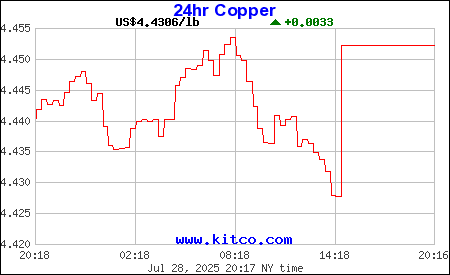
Neben Buntmetallen sind die Edelmetalle heute ebenfalls unter Abgabedruck.

Kupfer als Beispiel für Buntmetalle:
Der USA Bären-Thread 10185061

Antworten
pfeifenlümmel:

zu #591 Die menschlichen

4
30.03.11 17:46
Ausscheidungen nach dem Konsum japanischer Lebensmittel  sollten aber unbedingt zur Endlagerung zurück nach Japan gehen!
Antworten
Anti Lemming:

Man kann die Atomkatastrophe auch

9
30.03.11 17:56
bewältigen, indem man die "tolierbare Jahresdosis" um den Faktor 100 hochsetzt. Dann ist plötzlich alles ungefährlich und man kann sogar Spinat aus Fukushima essen.

Bei den AKW-Arbeitern wurde es genauso gemacht. Da wurde die zulässige Jahresdosis von 100 auf 250 Millisievert erhöht. Manche Arbeiter haben sich das schon in einer Viertelstunde eingefangen, da die Strahlung teils bei 1 Sievert lag (im Tunnel zur Turbine, wo die Kabel verlegt wurden).


Zu Divergenz Kupfer vs. Aktien. Aktien steigen noch wegen Windowdressing der Fonds. Bei Kupfer (fallender Chart in # 592) gibt es kein Window-Dressing, weil die großen Fonds überwiegend in Aktien und Bonds investieren. Die These, dass Kupfer den Aktien nach unten vorläuft, könnte sich durchaus bewahrheiten.
Antworten
Malko07:

#78593: Vor allem wird

5
30.03.11 18:15
man demnächst die Grenzwerte für Fisch erheblich herauf setzen müssen. Dabei braucht der Fisch gar nicht aus Japan zu kommen.

Die wirklich gefährlichen Teilchen erzeugen nur wenig Strahlung, da Alphastrahlung und werden deshalb meistens nicht erfasst. Z.B. Plutonium.

Aber die Japaner wollen jetzt die Kraftwerke mit Harz aus Drohnen bepinkeln und Leichentücher ausbreiten - was will man mehr?
Antworten
pfeifenlümmel:

Möchte mal gern wissen,

7
30.03.11 20:00
wieviele Nachrichtenseher ( mit dem 2-ten sieht man besser ) um 19.00 Uhr die entscheidende Meldung gehört haben. Werbewirksam sah man Frau Aigner, wie sie den Geigerzähler über die Lebensmittel schwenkte. Dazu kam die Meldung, dass alle Lebensmittel aus Japan nun streng kontrolliert werden. Erst in einem Nebensatz hieß es, dass Kritiker eine Erhöhung der Toleranzwerte bemängeln. Da freuen wir uns, dass wir unseren malko haben ( halb ernst, halb grins ).
Antworten
Anti Lemming:

Rettungsschirm für Portugal immer wahrscheinlicher

 
30.03.11 20:24
www.handelsblatt.com/finanzen/...wahrscheinlicher/4005636.html
Antworten
pfeifenlümmel:

Die Windfritzen wie

8
30.03.11 20:55
Vestas und Nordex liegen in der langfristigen Betrachtung weit hinter dem Dax zurück. Das sollte sich nun aber ändern. Die Politik muss nachgeben und kann die Windkraft zumindest in Deutschland nicht mehr zurückhalten. Die Entwicklung der Windkraft in den übrigen Ländern wird sehr viel von der Entwicklung in Japan abhängen. Meiner Meinung nach ist die Tepco schon lange mit ihrem Latein am Ende. Immer wieder Nickerchen und sonst tote Hose. Nimmt die Verseuchung in Japan zu ( leider rechne ich damit ), werden selbst die duldsamen Nickerchenempfänger anders über ihre Kernkraft denken müssen! Die gesamte Welt wird nchdenklich werden, je länger der radioaktive Qualm aufsteigt. Und auch Madame Aigner kann sich ihre Fuchtelei mit ihrem Geierzähler an ihren Hut stecken.
Antworten
Kicky:

Vorsicht bei Kupfer

8
30.03.11 22:21
ftalphaville.ft.com/blog/2011/03/28/529196/...use-for-concern/
We’re calling it the “The Great Chinese Commodity-as-Collateral Financing” fiddle.

That is, the purchase of commodities like copper on deferred payment terms for the sole purpose of raising cheap financing for reinvestment in higher yielding assets.

We’ve raised the alert before, but now thankfully more and more analyst research seems to be catching on.

The latest comes in the shape of a Standard Bank note by a team freshly back from a Chinese field trip (H/T the FT’s Jack Farchy).

China trip report — copper market a real cause for concern”.

Here are some particularly useful anecdotes we found from the note....
• Anecdotally, something in the region of 600,000 mt of refined copper is currently sat in bonded warehouses in Shanghai, with perhaps another 100,000 mt in the southern ports. This is equivalent to around 11% of China’s total refined consumption and around 40% of China’s net refined copper demand.

• Bonded stocks have climbed by around 300,000 mt since the beginning of this year, pointing to the absence of end use demand at the moment. The amount of metal is so high, that spare capacity at some bonded warehouses is running out, with some metal being stored outside.

• The scale of the refined inventory casts into doubt the size of the expected refined deficit in the copper market this year, and raises the prospect of a balanced market, or even a small surplus.

• More worryingly however is that the primary use of copper in bonded warehouse appears to be as a financing mechanism to provide cheap working capital for various types of business often unrelated to the metallic industry.
Initially via a letter of credit and then by using deferred payment LC, they create a borrowing vehicle. Estimates for the amount of metal tied up in such a way range from 40-80% of total bonded stocks. Our estimates are towards the upper end of this range.

• Property developers (or the property developing arms of conglomerates), appear to be behind the lions share of this type of activity, driven by an unwillingness by domestic banks to extend finance, or the imposition of interest rates of anything from 10-20% when they do. On that basis, interest rates on metal of LIBOR + cost of funding look very attractive indeed.

The big news of course is that Standard Bank attributes the lion’s share of the commodity “fiddle” to property developers.

That means, in their opinion, not only is the arrangement exposed to falling copper prices, it’s equally vulnerable to falling Chinese real-estate prices. Potentially, more so.....
Antworten
Kicky:

Obama unterzeichnete Geheimbefehl z. Unterstützung

5
30.03.11 22:29
www.reuters.com/article/2011/03/30/...er-idUSTRE72T6H220110330
(Reuters) - President Barack Obama has signed a secret order authorizing covert U.S. government support for rebel forces seeking to oust Libyan leader Muammar Gaddafi, government officials told Reuters on Wednesday.

Obama signed the order, known as a presidential "finding", within the last two or three weeks, according to four U.S. government sources familiar with the matter.

Such findings are a principal form of presidential directive used to authorize secret operations by the Central Intelligence Agency. The CIA and the White House declined immediate comment.

News that Obama had given the authorization surfaced as the President and other U.S. and allied officials spoke openly about the possibility of sending arms supplies to Gaddafi's opponents, who are fighting better-equipped government forces.
....
Obama said the U.S. had not ruled out providing military hardware to rebels. "It's fair to say that if we wanted to get weapons into Libya, we probably could.
Antworten
Auf neue Beiträge prüfen
Es gibt keine neuen Beiträge.

Seite: Übersicht ... 3142  3143  3145  3146  ... ZurückZurück WeiterWeiter

Börsen-Forum - Gesamtforum - Antwort einfügen - zum ersten Beitrag springen
Vontobel Werbung

Passende Knock-Outs auf DAX

Strategie Hebel
Steigender DAX-Kurs 5,00 10,00 15,02
Fallender DAX-Kurs 5,00 9,98 15,00
Den Basisprospekt sowie die Endgültigen Bedingungen finden Sie jeweils hier: DE000VM5A3V0 , DE000VG93YH8 , DE000VG93XM0 , DE000VJ13E13 , DE000VJ7C0K1 , DE000VJ8CKG8 .Bitte informieren Sie sich vor Erwerb ausführlich über Funktionsweise und Risiken. Bitte beachten Sie auch die weiteren Hinweise zu dieser Werbung.

Neueste Beiträge aus dem S&P 500 Forum

Wertung Antworten Thema Verfasser letzter Verfasser letzter Beitrag
29 3.820 Banken & Finanzen in unserer Weltzone lars_3 youmake222 28.03.26 19:20
469 156.462 Der USA Bären-Thread Anti Lemming ARIVA.DE 27.03.26 16:00
  56 PROLOGIS SBI (WKN: 892900) / NYSE 0815ax Lesanto 06.01.26 14:14
    Daytrading 15.05.2024 ARIVA.DE   15.05.24 00:02
    Daytrading 14.05.2024 ARIVA.DE   14.05.24 00:02

--button_text--