Wegen der unerwarteten Resonanz auf # 446 möchte ich mich zu dem Trade ausführlicher äußern. Zunächst: Die Position macht 1 % meines Depots aus, es handelt sich daher um Spielgeld.
Die Gefahr, in einen intakten Uptrend (von TLT, dem Underlying von TBT) zu shorten ist evident. Mein long in TBT ist als kurzfristiger "Scalp"-Tradegedacht, der darauf abzielt, dass auf die Kaufpanik in TLT in dieser Woche am Anfang der nächsten Woche ein Rücksetzer kommt (techn. Korrektur im Uptrend). Ansonsten bin ich im Depot in Shorts investiert, im Einklang mit dem von mir erwarteten Deflations-Szenario. TBT fliegt bei Verlusten schnell mit SL raus.
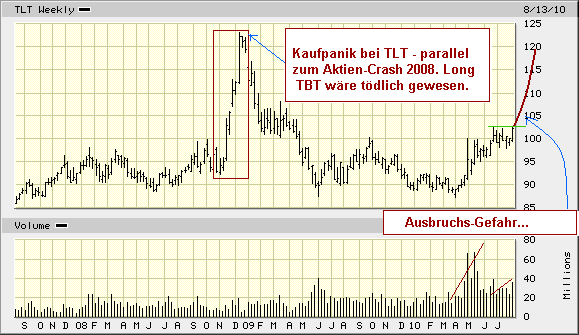
Longs oder Shorts in langlaufenden US-Staatsanleihen sind ein äußerst kompliziertes Kapitel. Man denke nur an Herbst/Winter 2008, als Aktien in Grund und Boden stürzten und TLT fahnenstangenartig auf 120 hochschoss (Chart unten). Seit April bewegt sich TLT entgegengesetzt zum SP-500, stieg also deutlich (dasselbe sieht man beim Bundfuture). TBT als Doppelshort auf TLT fiel in der Zeit entsprechend. Es gibt Leute, die sagen, dass ein Long in TBT einem Long im SPY (bzw. SSO = Doppellong auf SPY) entspricht.
Das ist aber etwas verkürzt, denn wenn in USA reale Inflation aufkommt - z. B. durch fortlaufende Nullzinsen TROTZ realen Preissteigerungen von 2 bis 3 % (was manche bereits jetzt sehen) - , dann könnte es mittelfristig für US-Langläufer nicht so toll aussehen. In der starken Inflation der 1970-er Jahre verloren US-Longbonds sogar zeitweise 50 % ihres Kurswertes. Aktien gingen damals ebenfalls in den Keller. Man kann im Fall aufkommender deutlicher Inflation also davon ausgehen, dass sich die bisherige anti-parallele Entwicklung von SPX und TLT (die typisch ist für ein Deflations-Szenario) dann in eine Parallelbewegung umkehrt (d.h. nicht nur Aktien fallen wegen Inflation, sondern auch die Longbonds).
Die Sache ist mithin äußerst kompliziert. Zur Info unten noch ein Artikel des Street.com-Bond-Spezialisten Tom Graff, der obige Inflationsentwicklung latent kommen sieht und aggressiven Tradern einen "Pair Trade" empfiehlt aus einem Long in Bonds mittlerer Laufzeiten (3 bis 7 Jahre), gehedgt durch einen Short auf Langläufer (30 Jahre).
Meine kleine Posi korrespondiert mit der "Komplikation" dieses Trades. Als Zock (wie von mir geplant) ist das egal (bei engem SL), nicht aber bei einer strategischen Posi - die manche hier im Thread ja mit "long US-Longbonds" haben...
Graff ist, wie viele US-Bondspezis, eher bullisch, was die US-Wirtschaftsentwicklung betrifft. Ich stimme seinen Thesen in vielen Punkten nicht zu (unten jeweils in Klammern). Es ist aber interessant zu lesen, wie die US-Bonds-Profis zurzeit ticken. Sie gelten zwar als smart (und smarter als Aktienanleger), doch auch Sie sind vor Irrtümern nicht gefeit. Zu den realistischeren Bond-Profis zählen für mich die Leute von PIMCO. Doch das bärische Zeug, was Gross und Co. seit Monaten von sich geben, könnte auch Sell-Side-Gewäsch sein, um die Meute in die falsche Richtung zu schicken. Graff ist in dem Punkt wohl ehrlicher.
Bonds
Bondlife: A License to Kill
By Tom Graff
Street.com Contributor
8/13/2010 5:15 PM EDT
Although many think the Federal Reserve is out of bullets, it actually has unlimited firepower when it comes to its inflation-fighting ability. And now the Fed is telling us that it is about to unleash its super-weapon: the printing press.
The Fed is on a path that will inevitably lead to additional quantitative easing (QE). In this week's Bondlife, we'll examine how another round of QE will work, and what you should (and should not) own to profit from it.
Interest Rates and the Fed: You Only Live Twice
It is often said that the first round of quantitative easing failed because the printed money just got stuck at the banks in the form of excess reserves. We know that as the Fed was purchasing more and more assets for its own balance sheet, the level of excess bank reserves was rising in an almost-one-for-one fashion. If one buys this argument, it would follow that additional QE would do nothing more than generate even more excess reserves and not create any kind of monetary stimulus at all.
This view shows a fundamental misunderstanding as to how QE works. First, the banks didn't get the QE money directly. This is clear once one considers the actual process the Fed used for buying bonds. When the Fed was buying government-sponsored-enterprise debt, it would announce the range of maturities it was going to buy on a given day and would take offer levels from investors. I participated in this process myself. I would call up a primary dealer and tell them what bond I was willing to sell and at what price.
I never got lifted by the Fed (because I was hoping at some point the Fed wouldn't get enough offerings and would lift an off-the-market level). But had I been, the Fed would have paid my clients for the purchase. The primary dealer I used was just an intermediary. Once my clients had the cash, they could have spent it on anything they chose. [Ähnliches gilt im Prinzip für die Aktienkäufe der Zockerbanken... A.L.]
No matter what a recipient of Fed cash actually does with the capital, the money eventually winds up in the banking system. Say, for instance, that I sell a bond to the Fed and then choose to buy a new Chevy Malibu. Some of that money would go to the dealer, some of it to the dealer's employees, and some of it to GM. Those recipients, in turn, deposit the money in their banks.
Here's another example. Instead of buying that new car, say I choose to reinvest the proceeds from my Fed sale in another bond -- a new issue for IBM. Where does that money go? Into IBM's bank account. Or say I just want to sock the proceeds away for a rainy day. It the money would then just go into my own bank account. This is a bit of an oversimplification, as some of these transactions would have several iterations, but you can see that ultimately all money flows through the banking system.
You can see that the Fed's newly printed money could flow through several hands before making it to the banking system. In the scenario where I bought a car, perhaps the car salesman buys a new TV with his commission check, then perhaps the retailer who sold the TV spends his profits on buying more inventory, then the manufacturer spends its profits on the company Christmas party, the caterer sends her daughter to college with her profits, etc., etc.
Notice that a bank's willingness to lend doesn't come into the equation at all. It is consumers' willingness to spend that determines whether or not the money flows through the economy productively. [Das ist DAS Argument für "unser" Deflations-Szenario... - A.L.]
The fact that neither consumers nor businesses are willing to spend/invest, and instead are holding large cash balances, tells us all that we need to know about interest rates. They are too high. [MMn ein Monetaristen-Irrtum - A.L.] Economic agents know the rate of return on cash is zero, and they are happy with that. If we want this cash to be utilized in the economy, we have to make the return on cash less than zero.
Only through creating inflation is this possible. Nominal interest rates can't fall below zero, but real interest rates can if we get enough inflation. Put another way, if the nominal rate on cash is zero, but inflation is 2% or 3%, then there would be a clear disincentive to just hold cash. In real terms, cash is a sure loser.
All the Fed needs to do is create expectations of higher inflation and spending will follow. [Da hab ich meine Zweifel, warum sollten Babyboomer ihre Rente mit Flat-TVs und Reisenv verpulvern? - A.L.] With the right QE program, creating these expectations should be fairly easy. What if the Fed simply told the world they would buy as many Treasuries as necessary to push inflation above 2%? They announce no limit in size, no timing of purchases, just that they want to push inflation higher by any and all means necessary. You don't think inflation expectations would rise?
Treasury Bonds: Die Another Day
The consequence of all this for Treasury bonds is eventually going to be a bear steepening of the yield curve. As a practical matter, the Fed will hold short-term interest rates at the current level, but long-term inflation expectations will cause long-term bonds to increase in yield. Turning this into a trade gets a bit tricky, though.
With the Fed holding short-term rates so low, could we see five-year to seven-year bonds hold in (or even rally) while 30-year bonds sell off? Absolutely. So a generalized bond short is a mistake. But moving money more into the middle of the curve, say three to seven years, should significantly outperform holding the tails. A more aggressive trade would be to buy five-year to seven-year bonds vs. a 20-year to 30-year-bond short position.
Corporate Bonds: Dr. No
Corporate bonds are the tell for whether the Fed's efforts are working. We are looking for a surge in corporate bond issuance as the indicator that companies are re-allocating away from cash and into real investments. [Warum sollten Firmen investieren, wenn die Umsätze sinken wg. hoher AL und bereits jetzt Überkapazitäten drücken? - A.L.] As long as corporations refuse to borrow, I can only conclude that interest rates aren't low enough to make an equilibrium. [erneut: Monetaristen-Irrtum]. Again, this gets back to the need for some inflation. Even a slew of stock buy-backs would be hugely positive for the economy.
High-yield would be a clear winner in a mild inflation uptick. Inflation benefits debtors and hurts lenders, but in the case of high-yield companies, a little inflation would help improve revenues and thus credit quality. [Was passiert, wenn die steigende Inflation Leute aus Junkbonds aussteigen lässt - Abwärtsspirale? A.L.] Investment-grade corporate bonds would get some credit-quality benefit but it would be relatively small. I think it is actually safer to be a bit lower on the quality scale. [Das scheint mir eine Schnapsidee, aber dennoch interessant zu wissen, wie US-Bondprofis hier ticken - A.L.]
Mortgage-Backed and Agency Bonds: Live and Let Die
With the Fed now letting its portfolio of mortgage-backed securities (MBS) die, does this have a large impact on MBS trading? It Shouldn't.
I estimate that the MBS run-off amounts to about $10 billion to $20 billion per month. Not a very large amount in the scheme of a $9-trillion mortgage market. The bigger problem faced by the MBS world is a potential increase in interest-rate volatility. Right now, volumes are extremely low as the world is pricing in a Fed on perma-hold. But aggressive QE changes the equation. [Meint Graff damit "Weimarer Geldgedrucke?" - A.L.]
Even if the direction of yields in uncertain, clearly the level of uncertainty would go up. Since MBS are essentially a covered-call trade, rising volatility will impact prices directly. But perhaps more important is that the market will start pricing the possibility of rising rates, and thus the extension of the average lives in MBS.
There is very good value here in low-coupon 15-year MBS, where the variance in potential average life is more contained. But readers who are hanging out in a broad MBS fund may want to look elsewhere.
TIPS: Goldfinger
Treasury inflation-protected securities (TIPS) had a poor week, up about 0.25 points for the week vs. the 10-year Treasury, which was up 1.25 points. Breakevens fell to 1.67% in the 10-year area, the lowest since September 2009.
Despite this, I remain bullish on TIPS. With the Fed clearly becoming more aggressive, I doubt breakevens fall materially from here. So you have little downside. Your upside comes if the next round of QE really works and we get an inflation spike. No matter how you set the odds of either scenario, TIPS make a ton of sense.
Municipals: The Living Daylights
Its muni lag time again. That is, the Treasuries have rallied so aggressively that municipals have become unusually cheap. [Die US-Bundesstaaten sind auch "ungewöhnlich pleite" - A.L.] Ten-year-and-longer munis are widely available at 100% or more of Treasuries. When Treasury bonds are rallying, retail investors choke on the absolute yield. They look at how low the yield is and just refuse to buy.
But after a few weeks of earning nothing in cash, they give in and buy a mutual fund. Last week we saw just under $1 billion in new flows into muni funds and, despite this, munis kept lagging Treasuries. Note also that the 10-year to 15-year segment of the yield curve is much cheaper than the front-end. Again, this is related to retail flows. Most investors are afraid to push out the curve. Don't be. I suspect that, as Treasury rates rise, intermediate-term munis will just hold in place, and you'll earn so much more yield in the interim.
Chart von TLT
Bei einer Wiederholung des Aktiencrashs von 2008 (gemäß "Hindenburg-Omen" nicht unwahrscheinlich) könnte TLT erneut in Kaufpanik "durch die Decke" gehen. Long TBT wäre dann tödlich (außer man hat eine kleine Posi und lässt sie laufen, denn 2009 ging es ja auch stark wieder runter...). Besser freilich ist ein enger SL in TBT. Käme überraschend Inflation auf (im Tom-Graff-Szenario durch extremes QE der Fed), könnte TLT allerdings im 1970-er Stil [Stagflatons-Szenario] in die Knie gehen und im Extremfall bis zu 50 % verlieren. Long TBT wäre dann eine Goldgrube, vermutlich ebenfalls Longs in Gold. Leute, die gleichzeitig long in Gold sind und long in US-Langläufern, würden dann in zumindest einem der Trades falsch liegen. (Verkleinert auf 96%)


 Zurück

 Werbung