Neuester, zuletzt geles. Beitrag
Antworten | Börsen-Forum
Übersicht ZurückZurück WeiterWeiter
... 2314  2315  2317  2318  ...

Der USA Bären-Thread


Beiträge: 156.441
Zugriffe: 26.300.431 / Heute: 1.111
S&P 500 6.827,61 -1,07% Perf. seit Threadbeginn:   +367,97%
 
Malko07:

daiphong, seit einiger Zeit

13
23.02.10 15:50
prognostiziere ich einen kommenden starken US-$, was ich auch erläuterte, es aber nie als "absolute" Wahrheit darstellte.  Das war lange Zeit hier eine Todsünde. Wie kann man nur einen stärkeren $ erwarten, pfui!  So wie es jetzt auch eine Todsünde ist, von mindestens temporär steigenden US-Staatsanleihekursen und US-$  bei absteigenden Aktien- und Rohstoffpreisen auszugehen. Keiner kann darauf bestehen, dass seine Zukunftssicht stimmt. Nur wenn man eine andere Meinung als die "Leitung" hat, wird fast eine religiöse Schlacht losgetreten. Wie kann man sich nur anmaßen "Widerstand" zu leisten?! Das war auch schon so, als ich mich ziemlich alleine gegen die verquere Inflationstheorie stellte. Tut mir Leid, eine plausible Linie, wenn man etwas größere Zeiträume als einige Wochen summiert, kann ich nicht erblicken.  Ich war ja schon ein Depp als ich anfänglich mit der Griechenlandkrise auf den ganz normale $-CT hinwies, der jetzt plötzlich wieder maßgebend ist. So ist ja auch jede Anlageklasse Schrott.  Wozu diskutiert man dann noch? Alles bricht zusammen und die Derivate werden ausbezahlt. Lachhaft!

Die Sicht ob die Aktienkurse noch steigen werden oder demnächst feste in den Keller fallen werde sei jedem selbst überlassen. MMn weiß es keiner und damit bleiben derartige Prognosen Spekulationen und werden keine absolute Wahrheiten. Spekulieren darf man.
Antworten
CarpeDies:

Dem Dax geht ggü Dow

 
23.02.10 15:50
die Puste aus. Er kann dem Dow kaum mehr folgen. Eigentlich sollte es anders herum sein
Antworten
Anti Lemming:

Man muss die Zeitphasen im Auge behalten,

9
23.02.10 16:02
Malko. Hier der Versuch einer Einordnung:

Die erste Phase des Dollar-Carrytrades lief ab 2002 und gipfelte im Sommer 2008, als Öl bis 147 Dollar stieg und EUR/USD bis 1,60. Ich vermute - und mehr als das ist eh nicht möglich - das dahinter Goldman-Sachs und Co. steckten: Der Reflationierungs-Trade in den Rohstoffen sollte die Risikoscheu im Gefolge der Bear Stearns-Pleite im März 2008 kompensieren und Aktien sowie anderen Assets trotz fundamentaler Gegenwinde neuen Auftrieb verleihen.

Der Dollar-Carrytrade bzw. "Rohstoffblase 1.0" platzte, als im Herbst 2008 reihenweise Großbanken inkl. Lehman pleite gingen. Risikoscheu trieb die Carrytrader aus Rohstoffen und Assets aller Art raus und führte zu einer starken Rallye im Dollar (bis 1,25) und bei US-Staatsanleihen (TLT stieg bis 120 Dollar). Staaten galten zu diesem Zeitpunkt noch als relativ sicher (außer Island und Euro-Oststaaten wie Lettland).

Die Echo-Blase begann, als die Fed die Zinsen auf Null senkte, das Quantitative Easing ankündigte und den Markt in Liquidität ersoff (auch die EZB warf mit dreistelligen Millliardenbeträgen um sich). Die Liquidität trieb als erstes Rohstoffe (ab Dez. 2008) nach oben, ab März zuätzlich Aktien und Anleihen. Schuldenfinanzierte staatliche Bailouts, Konjunkturpakete und staatliche "Hyperliquidität" füllten leidlich die Löcher, die die schrumpfende Realwirtschaft hinterlassen hatte.

Das Platzen der Echoblase begann mMn Ende 2009 mit der Gefahr aufkommender Staatspleiten - erst Dubai, dann in 2010 zusätzlich Portugal und Spanien; seit gestern auch Kuwait. Die Staatspleiten gehen u. a. auf die überbordende Schuldenaufnahme zurück. Staaten gelten nun, anders als beim Platzen der "Assetblase 1.0", NICHT mehr als sicher - nicht einmal große wie Großbritannien. Damit hat die Weltfinanzkrise eine verschärfte Gangart eingeschlagen.

Auch für das Platzen der Echoblase bedurfte es eines Auslösers. "Asset-Blase 1.0" platzte im Herbst 2008 wegen der Bankenpleiten, die die private Liquidität einfror. Asset-Blase 2.0 (Echoblase) könnte jetzt platzen, weil die staatliche Hyperliquidität im Gefolge von Staatskrisen bzw. drohenden Staatspleiten einzufrieren droht. Griechenland z. B. hat jetzt keine Chance mehr auf Reflations-Experimente. Die EU verordnet eisern deflationäres Sparen. Dies könnte, wenn sich die Staatskrisen weiter zuspitzen, auch größeren Staaten wie Spanien und Großbritannien, evtl. auch USA drohen.

Die Euro-Schwäche der vergangenen Wochen, die Du erwähnst, geht mMn in der Tat auf Dollar-Carrytradeauflösungen zurück. Die Staatskrisen sorgen für eine neue Risikoaversion, von der der Dollar mal wieder profitiert. Auslöser jedoch war die Krise in der EU-PIGS-Staaten, die zugleich eine Euro-Schwäche zur Folge hatte.

In beiden Fällen war/ist aufkommende Risikoaversion der Motor.

Ob es jetzt wirklich zum Platzen von Assetblase 2.0 kommt, weiß niemand. Ich wage dennoch, ausgehend von der Dollar-Stärke samt der damit verbundenen fundamentalen Wirkungen (US-Exportschwäche, CT-Auflösungen), die Prognose, dass wir aktuell in den Anfängen stecken, wobei das Top im Januar lag. Setzt sich die Entwicklung entsprechend meiner Erwartung fort, wird EUR/USD bis Sommer 2010 noch deutlich schwächer mit Ziel zwischen 1,15 und 1,30 (minimal). Im gleichen Maße wird Luft aus Assets aller Art, insbesondere Anleihen und Rohstoffen, abgelassen.

Der Abwertungswettlauf der Währungen besteht nach wie vor, weil jedes Land (Export-)Vorteile auf Kosten anderer sucht. Der starke Dollar ist den Amis sicherlich in dem Sinne ein Dorn im Auge. Dem ist jedoch übergeordnet, dass USA in beabsichtigter Menge US-Staatsanleihen absetzen KANN. Dies ist im Gefolge der sich in den letzten drei Monaten zuspitzenden Staaten-Krisen, schlecht gelaufener US-Treasuries-Auktionen und fallender Quoten "ausländischer Bieter" nun nicht mehr so sicher. Der neuerdings stärkere Dollar geht sicherlich auch z. T. auf diese übergeordneten politischen Interessen zurück, zumal die Chinesen sich mehrfach über den fallenden Dollar beschwert hatten.

Hinzu kommt, dass die Staatskrisen für eine neue Risikoaversion sorgen, die eine Flucht in den Dollar (und raus aus dem Euro) zur Folge hat.

Aktuell droht in der Tat Deflation, in der EU insbesondere in den PIGS-Staaten (verordnet durch Sparzwang), aber auch in USA. Das Investorengeld auf dieser Welt ist endlich. Die nächste Stufe der Risikoaversion könnte sich - im Gefolge der Staatskrisen - auch auf Staatsanleihen ausdehnen. Im Fall Griechenland sahen wir bereits, dass Anleihen nur noch mit hohen Zins-Aufschlägen an den Mann zu bringen sind. Dies droht mMn demnächst auch in anderen Ländern (Kakerlaken-Effekt, eine Kakerlake kommt selten allein) - bis hin zu GB und USA. Der Kursverfall der Langläufer verteuert Kredite (inkl. Hypotheken), was aber aber letztlich deflationär wirkt, weil die Wirtschaft infolgedessen weiter schrumpft.

Klingt doch schlüssig so, oder siehst Du immer noch "Fahnen im Wind".


Auf die Gefahr der Staatskrisen bzw. Staatspleiten hab ich bereits Ende letzten Jahres aufmerksam gemacht und diesen Thread dazu eröffnet:

http://www.ariva.de/forum/...fuer-2010-Ende-der-Schulden-Sause-397356
Antworten
Anti Lemming:

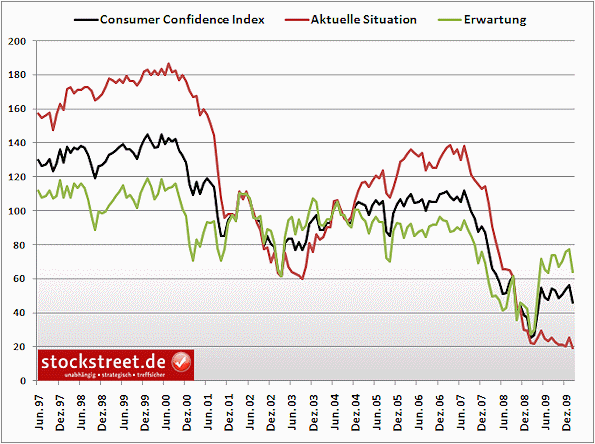
Verbrauchervertrauen und DAX fallen um die Wette

6
23.02.10 16:04
(Verkleinert auf 92%) vergrößern
Der USA Bären-Thread 301669
Antworten
CarpeDies:

Der Einbruch ist schon heftig

4
23.02.10 16:06
WASHINGTON (MarketWatch) - Consumer confidence fell sharply in February as Americans turned more pessimistic about job prospects and the U.S. economy, the Conference Board reported. Just a month after touching a 16-month high, the board's Consumer Confidence index sank 11 points to 46.0 from an upwardly revised 56.5 in January. It's the lowest reading since April 2009. Economists surveyed by MarketWatch, who were looking for a slight drop to 55.5 points from the previously reported January level of 55.9.
Antworten
Anti Lemming:

Verbrauchervertrauen sinkt im 11 Punkte

4
23.02.10 16:06
Feb. 23, 2010, 10:02 a.m. EST
U.S. consumer confidence falls 11 points
By Jeffry Bartash

WASHINGTON (MarketWatch) - Consumer confidence fell sharply in February as Americans turned more pessimistic about job prospects and the U.S. economy, the Conference Board reported. Just a month after touching a 16-month high, the board's Consumer Confidence index sank 11 points to 46.0 from an upwardly revised 56.5 in January. It's the lowest reading since April 2009. Economists surveyed by MarketWatch, who were looking for a slight drop to 55.5 points from the previously reported January level of 55.9.
(Verkleinert auf 88%) vergrößern
Der USA Bären-Thread 301671
Antworten
CarpeDies:

Nochmal zum Verbrauchervertrauen

3
23.02.10 16:11
Wie soll das noch werden, wenn die US-Regierung auch noch ihre diversen Stützungsmassnahmen zurückfahren sollte...


WASHINGTON (MarketWatch) -- Consumer confidence fell sharply in February as Americans turned more pessimistic about job prospects and the U.S. economy, the Conference Board reported.

Just a month after touching a 16-month high, the board's Consumer Confidence index sank 11 points to 46.0 from an upwardly revised 56.5 in January. It's the lowest reading since April 2009.

Economists surveyed by MarketWatch, who were looking for a slight drop to 55.5 points from the previously reported January level of 55.9. Read our complete economic calendar and consensus forecast.

In a healthy economy, the index average is about 95 points. It's ranged between 46 and 56 since last May, bottoming out at a record-low 25.3 in February 2009.

The sharp drop in February, which follows three straight monthly gains, reflected growing concern by consumers about a U.S. economic recovery.

Lynn Franco, director of consumer research at the Conference Board, said fewer consumers are 'anticipating an improvement in business conditions and the job market over the next six months. Consumers also remain extremely pessimistic about their income prospects."

As a result, the present situation index plunged to 19.4 from 25.2, its lowest level in 27 years.

At the same time, the expectations index fell to 63.8 from 77.3.

"The combination of earnings and job anxieties is likely to continue to curb spending," Franco said
Antworten
Anti Lemming:

2012 werden wir in Rückblicken lesen

8
23.02.10 16:15
dass die Erholung des Jahres 2009 auf übertriebener Hoffnung basierte, der 2010 ein Doppel-Dip folgte, weil staatliche Stimulanzpakete zum einen auf Dauer an Wirkung verlieren und zum anderen notwendigerweise befristet sein müssen.

Ganz simpel, ganz logisch...
Antworten
CarpeDies:

Charlie Munger's 10 Gebote

6
23.02.10 16:21
By Paul B. Farrell, MarketWatch

ARROYO GRANDE, Calif. (MarketWatch) -- Good news, Americans are "downbeat about today. Upbeat about tomorrow," says the latest USA Today/Gallup Poll. "Americans feel battered by hard times, record home foreclosures, stubbornly high unemployment rates and war."

And yes, we are "fed up with Washington and convinced more than 3 to 1 that the nation is heading in the wrong direction," yet there's "confidence that there will be better times ahead, that the classic American dream endures and hasn't been extinguished. It's not even at its low ebb." Why? Because we're in denial!
Do Main Street's 95 million investors know something Warren Buffett's long-time partner, Charlie Munger, doesn't know? Munger is warning us "It's Over" for America. Yes, "o-v-e-r," America's in decline, at the end-of-days, coming to "financial ruin," says Munger.

Optimism has always been the enduring spirit that made us a great nation, brought us back from overwhelming challenges and impossible odds -- WW II, the Civil War, the 1776 Revolution. Yes, that spirit still burns in our soul, says the poll.

But we also know, as we said earlier in "The Death of the Soul of Capitalism," that over the long-term, through many centuries, historians give nations an average of about 200 years before they burn out. Why? Because the "blind optimism" that makes a nation great in the early years of its rise to power and glory becomes, paradoxically, its worst enemy in the end-days.

Their arrogance traps them in a self-sabotaging cycle that weakens their resolve, makes them vulnerable to new, unpredictable challenges, ultimately destroying them from within. That happens over and over throughout history, even as their optimistic brains tell them they're still the greatest.

So for a moment, please set aside your "optimism," listen to our translation of Munger's drama as a 10-scene crime-thriller about America on the "road to ruin."
Plot notes: Warning, America is on a 'road to financial ruin'

Turns out that like Buffett, whose tales we detailed earlier, Munger's a good storyteller. His parable, "Basically It's Over: A parable about how one nation came to financial ruin," appeared in Slate magazine. Clearly he's warning about the end of capitalism, the end of democracy, the coming end of America.

In his parable Munger calls America "Basicland ... rich in all nature's bounty." In our recasting it as a drama, we'll use "America" rather than "Basicland" in the narrative to drive home the full impact of Munger's powerful message.
Scene 1: Power and wealth create false sense of invincibility

Significantly, Munger says 2012 is the turning point, a signal, the moment setting up the final crisis scene. We've often made a similar timing prediction, one tied to the 2012 election, and a reminder of the warning made by Jared Diamond in "Collapse: How Societies Choose to Fail or Succeed." In the late stages of a nation's cycle: A crisis hits. Everyone, leaders and citizens, act surprised. But it's too late: "Civilizations share a sharp curve of decline. Indeed, a society's demise may begin only a decade or two after it reaches its peak population, wealth and power." Just 20 short years to ruin?

Munger warns: "Even a country as cautious, sound, and generous as America could come to ruin if it failed to address the dangers that can be caused by the ordinary accidents of life. These dangers were significant by 2012, when the extreme prosperity of America had created a peculiar outcome: As their affluence and leisure time grew, America's citizens more and more whiled away their time in the excitement of casino gambling." Yes, Main Street "feels battered" while Wall Street gambling casinos generate billions.
Scene 2: Greed consumes America: Gambling replaces real work

In Munger's brilliant parable "the winnings of the casinos eventually amounted to 25% of America's GDP, while 22% of all employee earnings in America were paid to persons employed by the casinos" and "many of the gamblers were highly talented engineers attracted partly by casino poker but mostly by bets available in the bucket shop systems, with the bets now called financial derivatives." Yes, the same derivative bets Buffett targeted when he warned against "financial weapons of mass destruction."

Scene 3: Wall Street's casinos prosper as Main Street suffers

Munger's also not talking about just the million or so gamblers working in Wall Street's "too political to fail" casino-banks. No, "gamblers" are also among Main Street America's 95 million average investors, though most of the high rollers are the slick pros on casino payrolls where "most casino revenue now came from bets on security prices under a system used in the 1920s." Think of Goldman's trading operation that often makes $100 million profits daily, while America has close to 20% underemployed.
Scene 4: America's side-bet debt to foreign casinos skyrockets

Now comes the crucial turning point in Munger's crime-thriller: "Many people, particularly foreigners with savings to invest, regarded this situation as disgraceful. After all, they reasoned, it was just common sense for lenders to avoid gambling addicts ... They feared big trouble if the gambling-addicted citizens of America were suddenly faced with hardship." They were right.
Scene 5: Nations in denial rarely prepare for disasters in advance

"Then came the twin shocks," a plot twist borrowed from "Avatar," "Wall-E" and Al Gore, the kind of shocks that most "optimists" (especially those hell-bent on voting Obama and the liberals out of office by 2012) always deny. So, "hydrocarbon prices rose to new highs." Munger must mean a twist like oil hitting a scene-stealing $1,000 a barrel.
Scene 6: In the later stages, get-rich-quick beats real work

America seeks the advice of the "Good Father," a tall ex-Fed chairman who suggests "America change its laws. It should strongly discourage casino gambling, partly through a complete ban on the trading in financial derivatives, and it should encourage former casino employees -- and former casino patrons -- to produce and sell items that foreigners were willing to buy." Never happen: Not as long as Wall Street's gamblers can make more in a year trading derivatives than most Americans make in a lifetime. Why "work?"
Scene 7: Wall Street CEOs, economists, lobbyists love gambling

Sounds great, many approved, "but others, including many of America's prominent economists, had strong objections. These economists had intense faith that any outcome at all in a free market -- even wild growth in casino gambling -- is constructive. Indeed, these economists were so committed to their basic faith that they looked forward to the day when America would expand real securities trading, as a percentage of securities outstanding, by a factor of 100, so that it could match the speculation level present in the United States just before onslaught of the Great Recession that began in 2008."
Scene 8: Wall Street gamblers love Reaganomics, hate change

Though Munger and his partner got rich in this bizarre parable, his plot turns dark as America's "investment and commercial bankers were hostile to change. Like the objecting economists, the bankers wanted change exactly opposite to change wanted by the Good Father." Wall Street "came to believe that the Good Father lacked any understanding of important and eternal causes of human progress that the bankers were trying to serve" by leaving today's free market gambling casino operations untouched, so it could quickly return to pre-2008 "greed is very good" reality.
Scene 9: Main Street investors join Wall Street's 'Happy Conspiracy'

The endgame now unfolds rapidly. Munger warns that America's investors, workers and citizens have become so jaded they merge with Wall Street's self-sabotaging conspiracy: "Of course, the most effective political opposition to change came from the gambling casinos themselves. This was not surprising, as at least one casino was located in each legislative district." They "saw themselves as part of a long-established industry that provided harmless pleasure while improving the thinking skills of its customers."
Scene 10: Politicians love Wall Street's derivative casino: Game over!

The 86-year-old Munger is himself a metaphor for America's version of the classic historical cycle: He was an optimist as he and Warren built their $267 billion company over four decades. But sadly, his parable, his vision of America's future, has no optimistic finale. Rather it's reminiscent of Diamond's "Collapse," Bogle's "Battle for the Soul of Capitalism," and so many other recent reminders about how America just went over a cliff and how Wall Street's casino-banks will soon drive us off a bigger cliff into the Great Depression II by 2012.

Munger's parable is more than a Hollywood suspense-thriller, it's another example of the classic historical life-cycle of a nation.

In the final scenes "politicians ignored the Good Father one more time," the casino-banks returned to gambling in derivative "securities with extreme financial leverage. A couple of economic messes followed, during which every constituency tried to avoid hardship by deflecting it to others. Much counterproductive governmental action was taken, and the country's credit was reduced to tatters. America is now under new management, using a new governmental system. It also has a new nickname: Sorrowland."
Epilogue: Your moral dilemma: a no-win scenario or historical destiny?

Do we really have a choice? Ask yourself, what's ahead after 2012? Can you see beyond a destructive campaign: Obama at war with Palin and the "Tea Party of No?" What are the long-term prospects of our "civilization." Do you share Munger's dark vision?

Or does the USA Today/Gallup Poll tell you guys like Munger, Buffett and Volker do "lack any understanding of important and eternal causes of human progress that the bankers are trying to serve" with their gambling casinos. "Optimists" in those polls are just politicians, bankers and citizens like you, in denial, can't hear the warnings. So we get no changes, no action, no preparations because at this stage in the long-term historical cycle, optimism has turned into our worse enemy, wishful-thinking.

Solution? Get into action, let's launch the "Second American Revolution." Got any constructive, optimistic strategies? Share them. Add your comments

Antworten
musicus1:

MALKO, du bist hier ein wichtiger teil im BT

14
23.02.10 16:36
und  ich gehe mal davon aus, dass viele andere user auch ähnlich denken, ich finde dein meinungsbild mehr als interessant ,manchmal sogar  spannend,  ich möchte dich nicht missen....... und AL als oberbär hier und chef, sollte doch auch mal die zügel im meinungsbild  schleifen l assen, immer die unterschiedlichkeit von meinungen im auge behalten, dass sollten wir hier nicht nur pflegen, nein, es ist ein absolutes muss.......
Antworten
Maxgreeen:

alles in bester Ordnung - es war nicht die

4
23.02.10 16:56
Nachtigall es war der Winter

ifo-Konjunkturexperte Abberger wollte angesichts des harten Winters einen Rückgang des Bruttoinlandsprodukts (BIP) im ersten Quartal nicht ausschließen. "Einen solch strengen Winter hatte sicher niemand in den Prognosen berücksichtigt, da muss man sicher noch einmal schauen, was der Winter an Rückschlägen verursacht hat", sagte er. Die insgesamt positive Grundtendenz für die Konjunkturentwicklung sei wohl noch vorhanden, fügte er hinzu. Für das erste Quartal habe das ifo-Institut noch keine Prognose erstellt. "Aber es wird sicher schwächer werden als gedacht, und es ist sogar auch noch einmal ein Minus drin", sagte Abberger. Er gehe aber davon aus, dass das im Wesentlichen in den Folgequartalen auch wieder aufgefangen werden könne.

PS: Das gleiche in Englisch für das Verbrauchervertrauen
Dieses Posting wurde elektronisch erstellt und enthält deshalb keine Unterschrift.
Bei berechtigten Einwänden email an be@schwer.de
Antworten
daiphong:

Malko, wir müssen ja täglich hinzulernen ;-)

6
23.02.10 16:57
und profitieren dabei sicher alle oft von Dir. Gibt ja auch genug zu durchdenken in solchen Zeiten, und nicht jedes Nichtwissen und falsches Linienverlängern ist gleich bös gemeint. Wir spekulieren aber auch in sehr verschiedenen Zeitebenen und Märkten, mit sehr verschiedenen Erfahrungen. Eine Einheitsmeinung hat es mMn, abgesehen von einer bärischen Tendenz, hier nie wirklich gegeben, alleine schon durch Deine Arbeit hier.
Antworten
Anti Lemming:

Ich möchte Malko auch nicht missen

11
23.02.10 17:05
und es gab in der Vergangenheit viele wichtige Weichenstellungen in der "Thread-Meinungsbildung", der er angestoßen hat. So brachte er als erster (oder einer der ersten) eine mögliche Deflation ein, als andere (inkl. mir) noch mit "Inflation infolge des Gelddruckens" rechneten. Die Frage ist zwar bis heute noch nicht abschließend beantwortet, die Geister (auch außerhalb des Threads) streiten sich. Deflation erscheint inzwischen aber als die wahrscheinlichere Variante.

Malko reagiert allerdings etwas empfindlich, wenn man Argumente vorträgt, die seine aktuellen Investments infrage stellen. Als ich im Feb. 2007 diesen Thread eröffnet hatte, war Malko noch long in Aktien und hat gegen meine bärischen Statements standhaft Gegenpositionen bezogen. Sein Ausstieg aus Aktien erfolgte erst im März 2007 bei dem "Mini-Crash", den es damals gab.

Aktuell sehe ich eine ähnliche Gemengelage, wenn man die Sicherheit von Staatsanleihen infrage stellt. MMn solte es hier aber keine "heiligen Kühe" geben, sondern man sollte auch scheinbar randständige Entwicklungen ins Kalkül ziehen dürfen, ohne dafür in die Deppenecke gestellt zu werden. Für solche Gedankenspiele ist der Thread ja da (als eine Art Brainstorming-Instanz). Was jeder in seinem Depot daraus macht, bleibt ihm eh selber überlassen.

MMn gibt es zumindest eine beobachtbare Tendenz in den letzten Monaten: Staaten gelten nicht mehr dank ihrer schieren Größe als Garanten unbegrenzter Sicherheit. Das gilt auch für kleinere (und evtl. bald auch größere?) EU-Staaten.

Wenn z. B. wahr wird, was Soros in der FT (unten) als Lösungsvorschlag für das EU-Desaster anregt - eine Art EU-Unversalanleihe - dann wird es um die Sicherheit der deutschen Staatsanleihen nicht mehr so toll bestellt sein. Es steht zwar dann die gesamte EU als Garant dahinter, aber die Verwässerungen der Griechen und anderer potenzieller Mißbräuchler dürften dann auch auf Deutschland abfärben. Wird das deutsche AAA zu halten sein, wenn die PIGS "rumwässern"? - eine Sorge, die den Euro seit seiner Schöpfung begleitet.


So makeshift assistance should be enough for Greece, but that leaves Spain, Italy, Portugal and Ireland. Together they constitute too large a portion of euroland to be helped in this way. The survival of Greece would still leave the future of the euro in question. Even if it handles the current crisis, what about the next one? It is clear what is needed: more intrusive monitoring and institutional arrangements for conditional assistance. A well-organised eurobond market would be desirable. The question is whether the political will for these steps can be generated.

The writer is chairman of Soros Fund Management and author of the Soros Lectures, published by PublicAffairs this month
(Quelle: Kicky ioben, FT).
Antworten
permanent:

Was habe ich verpasst?

6
23.02.10 17:11

Ich sehe Malko07 ebenfalls als einen der Hauptauteure hier im Thread aber wo bitte steht etwas von seinem Abgang????

Traueransprachen zum Todesfall, aus welchem Grund?


Gruß


Permanent

Antworten
Maxgreeen:

Malko bekommt im Durchschnitt für jedes Posting

9
23.02.10 17:22
5 grüne Punkte!!! Eine bessere Quote hat keiner bei ARIVA.

:))
Dieses Posting wurde elektronisch erstellt und enthält deshalb keine Unterschrift.
Bei berechtigten Einwänden email an be@schwer.de
Antworten
Ischariot MD:

*LOL* - alle ganz entspannt bleiben

7
23.02.10 17:49
und wenn Malko gerade das Gefühl haben sollte, einen Beißring haben zu wollen, hier bitte:
Alle Freunde sind schon da  ;o)
___________________________________________

Rentnergang will Altersvorsorge aufmischen

Bei der Reform der Vorsorgesysteme gibt es für Berater viel zu verdienen. Ab sofort will auch eine illustre Truppe rund um Carsten Maschmeyer und Bert Rürup richtig Kasse machen. (von Herbert Fromme)

Altkanzler Gerhard Schröder , 65, ist da ("Ich bin mit den beiden Gründern persönlich befreundet"). Hans-Dietrich Genscher, nach eigenen Worten mit 82 "Uralt-Außenminister", hält die Festrede im Büro in der Bockenheimer Landstraße. Ex-Arbeitsminister Walter Riester (66) outet sich als Mitarbeiter der frisch gegründeten Maschmeyer Rürup AG, die Montag offiziell die Eröffnung ihres Frankfurter Standorts feiert.
Auch Banker sind reichlich vor Ort, aktive und solche im Ruhestand - immerhin steht Ex-Commerzbankchef Klaus-Peter Müller  (65) nicht nur dem Aufsichtsrat der Bank vor, sondern auch dem der neuen Gesellschaft. Die beiden anderen Mitglieder sind Stefan Homburg, 48 Jahre alt und Professor für öffentliche Finanzen sowie Steuerberater in Hannover, und Hansjörg Cramer, 65, bis vor zwei Jahren Vorstand und Vertriebschef der Allianz  Deutschland.
Carsten Maschmeyer  (50) und Bert Rürup (66) haben sich mit Bedacht die Unterstützung vieler Jahrzehnte Berufserfahrung für ihr Unternehmen gesichert. Sie suchen hochkarätige Verbindungen und Kontakte in die Spitzen von Unternehmen und Politik. Die Maschmeyer Rürup AG mit Hauptsitz in Hannover und Büros in Frankfurt und Berlin ...
www.ftd.de/unternehmen/versicherungen/...mischen/50078957.html
_________________
sagenhafter Filz !!!
Die Würde des Steuerzahlers ist unantastbar
Antworten
pfeifenlümmel:

Wenn die staatliche

2
23.02.10 18:27
Altersvorsorge "verbraten" ist, muss nun die private die Lücke schließen. Man muss es nur dem Wähler "verkaufen " als Beitrag zur eigenständigen Verantwortung.
Antworten
pfeifenlümmel:

Meine Güte,

 
23.02.10 18:47
unser Euro fällt ja heute, nicht zum Aushalten! Wird die Olivenernte so schlecht?
Antworten
permanent:

FDIC Says Number of Problem Banks Jumped 27%

5
23.02.10 18:50
FDIC Says Number of Problem Banks Jumped 27%
BANKS, FDIC, FEDERAL DEPOSIT INSURANCE, US BANKING, SHEILA BAIR
Reuters
| 23 Feb 2010 | 12:44 PM ET

The number of "problem" U.S. banks jumped 27 percent during the fourth quarter of 2009 to 702, the highest level since 1993 and a sign the industry's recovery remains uneven, regulators reported Tuesday.

The Federal Deposit Insurance Corp said the industry overall eked out a profit of $914 million for the quarter, benefiting from a healing economy, but said the improvement was concentrated in the largest banks.


FDIC Chairman Sheila Bair said the profit was a huge improvement over the $37.8 billion loss the industry reported in the fourth quarter of 2008. "It's not that this was a strong quarter. It's simply that everything was so bad a year ago," Bair said in a statement.

She later told reporters that although the number of problem banks "sounds scary," she described the bank industry as "challenged but stable."

Smaller institutions are still struggling with deteriorating loan portfolios, especially with loans tied to commercial real estate. The FDIC set aside an additional $17.8 billion during the fourth quarter for expected bank failures.

Regulators have closed 20 U.S. banks so far this year and 185 since January 2008, as banks continue to struggle with loan portfolios stocked with souring loans.

The additional provisions for expected bank failures sunk the balance of the FDIC's insurance fund even further to a negative $20.9 billion at the end of the year.

Carmine Grigoli, chief U.S. investment strategist at the equities division of Mizuho Securities USA in New York, said more and more smaller banks were likely to run into trouble due to commercial lending problems. "I don't think that's terribly surprising," said Grigoli.

FDIC: Cash to Cope

Despite a negative balance for the FDIC's insurance fund, which safeguards accounts up to $250,000, the agency says it has plenty of cash to operate and back customer accounts.

At the end of 2009, it asked banks to prepay three years of industry fees, worth about $45 billion, but while it received the cash, it could not put the money toward the insurance fund balance.


The FDIC said indicators of asset quality at banks worsened during the fourth quarter.

The annualized net charge-off rate for bad loans rose to 2.89 percent, compared to 2.72 percent during the third quarter. That is the highest net charge-off rate in the 26 years for which data is available.

Deterioration in assets drove up the number of institutions of the FDIC's problem list.

Problem banks are troubled institutions whose regulatory rating has been downgraded due to issues related to liquidity, capital levels, or asset quality.

Total assets at problem banks were $402.8 billion at the end of the fourth quarter, compared to $345.9 billion at the end of the third quarter.

The woes in the industry have been migrating from mortgage-backed securities to deteriorating home loans and are now largely tied to commercial real estate (CRE) loans that remain a looming problem.


Loan and lease balances dropped for the sixth quarter in a row, falling by 1.7 percent in the fourth quarter, the FDIC said. The Obama administration has repeatedly urged banks to loosen credit for small businesses, a key driver for the economy and job growth.

Bair said on Tuesday that larger banks "need to do a better job of stepping up to the plate" to extend credit to small business. She said regulators are trying to take a balanced approach to ensure banks make prudent loans.

Banks have complained that they are getting conflicting messages from policymakers urging lending, on one hand, and bank supervisors scrutinizing the quality of every loan.

Antworten
permanent:

Consumer Confidence

2
23.02.10 19:01

Der USA Bären-Thread 7492850

Aus Steffens Daily

Antworten
Malko07:

A.L. (#57888) unterstelle nichts

9
23.02.10 19:02
was du nicht wissen kannst. In was ich aktuell investiert bin und in was nicht, davon hat du schlicht keine Ahnung. Bekanntlich sage ich schon sehr lange überhaupt nichts von meinen Aktionen; ich sehe auch keinen Sinn darin. Ich unterliege auch nicht der Illusion mit meinen Postings hier den Markt beeinflussen zu können und mülle dafür panisch über Tage alles zu.

Solltest du auch größere Schwierigkeiten mit anderen Meinungen haben gibt es trotzdem keinen Grund hier ein Nachruf zu veröffentlichen. Ich fühle mich pudelwohl und sehe nicht ein weshalb ich das Feld räumen sollte.
Antworten
Malko07:

#57891; Sollte es wirklich zu einer

6
23.02.10 19:07
längeren Deflationsphase kommen (über mehr als 1 Jahrzehnt) kann man froh sein, wenn man eine Rendite von 1 bis 2 % erreicht. Mit so wenig werden sich diese Gangster nicht zufrieden geben.
Antworten
obgicou:

Jetzt rudert Malko zurück

9
23.02.10 19:08
letzte Woche war er angeblich noch massiv long Raviolidosen
Antworten
Stöffen:

Sehr richtig, Malko

11
23.02.10 19:10
das überlassen wir nämlich anderen Protagonisten, uns zu erzählen, wie sie ihre Scheinchen verbrennen ;-)))
Der USA Bären-Thread 301723
Bubbles are normal and non-bubble times are depressions!
Antworten
Malko07:

Asche auf

9
23.02.10 19:10
mein Haupt ....
Antworten
Auf neue Beiträge prüfen
Es gibt keine neuen Beiträge.

Seite: Übersicht ... 2314  2315  2317  2318  ... ZurückZurück WeiterWeiter

Börsen-Forum - Gesamtforum - Antwort einfügen - zum ersten Beitrag springen

Neueste Beiträge aus dem S&P 500 Forum

Wertung Antworten Thema Verfasser letzter Verfasser letzter Beitrag
29 3.789 Banken & Finanzen in unserer Weltzone lars_3 youmake222 10.12.25 11:19
469 156.440 Der USA Bären-Thread Anti Lemming ARIVA.DE 08.12.25 18:00
  55 PROLOGIS SBI (WKN: 892900) / NYSE 0815ax ARIVA.DE 19.10.25 10:00
    Daytrading 15.05.2024 ARIVA.DE   15.05.24 00:02
    Daytrading 14.05.2024 ARIVA.DE   14.05.24 00:02

--button_text--