Mmmmh... es wird delikat. Sehr delikat. Ex-FDIC´ler Eric P. Mains kündigt und verklagt CITI, Chase, WMB, u.a. ...
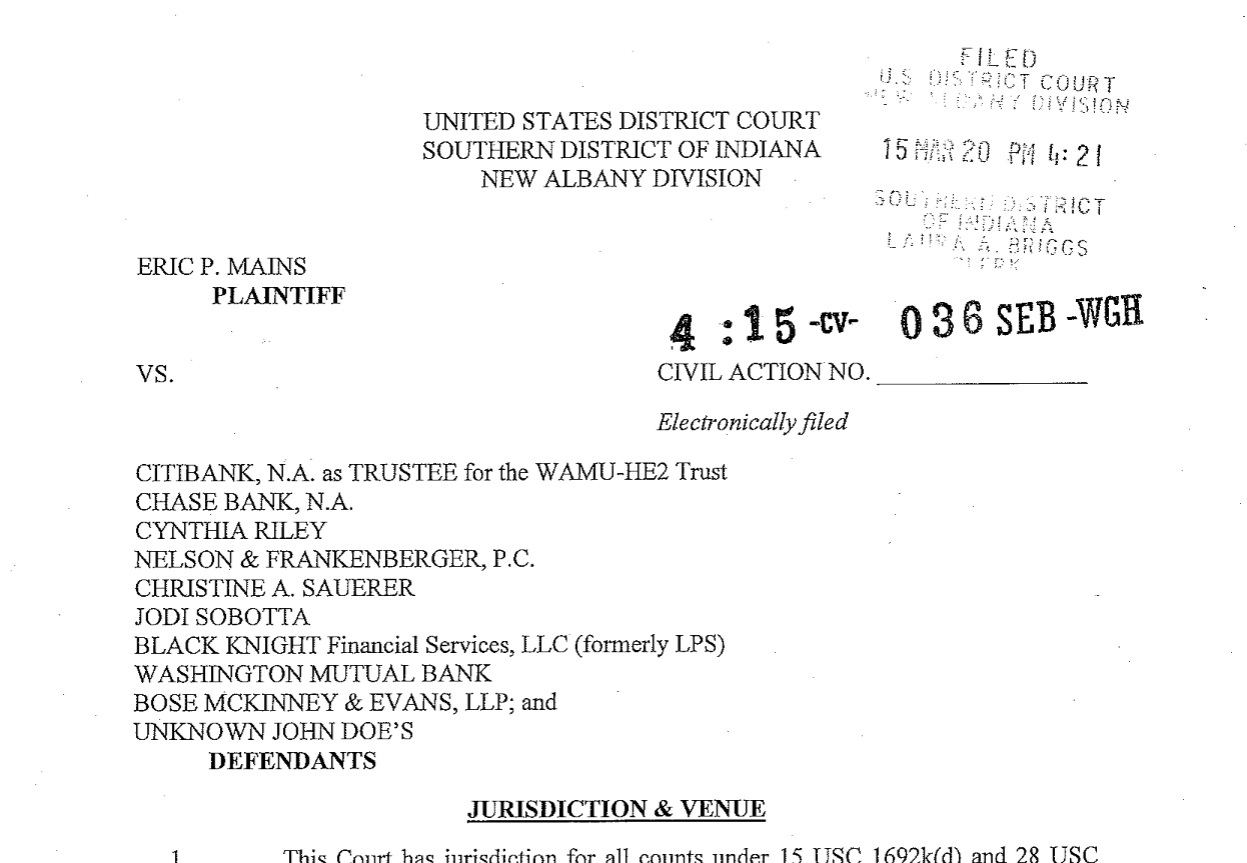
"...His Indiana lawsuit is filed in federal court. He alleges that
1. WAMU was not the actual lender in his own loan
2. That the loan was part of an illegal scheme from the start
3. That his loan was subject to claims of securitization but that those claims were false
4. That the REMIC Trust was never funded and therefore never had the capacity to originate or buy loans
5. That the intermediaries never followed the law or the documents for securitization of his loan
6. That the REMIC Trust never did purchase his loan
7. That Citi was therefore “trustee” for an unfunded trust
8. That Chase never purchased the loans from WAMU
9. That Chase could not have been the legal servicer over the loan because the loan was not in the trust
10. That Chase has filed conflicting claims as to ownership of the loans
11. That the affidavit of Robert Schoppe, whom Mains worked for, as to ownership of the loans was false when it states that Chase owned the loans
12. That the use of WAMU’s name on the loan documents was a false representation
13. That his loan may have been pledged several times by various parties
14. That multiple payments from multiple parties were likely received by Chase and others on account of the Mains “loan” but were never accounted for to the investors whose money was being used as though it was the Banks themselves who were funding originations and a acquisitions of loans
15. That the industry practice was to reap multiple payments on the same loan — and the foreclose as though there was balance due when in fact the balance claimed was entirely incorrect
16. That the investors were defrauded and that foreclosure was part of the fraudulent scheme
17. That Mains name and identity was used without his consent to justify numerous illegal transactions in which the banks repeated huge profits
18. That neither WAMU nor Chase had any rights to collect money from Mains
19. That Citi had no right to enforce a loan it did not own and had no authority to represent the owner(s) of the loan
20. That the modification procedures adopted by the Banks were used intentionally to force the borrower into the illusions a default
21. That Sheila Bair, Chairman of the FDIC, said that Chase and other banks used HAMP modifications as “a kind of predatory lending program.”
22. That Mains stopped making payments when he discovered that there was no known or identified creditor.
23. The despite stopping payments, his loan balance went down, according to statements sent to him.
24. That Chase has routinely violated the terms of consent judgments and settlements with respect to the processing of payments and the filing of foreclosures.
25. That the affidavits filed by persons purportedly representing Chase were neither true nor based upon personal knowledge
26. That the note and mortgage are void from the start.
27. That Mains has found “incontrovertible evidence of fraud, forgery and possibly backdating as well.” (referring to Chase)
28. That the law firms suborned perjury and intentionally made misrepresentations to the Court
29. That Cynthia Riley “is one overwhelmingly productive and multi-talented bank officer. Apparently she was even capable of endorsing hundreds of loan documents a day, and in Mains’ case, even after she was no longer employed by Washington Mutual Bank. [Mains cites to deposition of Riley in JPM Morgan Chase v Orazco Case no 29997 CA, 11th Judicial Circuit, Florida.
30 That Cynthia Riley was laid off in November 2006 and never again employed as a note review examiner by WAMU nor at JP Morgan Chase.
30. That LPS (now Black Knight) owns and operates LPS Desktop Software, which was used to create false documents to be executed by LPS employees for recording in the Offices of the Indiana County recorder.
31. That the false documents in the mains case were created by LPS employee Jodi Sobotta and signed by her with no authority to do so.
32. Neither the notary nor the LPS employee had any real documents nor knowledge when they signed and notarized the documents used against Mains.
33. Chase and its lawyer pursued the foreclosure with full knowledge that the assignment was fraudulent and forged.
34. That LPS was established as an intermediary to provide “plausible deniability” to Chase and others who used LPS.
35. That the law firms also represented LPS in a blatant conflict of interest and with knowledge of LPS fraud and forgery.
Some Quotes form the Complaint:
“Mains perspective on this case is a rather unique one, as Main is an employee of the FDIC (hereinafter, FDIC) who worked in the Dallas field office of the FDIC in the Division of Resolutions and Receiverships (hereinafter DRR), said division which was the one responsible for closing WAMU and acting as its receiver. Mains worked with one Robert Schoppe in his division, whom the defendant Chase Bank often cites to when pulling out an affidavit Robert signed. This affidavit states that Chase Bank had purchased “certain assets and liabilities” of WAMU in the purchase transaction from the FDIC as receiver for WAMU in 2008. Chase Bank uses this affidavit ad museum to convince the court system in foreclosure cases that this affidavit somehow proves that Chase Bank purchased “every conceivable asset” of WAMU, so it must have standing in all cases involving homeowner loans originated through WAMU, or to put it simply that this proves Chase became a holder with rights to enforce or a holder in due course of the loan as defined by the Uniform Commercial Code. Antithetically, when it wants to sue the FDIC for a billion dollars… due to mounting expenses from the WAMU purchase transaction, it complains that the purchase agreement it signed didn’t really entail the purchase of “every asset and liability” of WAMU… Chase Bank claims this when it is to their advantage in a lawsuit to do so. "
(Verkleinert auf 44%)











 Zurück