








 Zurück

 Werbung


The most important fundamental development of the week was not any of a slew of economic reports at all but the new federal budget proposal released by the White House. And it was a doozy: The Obama Administration proposed to spend $3.8 trillion, with $1.6 trillion on the equivalent of the national credit card.
Investors did not overtly seem to mind today, but they will. It is almost mind-numbing to think we've gone from the surplus that President Clinton left President Bush to the trillion-dollar hole we're in now. There is nothing good about the scenario of bone-crushing debt, as we have seen repeatedly throughout the world recently in places like Dubai, Greece, the United Kingdom and Japan. The fact that the U.S. dollar has managed to hold its own despite representing a country deeply in hock is only testament to the weakness of every other major developed-world government.
It's ironic in fact that plenty of emerging-market countries are managing their books far better than the United States and Europe. They include Chile, Azerbaijan, Angola, Ukraine and Romania -- all with debt at less than 15% of national GDP, while we are knocking on 60%!
Investors did not overtly seem to mind today, but they will. It is almost mind-numbing to think we've gone from the surplus that President Clinton left President Bush to the trillion-dollar hole we're in now. There is nothing good about the scenario of bone-crushing debt, as we have seen repeatedly throughout the world recently in places like Dubai, Greece, the United Kingdom and Japan. The fact that the U.S. dollar has managed to hold its own despite representing a country deeply in hock is only testament to the weakness of every other major developed-world government.
It's ironic in fact that plenty of emerging-market countries are managing their books far better than the United States and Europe. They include Chile, Azerbaijan, Angola, Ukraine and Romania -- all with debt at less than 15% of national GDP, while we are knocking on 60%!
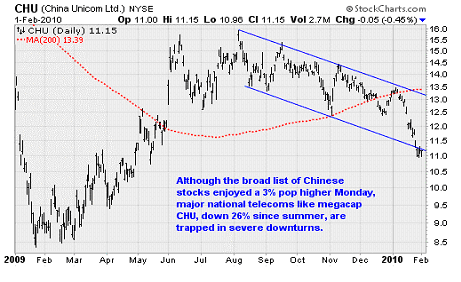 For now we are locked in miserable embrace with China, as they cannot halt their lending to us without harming their own economy, which is already fraying at the edges, as you can see in major telecoms like China Unicom Ltd. (NYSE ADR: